

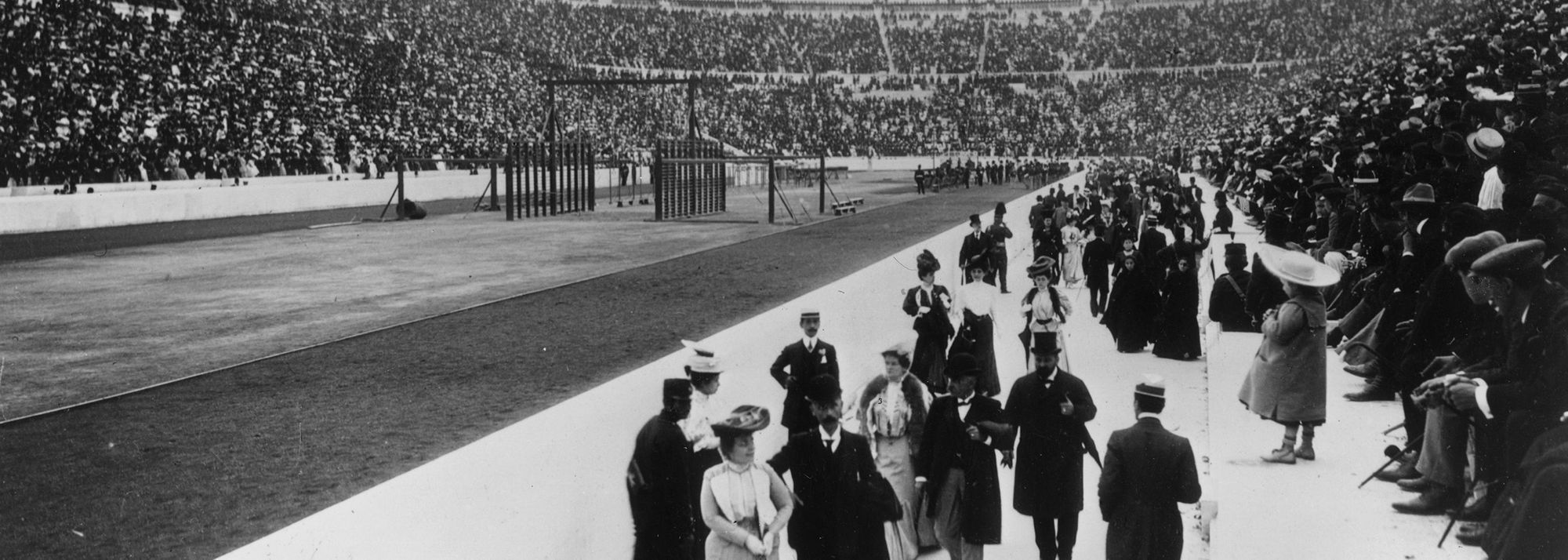


The 1896 Olympic Stadium (© Getty Images)
One hundred and thirty years ago, Edwin ‘Teddy’ Flack carved his name into sporting history, completing the Olympic 800m-1500m double at the inaugural modern Games in Athens. It remains one of the most remarkable feats of the early Olympic era – achieved in the space of just three days, and under circumstances that would test even the hardiest of competitors.
Remarkably, Flack’s exploits did not end there. Just 24 hours after sealing his place in Olympic history on the track, he stepped into unknown territory, lining up for the inaugural Olympic marathon.
After 30km of that race, on the dusty trail from the town of Marathon to the Panathinaiko Stadium in Athens, on the afternoon of Friday 10 April 1896, a tall, debonair Australian moved into the lead.
Resplendent in his distinctively tasselled Melbourne Grammar School cap, and his dark blue old school athletics shirt, the 22-year-old accountant had already made his mark on the first modern Olympic Games. The day before, he had won the 800m final, finishing 0.8 clear of Hungary’s Nandor Dani in 2:11.0.
Two days prior to that, he had won the 1500m title after pulling clear of the US favourite Arthur Blake to prevail by five yards in 4:33.2. Flack was the only man to have got the better of the otherwise all-conquering US contingent on the track or in the field in the magnificent marble Panathinaiko Stadium.
Athenians had taken the modest Melburnian to their hearts, lauding him as ‘The Lion of Athens’. His schedule the day before the marathon included taking part in the tennis tournament on the morning of the 800m final. He finished third in the doubles, partnering Briton George Robertson, and was awarded a posthumous bronze medal for that achievement in 2008 (winners received silver medals, runners-up bronze and third-placed competitors left empty handed in the 1896 Games).
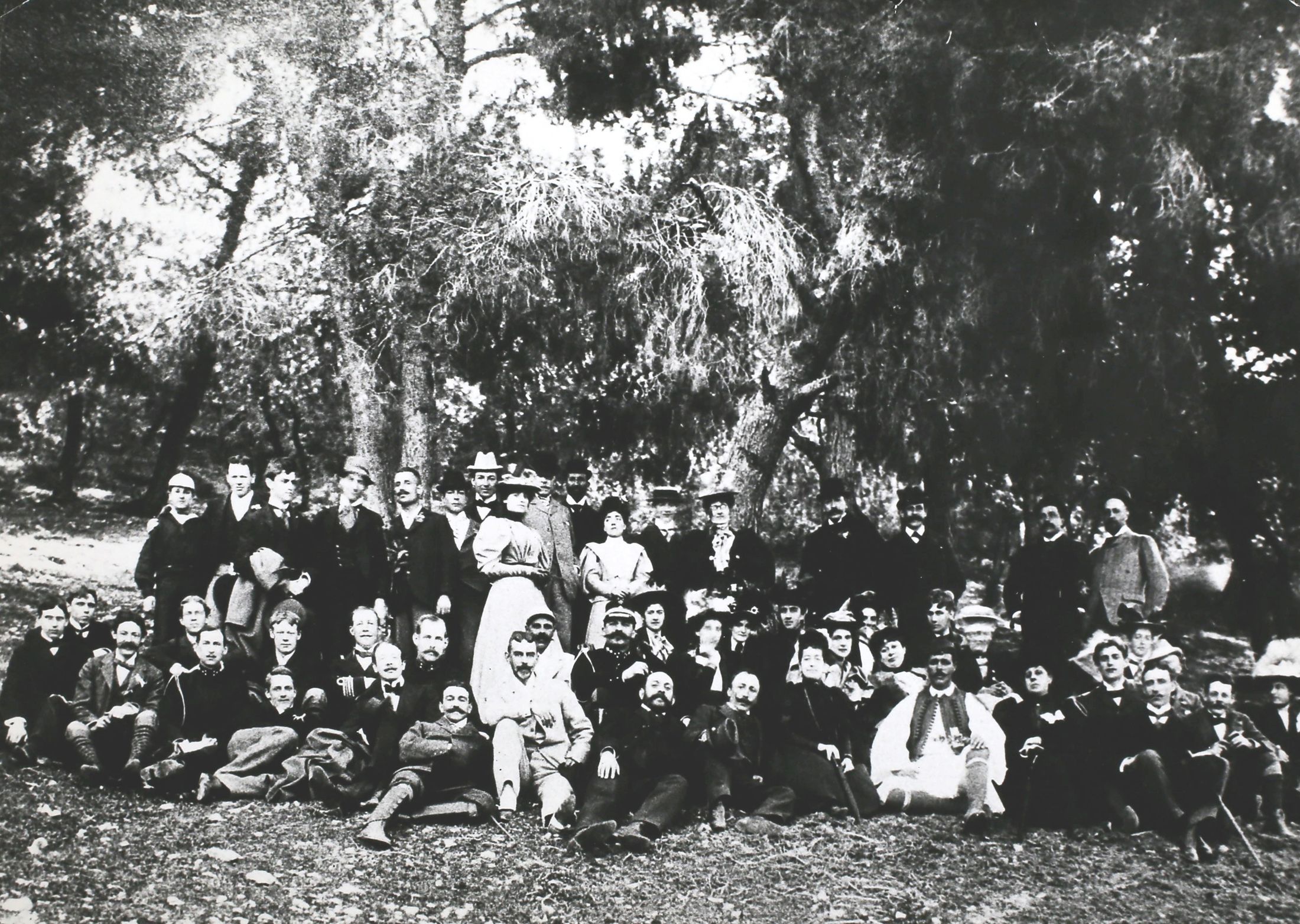
Medal-winners from the 1896 Olympic Games (© Getty Images)
An ardent student of Greek History in his Melbourne Grammar School days, Flack was determined to participate in the revival of the Ancient Olympic Games under the aegis of the French aristocrat Baron Pierre de Coubertin and a Greek Organising Committee headed by Crown Prince Constantine. Taking a month’s leave from his job with Price Waterhouse and Co in London, he was the only Australian participant in any of the nine sports on the schedule, officially attending as a representative of the London Athletic Club.
As a member of the Melburnian Hare and Hounds back home and of the Thames Hare and Hounds in London, Flack boasted a strong cross country pedigree but had never run farther than 16km (ten miles) before taking on the challenge of the 40km (25 mile) Olympic race staged in historical honour of the messenger (often identified as Pheidippides) who ran to Athens with news of a Greek victory in the Battle of Marathon in 490BC.
Legend has it that the messenger proclaimed “Rejoice, we conquer,” before collapsing and dying at the gates of Athens. Sadly, Teddy Flack was unable to rejoice at a triple Olympic conquest on the road from Marathon to the Greek capital.
As he related in a letter to his father, after passing the faltering Frenchman Albin Lermusiaux and taking the lead at 30km (18 miles), Flack himself started to struggle. “I managed to struggle on to the 34 kilo post,” he wrote. “I had no feeling in my legs whatever at this time. Just as I was on the point of giving in, a Greek came past me looking very fresh and running well. I staggered on for another 100 yards, rolling about from one side of the road to another, then stopped.”
The rest is Olympic, and marathon, history. The Greek runner was Spyridon Louis. He had grown up treading the same road, walking and jogging alongside the mules that transported barrels of spring water on a 16-mile round trip from his family’s farm in Marousi to Athens and back.
Sustained by a slug of brandy administered mid-race by his future father-in-law, Louis crossed the line in 2:58:50, amid scenes of patriotic celebration. Flack was picked up by carriage and taken to the stadium, where Prince Nicholas revived him with a concoction of egg and brandy.
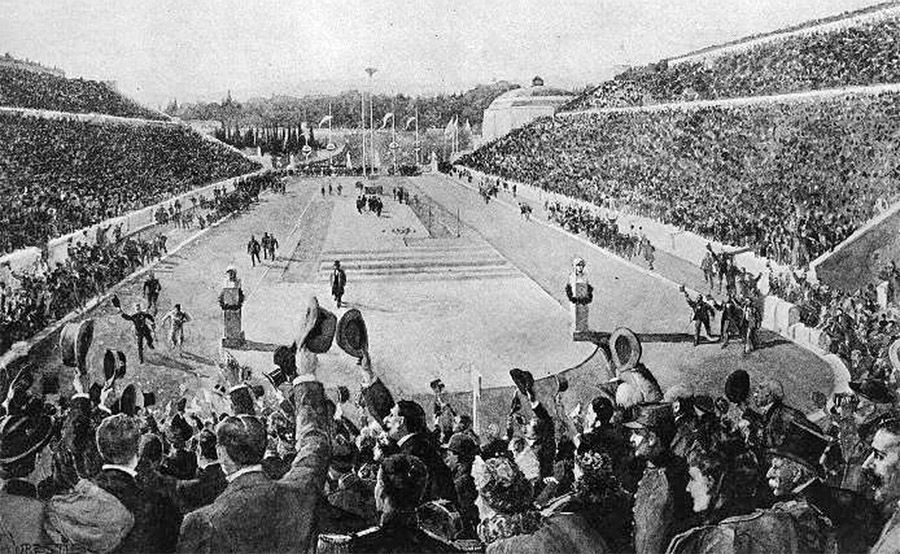
Spiridon Louis wins the 1896 Olympic marathon
“Of course I should have liked to have won very much,” he wrote to his father, “but everyone said it was better to turn out as it did, because the Greeks had set their minds on winning this event.”
Louis became a national hero and an international celebrity. He died in 1940, aged 67.
Flack never raced again at the highest level – his Olympic story, remarkable as it was brief, confined to those extraordinary days in Athens. In 1898 he returned to Melbourne to work in the Flack family accountancy firm. He became a member of the Australian Olympic Committee and died in 1935, aged 61.
Other notable moments from Athens 1896
Francis Lane, a medical student at Princeton University, won the opening event on the men-only inaugural Olympic track and field programme, clocking 12.2 in heat one of the 100m. The US sprinters wowed the Athenian crowd with their crouch starts, never before seen in Europe. Thomas Burke, a Boston University law student, won the final in 12.0, ahead of Germany’s Fritz Hoffmann, a rope-climbing specialist, with Lane and Alajos Szoklyi of Hungary sharing third place.
Burke won the 400m the next day in 54.2, completing a double that has yet to be emulated. In 1897 he served as the official starter for the first Boston Marathon.
James Connolly dropped out of Harvard University when he was denied permission to attend the 1896 Olympic Games. After a 16-day sea voyage, his wallet was stolen in Naples and he arrived in Athens with the rest of the US contingent at 9pm on what turned out to be the eve of the Games (they had not accounted for the Greek calendar). Employing two steps and a hop – permissible at the time in what was then known as the hop, skip and jump – he emerged victorious from the first final with a triple jump of 13.71m.
He was crowned as the first Olympic champion in 15 centuries, since the Athenian Zopyros was victorious in the sport of pankration, a combination of wrestling and boxing, in 385 AD. His name had a haunting echo through modern Olympic history. It was at 31 Connollystrasse, the street named in his honour in the athletes’ village at the 1972 Games in Munich, that the Palestinian terrorist group Black September launched the attack that led to the deaths of 11 members of the Israeli squad.
The US team in Athens, mainly students from Harvard and Princeton or members of the Boston Athletic Association, won nine of the 12 track and field events. As well as Thomas Burke (and the Australian Flack), Princeton student Robert Garrett also achieved a double, winning the shot (11.22m) and discus (29.15m) – and placing joint second in the high jump with Connolly (1.65m).
The 1984 NBC mini-series, The First Olympics: Athens 1896, while more than a trifle cheesy and more elastic with factual matters than Chariots of Fire was with the Paris Olympics of 1924, correctly portrays a blacksmith forging a mammoth 14kg discus for Garrett, who gave up the event after struggling to throw it in training, before discovering that a 2.0kg implement would be used in the competition.
The two-part series featured David Caruso as James Connolly and Bill Travers and Virginia McKenna as the parents of Teddy Flack. Travers also memorably starred as the title character in the British film Geordie, a Scottish gamekeeper and strongman who wins the hammer throw at the 1956 Olympics in Melbourne – fictitiously, of course. Hal Connolly of the US was the actual gold medal winner at the Melbourne Cricket Ground.
Simon Turnbull for World Athletics Heritage