

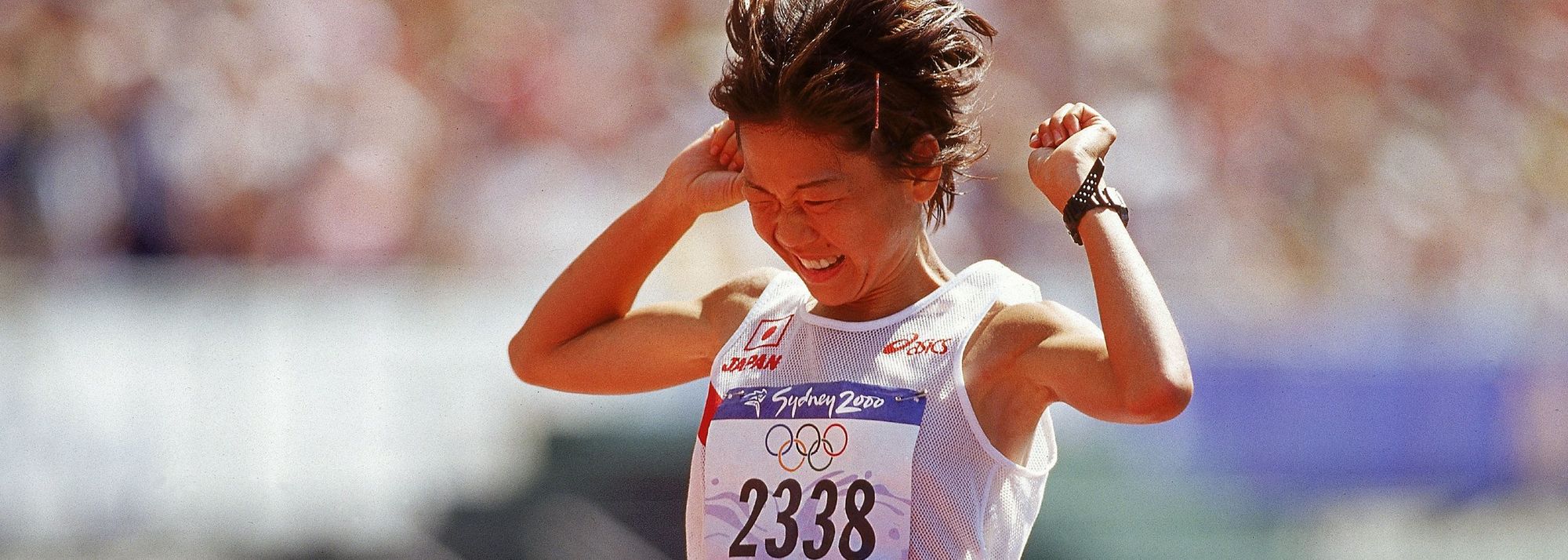


Japan's Naoko Takahashi wins the 2000 Olympic marathon (© Getty Images)
When Naoko Takahashi crossed the finish line at the 2001 Berlin Marathon, her expression turned from agony to ecstasy.
The digits on the giant clock above her clicked from 2:19:45 to 2:19:46 but, after straining for so long to chase time and history, the Japanese runner glanced first at her wristwatch and then at the face of her coach before fully realising what she had done.
With an official finishing time of 2:19:46, Takahashi had become the first woman to run the marathon in less than 2:20, breaking a barrier that Ingrid Kristiansen and Joan Benoit had pushed towards in the 1980s.
“I’m not anyone special,” the 29-year-old insisted that day, 30 September 2001, 25 years ago now. “I’m just a normal person. I just prepared well for today. It was a great challenge.”
It was a challenge for which Takahashi prepared with characteristic thoroughness under the guidance of her long-time coach Yoshio Koide, a former marathon runner who described his “earnest” charge as “a glutton for training, who never cuts corners”.
The pair followed the same formula that had brought Takahashi Olympic success in Sydney in 2000, when she prevailed ahead of Romania’s Lidia Simon in a Games record of 2:23:14.
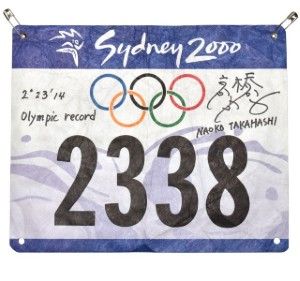
Naoko Takahashi's Sydney 2000 competition number (© World Athletics Heritage)
They spent a punishing four months at altitude in Boulder, Colorado, where Takahashi built her endurance with occasional runs of 70-80km.
Her regime also reportedly included a drink derived from the secretions of Japanese giant hornets, which was claimed by its developers to help endurance runners metabolise fat and reduce the build-up of lactic acid.
Takahashi arrived in Berlin with her own chef and masseur. Her entourage of a dozen also included the journalist who penned her weekly manga story Kazekko, The Daughter of the Wind – a comic strip with a readership of some 700,000.
A second cousin of Hideki Shirakawa, the Japanese chemist who was awarded a Nobel Prize for discovering conductive polymers, Takahashi had enjoyed a solid rather than spectacular track career, placing 13th in the 5000m final at the 1997 World Athletics Championships in Athens.
She made her marathon breakthrough in 1998, winning the Nagoya Women’s Marathon in 2:25:48, a Japanese record, before making light of the oppressive heat and humidity of Bangkok to win the Asian Games title in 2:21:47, then the fastest time ever in a women-only race.
That remained Takahashi’s PB when she lined up for her first mixed-gender marathon in Berlin in 2001 – in a field that included Tegla Loroupe, the Kenyan who had set the existing world best of 2:20:43 in the German capital in 1999.
Accompanied by a group of male pacemakers to halfway, Takahashi reached that marker in 1:09:50. “I looked at my watch at that point and knew I would just have to run the same time again,” she later recalled.
Only in the final two kilometres did her pace slow. “I was getting tired,” she confessed, “but knew I could still manage sub-2:20.”
The Daughter of the Wind finished with 14 seconds to spare, 57 seconds inside Loroupe’s world best, with the Kenyan a distant runner-up in 2:28:03.
“I have always had two goals,” Takahashi said. “One was to become an Olympic champion. The other was to break the world record.
“Both achievements are roughly on the same level for me.”
Takahashi was rewarded with a bonus of $100,000. When Jim Peters became the first man to break 2:20, clocking 2:18:40.4 in the 1953 Polytechnic Marathon from Windsor to Chiswick in west London, he finished in debt.
“It cost me 10 shillings [50 pence] to enter,” he recalled. “I got nothing for winning.”
The 2:17:39.4 mark that Peters clocked in the 1954 edition of the 'Poly' race stood as a global mark for four years. Takahashi’s landmark sub-2:20 time in Berlin lasted all of seven days.
Running in the 2001 Chicago Marathon, Catherine Ndereba reclaimed the world best for Kenya, breaking Takahashi’s time by 59 seconds with 2:18:47.
Koide later confessed the target for Takahashi in Berlin had been 2:18:32.
“Because of the headwind in the first 5km, she lost 20 seconds,” he lamented. “If she trains for the final 2km, she can run a further one minute faster.”
Sadly for Takahashi and her coach, it was not to be.
She won again in Berlin in 2002, clocking 2:21:49, but was troubled by injury thereafter. She announced her retirement after failing to qualify for the Beijing Olympics in 2008.
Simon Turnbull for World Athletics Heritage