

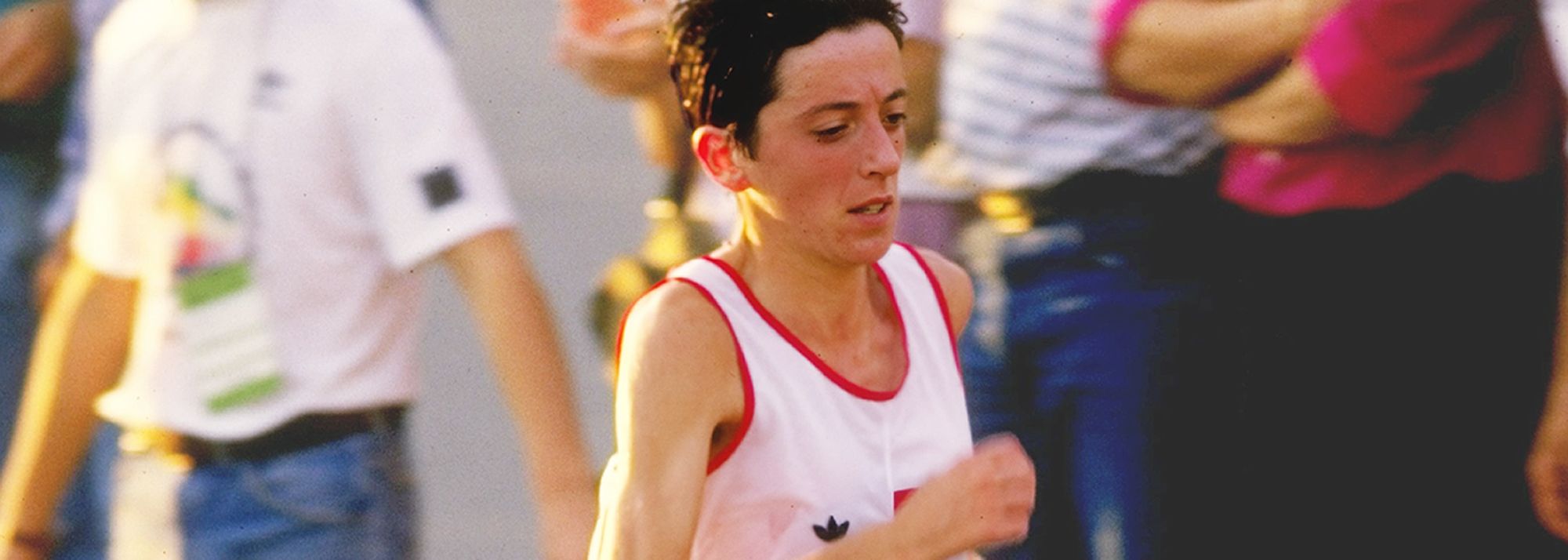


Rosa Mota at the 1987 World Championships (© Getty Images)
By the time Rosa Mota lined up for the Boston Marathon 1990, the diminutive Portuguese runner was already assured of a place among the giants of the women’s marathon.
Winner of the first major championship marathon for women, at the European Championships in Athens in 1982, the 1.57m (5ft 2in) Mota became the first woman to secure world and Olympic marathon titles when she followed her devastating triumph at the 1987 World Championships in Rome, where she finished a whopping seven minutes and 21 seconds clear of the field, with victory at the 1988 Olympics in Seoul.
For all of their trailblazing deeds in lowering the world best time for the women’s marathon, Grete Waitz, Joan Benoit and Ingrid Kristiansen never managed to accomplish that golden global double. Indeed, the feat went unmatched until Peres Jepchirchir of Kenya followed her Olympic triumph in 2021 with victory at the World Athletics Championships Tokyo 25.
Likewise, none of the hallowed trio of the women’s marathon – Waitz, the first world champion; Benoit, the first Olympic champion; or Kristiansen, whose 2:21:06 in London in 1985 stood as the world best for 13 years – managed to achieve a hat-trick of victories at the Boston Marathon.
In what the Boston Marathon aptly refers to as its ‘pioneer era’, before women were officially allowed to compete, Roberta ‘Bobbi’ Gibb (1966, 1967 and 1968) and Sara Mae Berman (1969, 1970 and 1971) were both unofficial first-placed female finishers on three occasions.
In 1990, however, Mota became the first to achieve a trio of victories in the ‘women’s open era’ of the world’s oldest annual marathon. To mark this momentous feat, Mota generously donated a memento from each of her Boston successes to the Museum of World Athletics: her winner’s medal from 1987, her shoes from 1988, and her singlet and bib number from 1990.
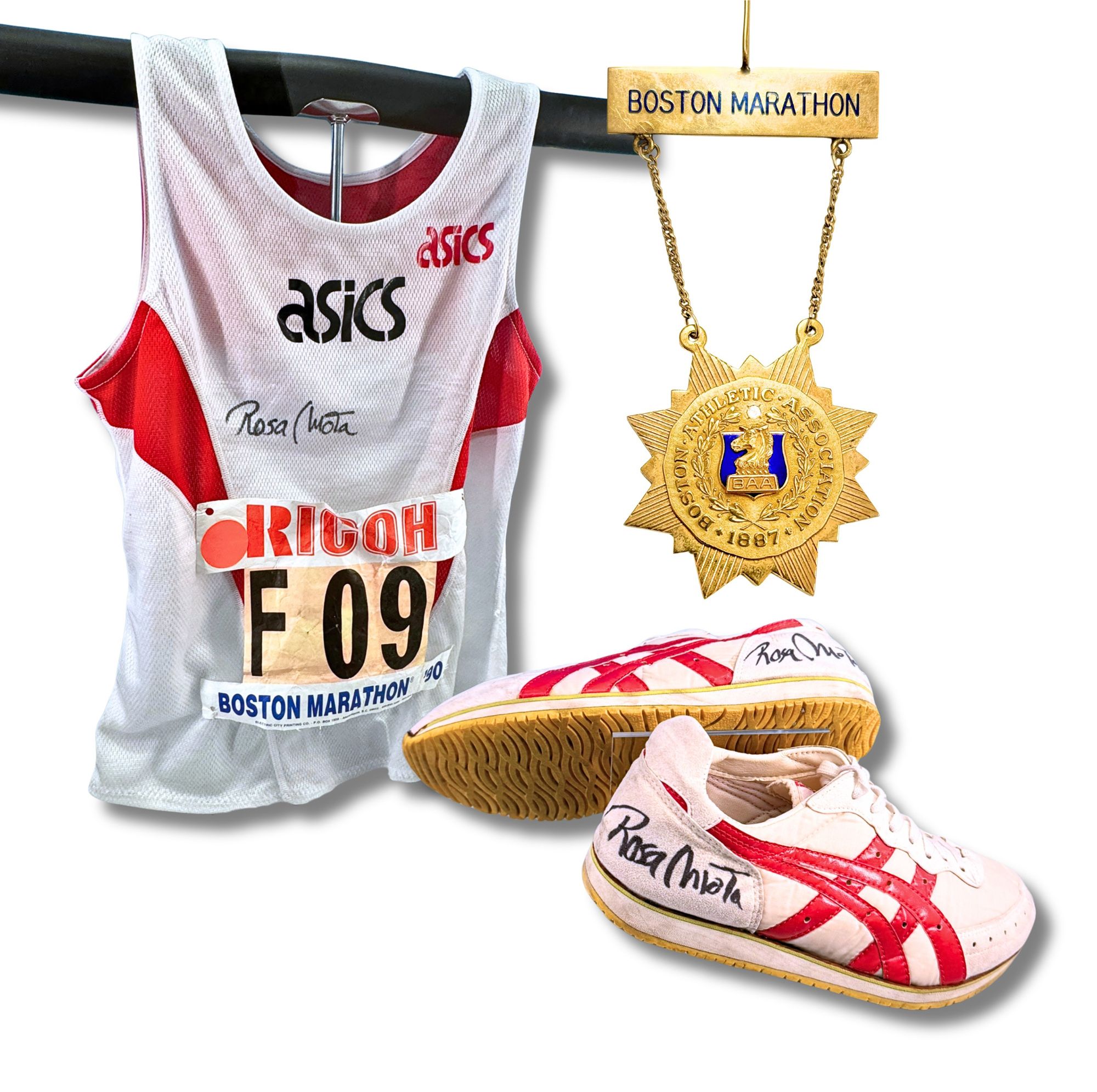
Rosa Mota's medal, shoes, singlet & bib from past Boston Marathons
In 1987 Mota motored to a comfortable victory, finishing 40th overall in 2:25:21, four minutes and 29 seconds clear of Belgium’s Agnes Pardaens. “It wasn’t that hard,” she confessed. It was even easier 12 months later. Mota cruised home in 2:24:30, crossing the Copley Square finish line with 4:56 in hand of her closest pursuer, Finland’s Tuija Jousimaa.
It was a somewhat closer call in 1990. Weary from perpetual battles with the Portuguese federation over her racing schedule and her coaching situation, Mota was also wary of the threat posed by Uta Pippig in the German’s first marathon since escaping from the East to the West.
She need not have worried. Haring off at 5:22-mile pace, she had victory effectively in the bag before hitting Heartbreak Hill at 20 miles. “No one is close,” Mota’s partner and coach Jose Pedrosa assured her. “Enjoy! Don’t kill yourself.” She crossed the line two minutes and 39 seconds clear of Pippig in 2:25:24.
Benoit and Kristiansen both notched a brace of Boston victories. Benoit enjoyed a breakthrough win in a course record 2:35:15 in 1979, sporting a Boston Red Sox cap, and the US runner also prevailed in 1983, on that occasion posting a world best of 2:22:43.
Kristiansen triumphed in 1986 and 1989. Waitz, her celebrated Norwegian compatriot, won nine times in New York but was beaten by the rolling hills in her one appearance in Boston, dropping out at 24 miles in 1982, requiring hospital treatment for damage to her quad muscles.
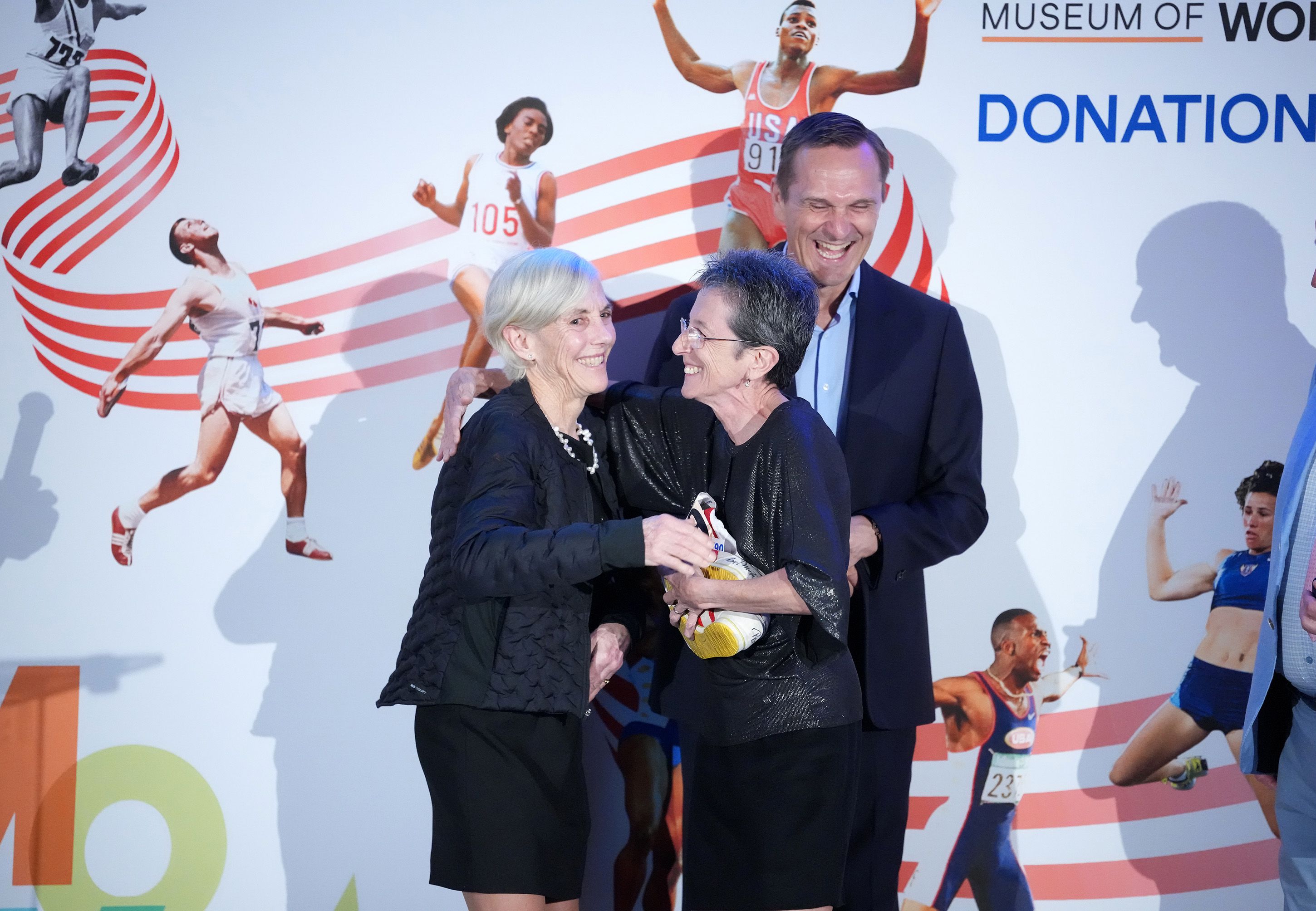
Joan Benoit Samuelson, Rosa Mota and Jon Ridgeon (© World Athletics Heritage  Errol Anderson)
Pippig proceeded to become the first woman to win Boston in three consecutive years (1994, 1995 and 1996) – a feat subsequently matched by Fatuma Roba (1997, 1998 and 1999) before another Kenyan, Catherine Ndereba, claimed a women’s record tally of four victories with back-to-back triumphs in 2000-2001 and 2004-2005.
As for the oft-overlooked Mota, she won twice in Chicago (1983 and 1984) and in London in 1991, a year after securing the European Championship marathon title for a third time.
And none of it would have happened had Pedrosa not persuaded “the sparrow-like Edith Piaf of the marathon”, as Adrianne Blue memorably described her in the book Faster, Higher, Stronger, to try the 26.2 miles distance just three days after finishing 12th on the track in the 3000m final at the 1982 European Championships in Athens.
Like the celebrated French chanteuse, Mota had immediate regrets when Pedrosa drove her round the undulating Marathon to Athens course. “It’s too far and too hilly. I might die like Pheidippides.”
Happily, Mota did not suffer the same fate as the messenger who, legend has it, dropped dead after running to Athens with news of a Greek victory in the Battle of Marathon in 490BC. In sweltering heat and humidity, she ran a smart race on the route that was used for the inaugural Olympic marathon in 1896, holding back in the opening stages before working her way through to the front with 10km remaining.
Mota finished 25 seconds clear in 2:36:04, with Italy’s Laura Fogli second and Kristiansen, the pre-race favourite, third. It was to be the only championship marathon medal in the Norwegian’s otherwise stellar career at the 26.2-mile distance.
For Mota, the diminutive Portuguese giant of major championship racing on the roads, it was the start of a marathon gold rush.
Simon Turnbull for World Athletics Heritage