

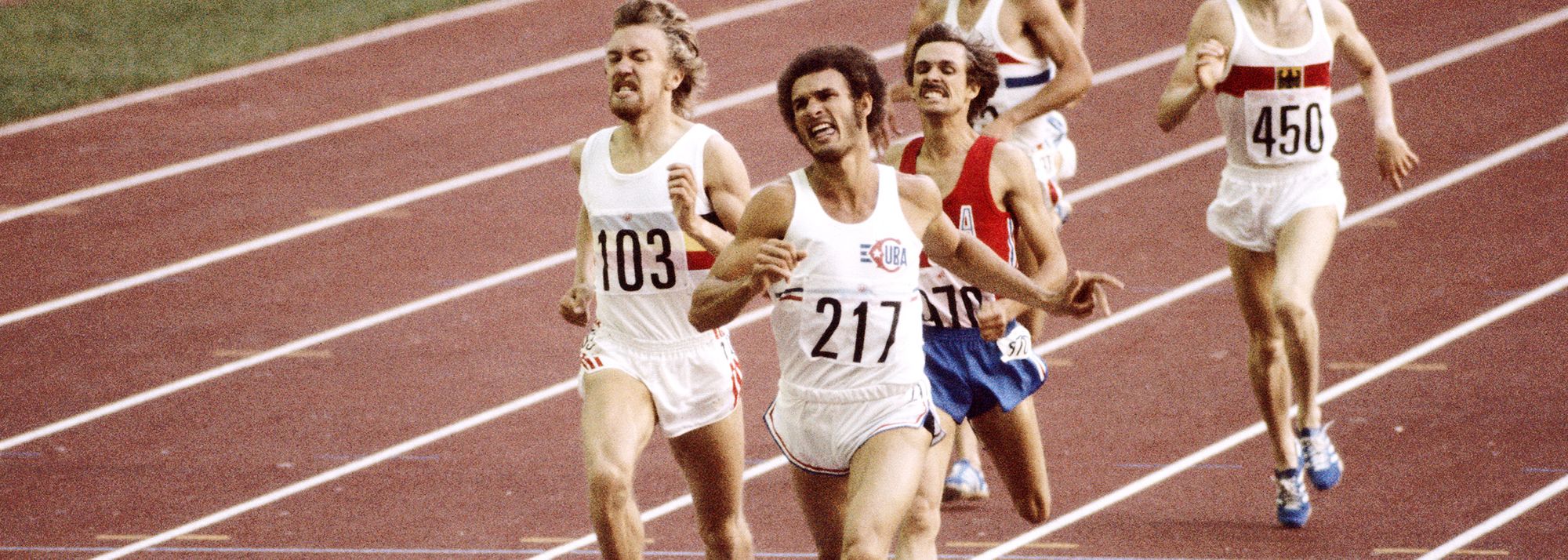


Alberto Juantorena at the 1976 Olympic Games (© Getty Images)
Fifty years ago, on 23 July 1976, athletics got under way at the Montreal Olympic Games. Over the days that followed, the Olympic Stadium became the stage for a rush of world records, breakthrough champions and enduring landmarks – among them Annegret Richter’s 100m victory for West Germany and Alberto Juantorena’s unprecedented 400m-800m double for Cuba.
Richter and Juantorena were among a host of track and field stars who struck Olympic gold and broke world records in Montreal, where the opening day of athletics marked the start of one of the sport’s most memorable Olympic editions.
Richter’s triumph was one of the standout disruptions of the competition. Of the 14 women’s events, East Germany won nine gold medals, the Soviet Union two, and Poland and Bulgaria one each. Richter denied the Eastern Bloc a clean sweep of the women’s sprint titles with the relentless rhythm that took her to 100m victory in the red and white vest of West Germany.
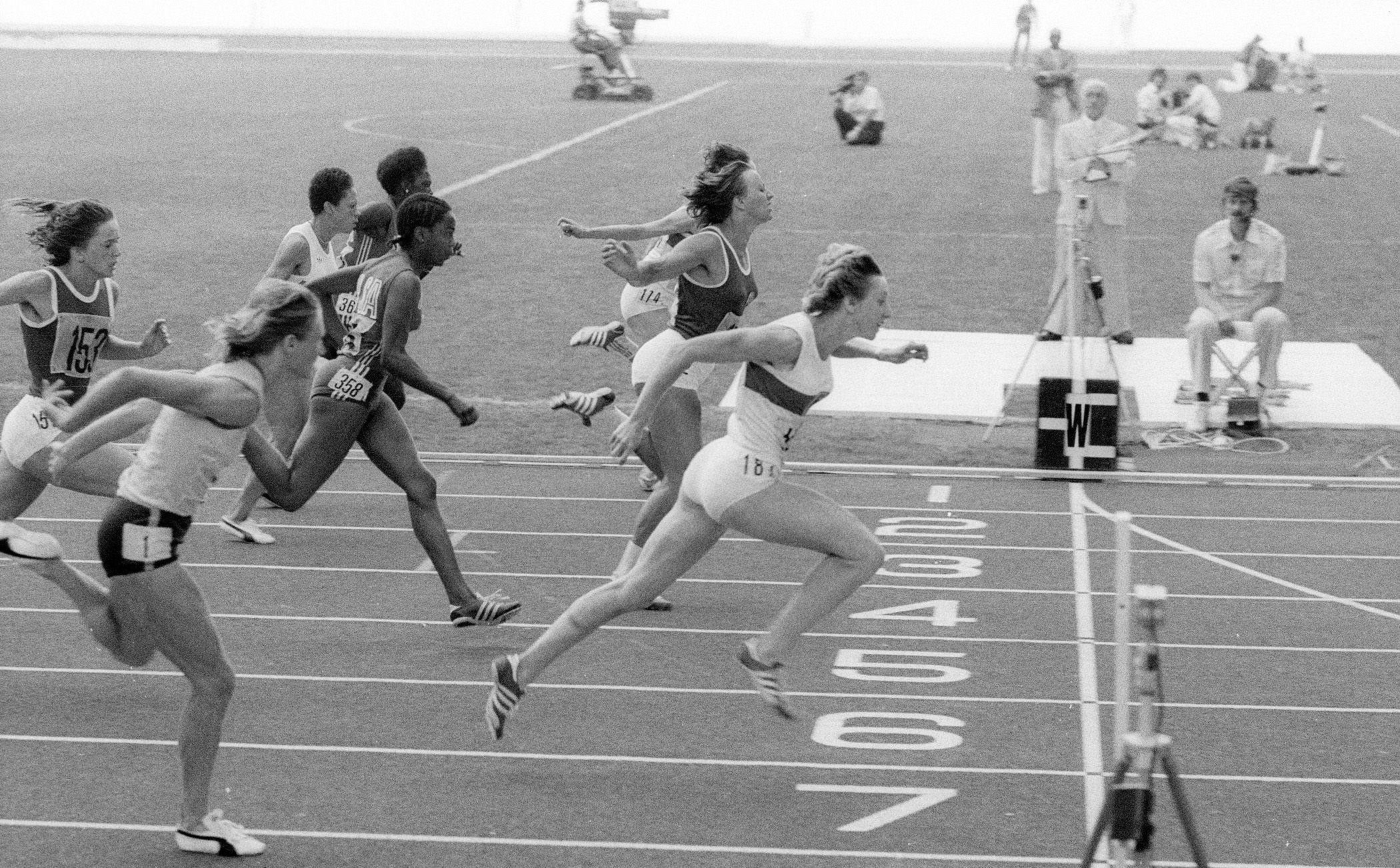
Annegret Richter wins the 1976 Olympic 100m title (© Imago)
The 25-year-old had already begun, along with her OSC Dortmund clubmate and training partner Inge Helten, to loosen the stranglehold on women’s sprinting enjoyed by Renate Stecher, the formidable East German who had stormed to 100m and 200m gold at the 1972 Olympic Games in world record times. Both Helten and Richter had clocked world records for 100m the month before the Games, Helten running 11.04 and Richter equalling Stecher’s hand-timed mark of 10.8.
Despite not going full-out in her semi-final in Montreal, Richter improved Helten’s electronic world record with 11.01. She might well have claimed a historic sub-11-second clocking in the final had it not been for a trio of false starts. As it was, she got out level with her principal rivals, then pulled clear from halfway to win by 0.05 from Stecher in 11.08, with Helten taking bronze in 11.17.
“After crossing the finish line, I wasn’t quite sure that I’d won,” Richter confessed. “It wasn’t until I saw the replay on the big screen that I saw I was clearly in the lead.”
Four years earlier, Richter had helped deny Stecher an Olympic treble in Munich, her storming run on the final bend furnishing Heide Rosendahl, the long jump champion and pentathlon silver medallist, with just enough of a lead to hold off the East German on the anchor leg of the 4x100m, the West German quartet prevailing in a world record of 42.81.
In Montreal, Richter fell a tantalising 0.02 shy of emulating Stecher’s 100m-200m double of 1972, clocking 22.41 in the longer sprint final behind the victorious East German Bärbel Eckert. Stecher took bronze in 22.47 and then gold as part of an East German quartet that eclipsed Richter and West Germany in the 4x100m.
Juantorena’s achievements were no less arresting. Rick Wohlhuter of the US, the world record-holder at 880 yards and 1000m, proclaimed: “Juantorena will not be a factor because he is a 400m runner who will have trouble running three 800m races in as many days.”
Instead, it was Wohlhuter who was found lacking when El Caballo showed his pedigree, Juantorena’s prodigious 2.7m-long stride taking him clear to victory in a world record of 1:43.50, with the inspired Belgian Ivo Van Damme snatching silver in 1:43.86 ahead of the fading Wohlhuter, third in 1:44.12.
With his distinctive knee-length basketball socks, Juantorena – a national youth team basketball prodigy and future long-serving member of the World Athletics Council – powered onwards to complete an unprecedented double by winning the 400m final, his seventh race in six days, in 44.26.
Virén doubles again, then falls short of Zátopek’s treble
Lasse Virén, a double winner over 5000m and 10,000m in Munich, emulated the Czech icon Emil Zátopek by holding on to the 10,000m crown, striking with 450m remaining to prevail in 27:40.38 ahead of Portugal’s world cross country champion Carlos Lopes (27:45.17) and Britain’s European 5000m champion Brendan Foster (27:54.92).
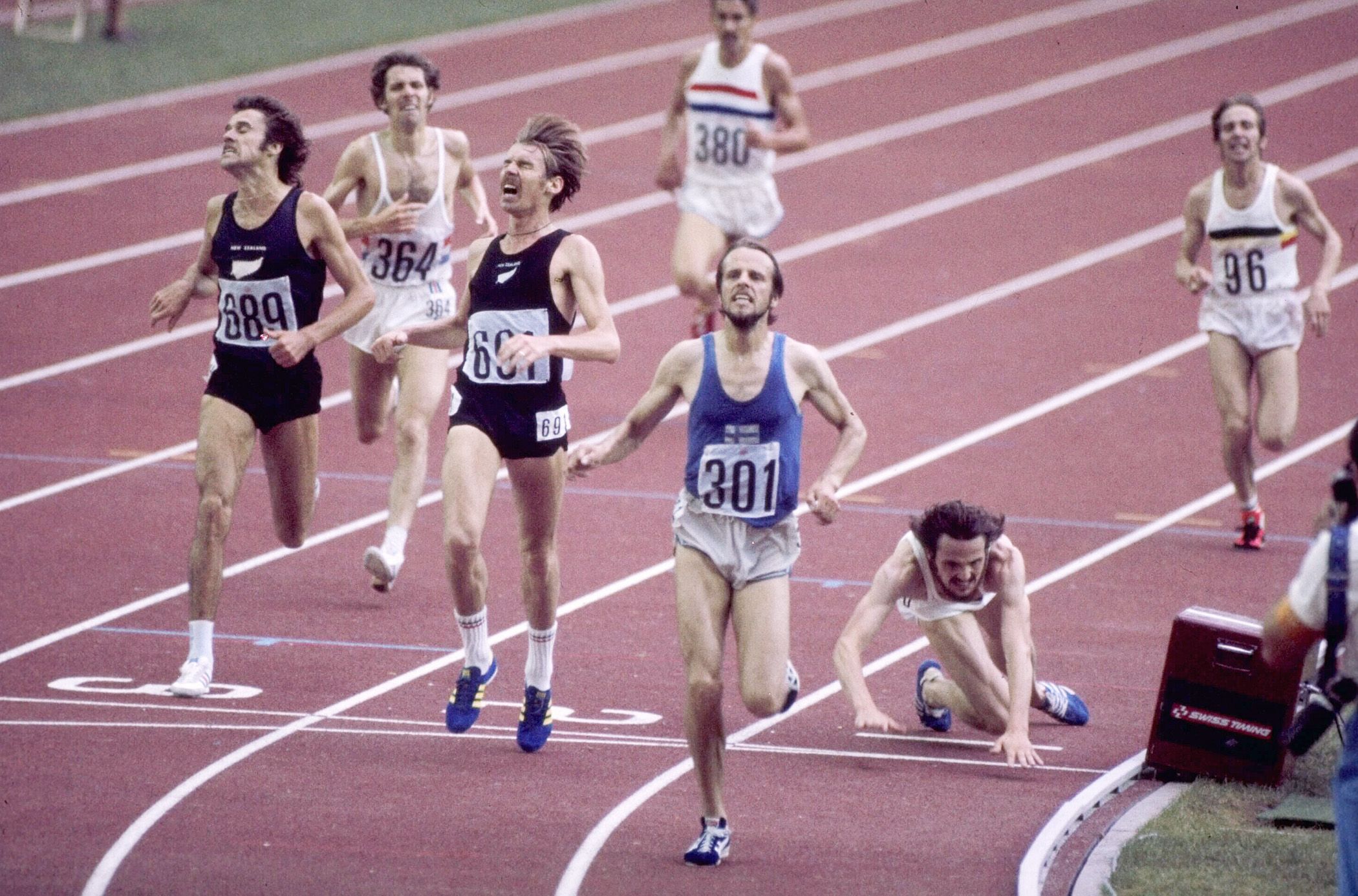
Lasse Viren wins at the 1976 Olympics (© Getty Images)
Virén then succeeded where Zátopek and fellow Finnish phenomenon Paavo Nurmi failed by completing a back-to-back Olympic distance double, outsprinting his rivals to win the 5000m in 13:24.76. The next day he boldly sought to emulate Zátopek’s epic 1952 golden treble, finishing fifth on his marathon debut – 3:16 behind Waldemar Cierpinski of East Germany, a surprise winner in an Olympic record of 2:09:55.
Németh follows golden family tradition
Miklós Németh finally emerged from the shadow of his famous father, Imre, the 1948 Olympic hammer champion and world record-breaker. The Hungarian javelin thrower, who later gave his name to a line of aluminium implements, sent his opening effort to a world record of 94.58m, stunning his rivals to such an extent that he finished 6.65m clear of Finn Hannu Siitonen, former holder of the global mark.
There were four other world records in individual events, plus one for the East German quartet in the women’s 4x400m relay (3:19.23). The 18-year-old Christina Brehmer, who ran the anchor leg, was no match for the 30-year-old Irena Szewińska in the individual 400m. The Polish sprint great took 10 metres out of the teenager in the home straight, crossing the line in a world record of 49.28 to take her tally of Olympic medals to seven across five different events – 12 years after taking long jump silver and 4x100m relay gold on her Olympic debut in Tokyo.
Long regarded as a supreme time-trialist without a major crown, Sweden’s Anders Gärderud emerged triumphant from a dramatic 3000m steeplechase final in a world record of 8:08.02, sprinting clear from the final barrier after East Germany’s Frank Baumgartl, who had drawn level, tripped and fell. Poland’s Bronisław Malinowski snatched silver in 8:09.11, while Baumgartl picked himself up to claim a consolation bronze in 8:10.36.
In his first season as a 400m hurdler, the smooth-striding Edwin Moses struck gold in a world record of 47.64, finishing 1.05 clear of his US teammate Mike Shine. In the decathlon, Bruce Jenner – now known as Caitlyn Jenner – signed off a stellar combined events career in supreme fashion, reeling off seven PBs to notch a third world record with a tally of 8618.
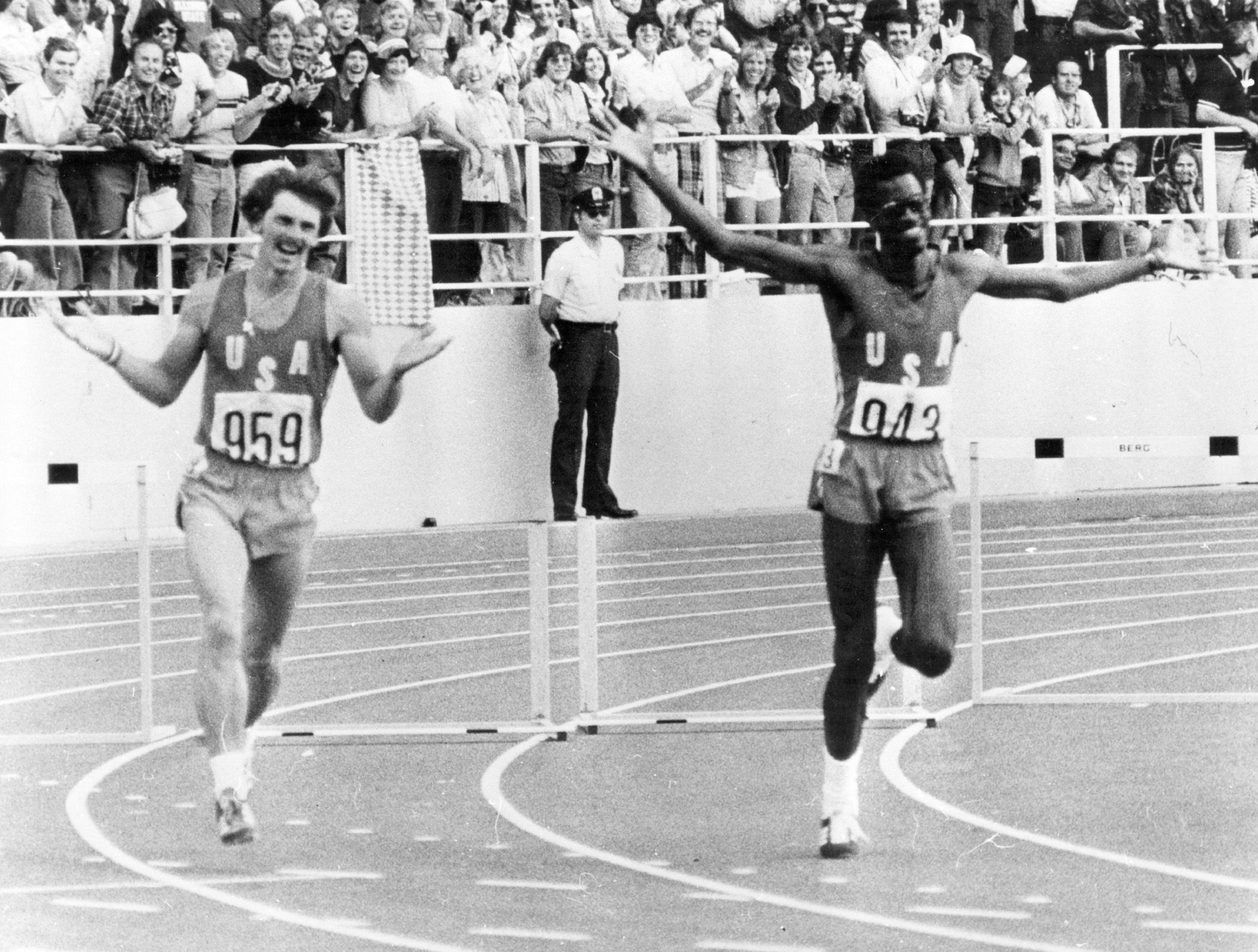
Edwin Moses (right) celebrates his 400m hurdles triumph at the 1976 Olympics (© Getty Images)
In other events, Soviet triple jumper Viktor Saneyev completed a hat-trick of Olympic triple jump victories with a leap of 17.29m; Guy Drut gritted his teeth to edge the 110m hurdles by 0.03 from Cuba’s Alejandro Casañas in 13.30, thus becoming France’s first track champion in a men’s event for 56 years; New Zealand’s John Walker claimed 1500m victory ahead of Belgium’s Ivo Van Damme in 3:39.17, in the absence of Tanzanian world record-holder Filbert Bayi, a victim of the African boycott; Trinidad and Tobago’s Hasely Crawford edged the 100m in 10.06, 0.02 ahead of Jamaica’s Don Quarrie, who took the 200m in 20.23; and, unsettled by the Montreal rain, high jump favourite Dwight Stones of the US had to settle for bronze with 2.21m, nine centimetres shy of his world record height, as 19-year-old Jacek Wszoła of Poland claimed gold with an Olympic record of 2.25m.
Half a century after athletics began in Montreal, the 1976 Games remain defined not by one star or one record, but by a rush of performances that pushed the sport into new territory.
Simon Turnbull for World Athletics Heritage