




Mizuki Noguchi wins the 2005 Berlin Marathon (© Getty Images)
It was clear to those watching Mizuki Noguchi zip around the track on the south-west shore of St Moritz Lake that she was not resting on her hard-won Olympic laurels.
Twelve months on from her masterclass in the 2004 Olympic women’s marathon in Athens, the Japanese athlete was undergoing an interval session of epic proportions at the high-altitude training centre in the Swiss Alps.
“There were some men’s runners from Europe watching me,” Noguchi recalled later. “They were convinced I was crazy.”
At an altitude of 1856 metres, she reeled off 45 repetition efforts around the 400m track – readying herself for the challenge of her first marathon as Olympic champion, on the streets of Berlin in September 2005.
Her fastest time at that stage of her career was the 2:21:18 it took her to win the Osaka Women’s Marathon in 2003. Noguchi’s goal in Berlin was to become the fastest ever female from her marathon-crazy homeland. To do so, she would need to better not just Naoko Takahashi, who became the first woman in history to crack 2:20 with her 2:19:46 in Berlin in 2001, but also Yoko Shibui, who improved the Japanese record to 2:19:41 in Berlin in 2004.
Only three other women had broken 2:20 at that point: Catherine Ndereba of Kenya with 2:18:47 in Chicago in 2001, Britain’s Paula Radcliffe with a stunning 2:15:25 in London in 2003 and Sun Yingjie of China, who clocked an Asian record of 2:19:39 in Beijing in 2003.
“My aim in Berlin is a Japanese record,” Noguchi said. “The course is good for breaking it. It is flat and I will be running with pacemakers. It will also be the first time I have run in a marathon with men in the field. I have only run in marathons for women so far."
The 27-year-old duly accomplished her mission. Wearing the F2 bib she has kindly donated together with a pair of shoes from her 2008 season to the Museum of World Athletics, Noguchi crossed the finish line in 2:19:12. She had broken the Japanese and Asian records and moved to third on the world all-time list, behind Radcliffe and Ndereba – two of the rivals who had been unable to get the better of her on the Olympic road from Marathon to Athens the previous year.
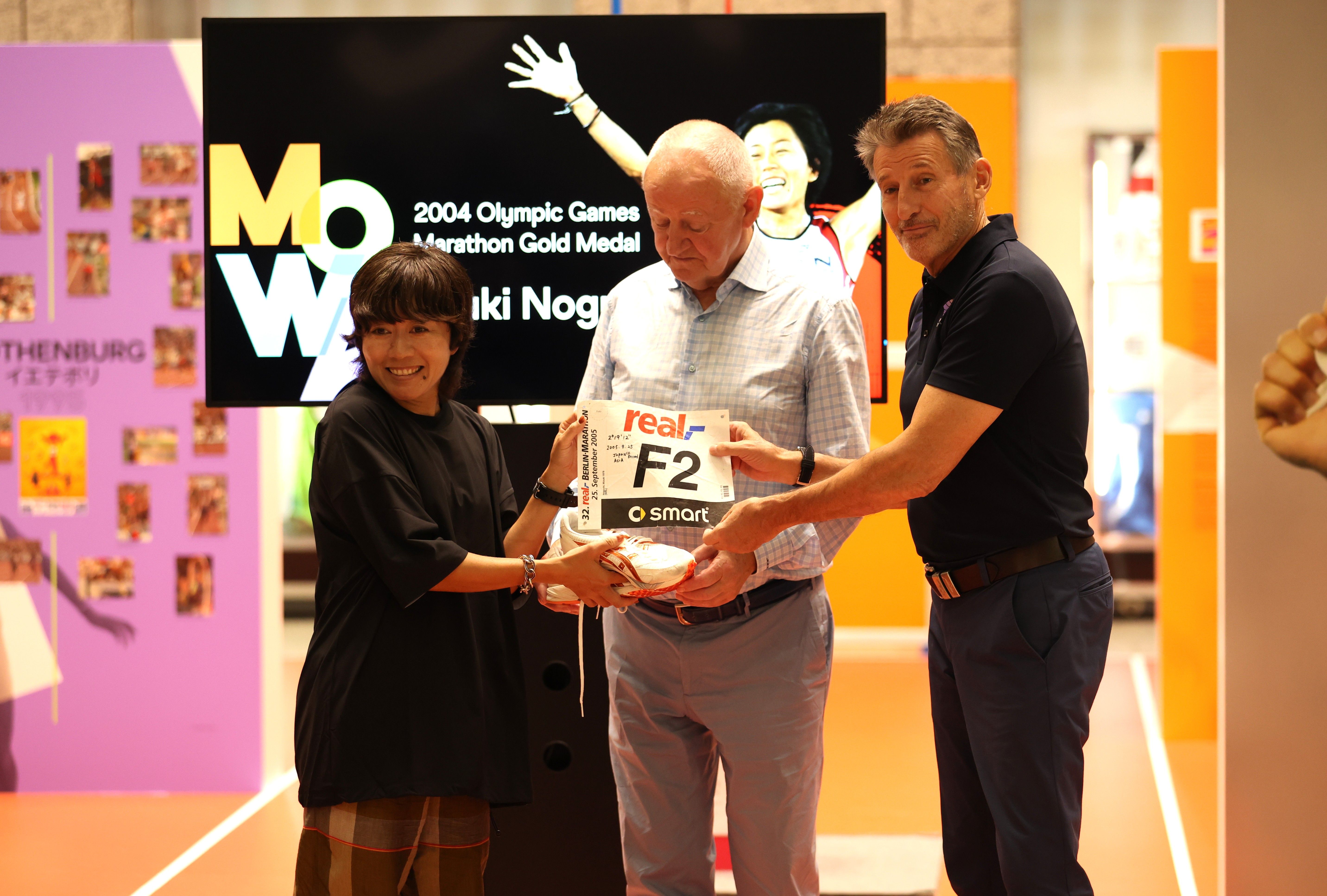
Mizuki Noguchi makes her donation to the Museum of World Athletics (© MOWA)
“It was not easy to run against the clock for the first time, instead of running against rivals next to me,” Noguchi confessed, “but I am very happy to have broken the Japanese record. I wanted to do this as a present to my coach, Nobuyuki Fujita.”
There were two bonus presents to come when it was confirmed that Noguchi had set world records with her split times at 25km (1:22:13) and 30km (1:38:48). Both marks had been held by her Japanese compatriot Takahashi, who clocked 1:22:31 and 1:39:02 en route to her Berlin Marathon victory in 2001.
“I did realise that I broke the 30km record when I passed the marker,” Noguchi said. “I looked at my watch and was happy about it. But I did not know about the 25km record. That came as a surprise. I am very happy with what I have achieved in Berlin. I will take home all the records as souvenirs.”
Sadly, there were to be no more souvenir records for Noguchi and her long-time coach. Victory in the 2007 Tokyo Marathon, in a time of 2:21:37, proved to be the last hurrah in a marathon career that also included a silver medal behind Ndereba at the 2003 World Athletics Championships in Paris.
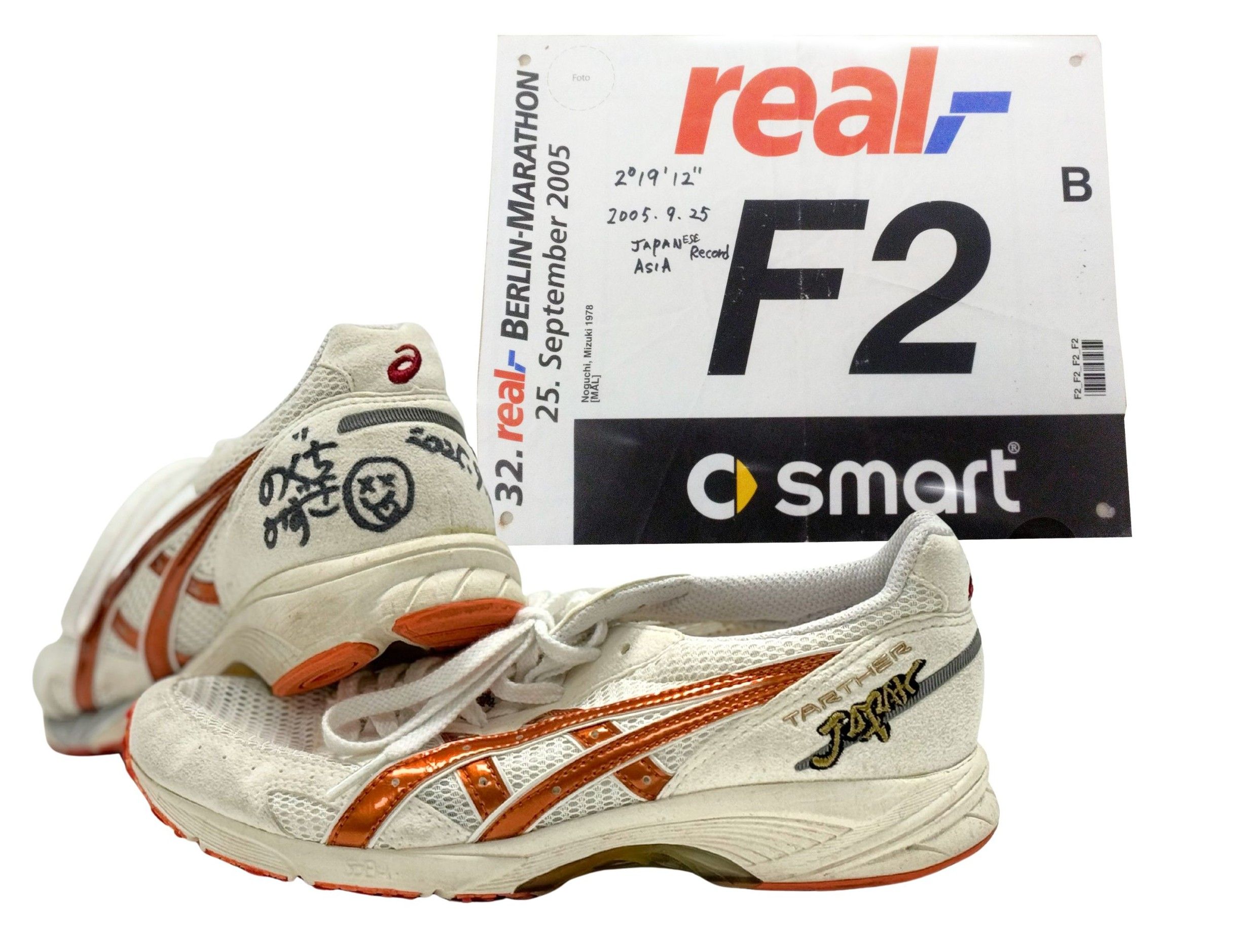
Mizuki Noguchi's donation to the Museum of World Athletics (© MOWA)
The high point for the woman from the coastal city of Ise was that epic victory in Athens in 2004, on the course on which Spyridon Louis won the original marathon race in the inaugural Games of the modern Olympic era.
Noguchi had prepared assiduously for that challenge in the mountains around St Moritz. With the undulating Marathon to Athens route in mind, she concentrated on improving her hill running – taking a break only to inspect the course in the Greek capital with Fujita.
“Be sure to take all the fluid and make your move at 25km,” her coach told her before she headed for the start line with the mercury pushing 35°C. On cue, at 25km, Noguchi launched her attack at the start of a series of inclines.
Radcliffe, beset by injury and illness, was unable to respond, dropping out at 36km. Ndereba closed in the final stages but finished 12 seconds behind as runner up.
Noguchi took the gold medal in 2:26:20, a record on the original marathon course.
Simon Turnbull for World Athletics Heritage