

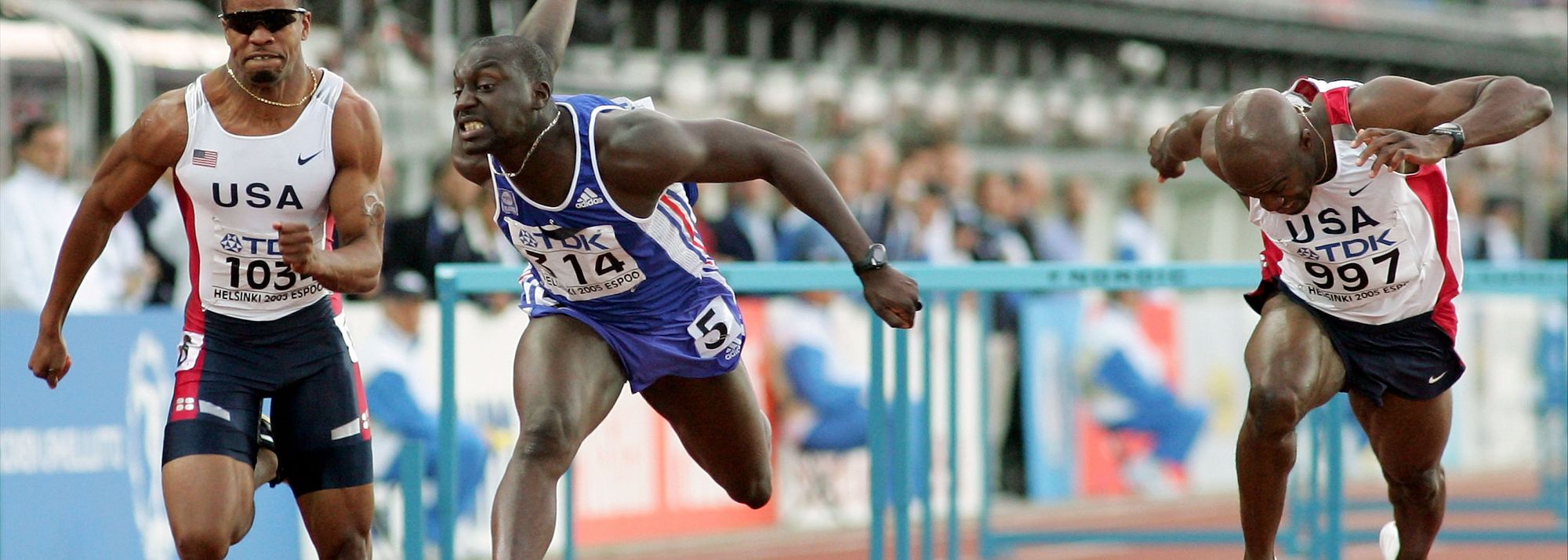


Ladji Doucouré wins the 2005 world 110m hurdles title (© Getty Images)
As his lead leg hit the last flight in the 110m hurdles final at the 2005 World Athletics Championships in Helsinki, Ladji Doucouré could have been excused for suffering an unnerving case of déjà vu.
In the Olympic final in Athens the year before, the young French medal hope had got shunted from second to eighth after crashing into the ultimate barrier, leaving Liu Xiang of China, a close rival from their junior days, a clear winner.
Doucouré had been the fastest all through the preliminaries in the Greek capital, setting French records in the opening round (13.18) and semi-finals (13.06).
For the 22-year-old, it was a different story when it came to the moment that mattered.
The Doucouré of 2005 was a smoother, steadier high hurdler than the 2004 version. Faster and stronger too.
A winter of all-round graft under the astute guidance of his long-time coach, Renaud Longuèvre, had paid tangible dividends with a first senior international title, the 2005 European indoor 60m hurdles crown in Madrid, and entry into the elite sub-13-second 110m hurdles club with a national record of 12.97 at the French Championships in Angers.
Liu closed rapidly on his inside on the run-in to the line in Helsinki but Doucouré held his form sufficiently to hang on for the world title. Only just, mind – by little more than the thickness of the right-foot spike he has kindly donated to the Museum of World Athletics as a reminder of a momentous achievement for Doucouré and for French athletics.

Ladji Doucouré's spike from the 2005 world final
“I didn’t believe I’d won until I saw the replay on the giant screen,” Doucouré confessed.
He had prevailed by a mere 0.01 from the low-leaning Liu, 13.07 to 13.08, with four-time world champion Allen Johnson of the US third in 13.10.
“It was a brutal race, a real fight all the way to the line,” Doucouré continued. “I wasn’t sure that I’d crossed the line first.
“We are in an event where we could run the race over again and the same person wouldn’t win it. I am not necessarily the best 110m hurdler but I was the best today.”
An engagingly modest soul, raised by a Malian father and Senegalese mother in the southern Parisian suburb of Viry-Châtillon, Doucouré was so embarrassed at receiving an appearance fee after false-starting at the Paris Golden League meeting in 2004 he donated it to the children at his track club, Viry Évry Nord Sud Essonne.
His victory in Helsinki made him the first French athlete to win a senior global 110m hurdles title since Guy Drut struck Olympic gold in Montreal in 1976. And there was more than an element of Gallic déjà vu in Doucouré following in his celebrated compatriot’s world-beating footsteps.
Drut won the French U20 decathlon title in 1968. Doucouré won it in 2001, the year he bagged European U20 decathlon gold in Grosseto, scoring 7747. Drut held the French junior record with 7565.
A 5.20m pole vaulter, Drut’s all-round sporting ability took him to second place in a European heat of the 1976 Superstars television contest – behind the five-time Wimbledon tennis champion Bjorn Borg, who got the better of him in the deciding 600m steeplechase.
Historically, Doucouré went one better than Drut in claiming a second global outdoor gold medal in Helsinki.
The day after his hurdles triumph, on 13 August 2005, he ran the lead-off leg for the French quartet that held off Trinidad and Tobago by 0.02 to win the 4x100m in 38.08 – partnered by Ronald Pognon, Eddy De Lépine and Lueyi Dovy.
“Before coming to Helsinki, I imagined winning two medals, maybe two bronzes,” Doucouré confessed. “To get two golds is a dream.”
Doucouré’s dream of becoming a professional footballer ended at the age of 13, when he broke his shin bone playing in the French schools’ championships. Three years later, in 1999, he had his first piece of track and field history, winning the first final contested at the inaugural World U18 Championships in Bydgoszcz, Poland: the 110m hurdles in 13.26.
At the 2000 World U20 Championships in Santiago, Chile, he edged Liu Xiang in the battle for bronze, 13.84 to 13.87, and won a silver medal alongside Pognon in the 4x100m.
Not until 2002, though, a year after his European U20 decathlon triumph, did the decision come to concentrate solely on the high hurdles.
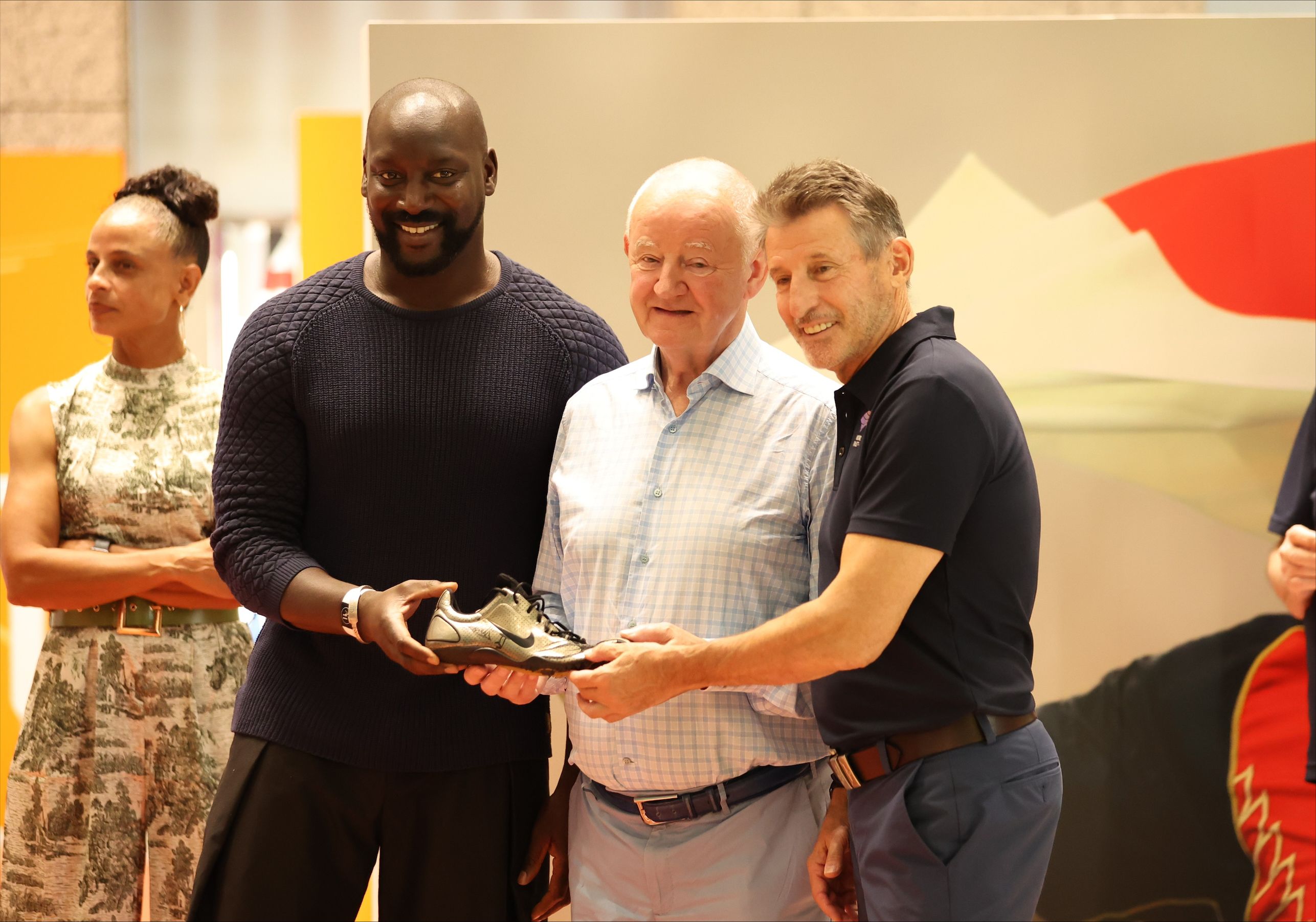
Ladji Doucouré, Michael H Burke, and World Athletics President Sebastian Coe
The guiding light in the switch was Longuevre, a former pole vaulter who initially started coaching the youthful Doucouré in that event. He subsequently encouraged his charge to explore the extent of his skills as a combined eventer before narrowing the focus to single discipline.
Injuries ultimately caught up with the dashing Doucouré. After the highs of Helsinki, he won just one further medal in the international arena: a second European indoor 60m hurdles gold in Turin in 2009.
That famous double in the Finnish capital, however, was enough to stir the patriot fervour of his coach, a technical advisor for the Île-de-France region, who oversaw Doucouré’s development at the National Institute of Sport and Physical Education.
“I am proud to be part of the technical staff founded by General de Gaulle to promote French sport,” Longuevre trumpeted. “We are paid by the taxpayer so that, since the age of 15, guys like Ladji can benefit from exceptional support.
“We know how to make champions. Thank you, France.”
Simon Turnbull for World Athletics Heritage