

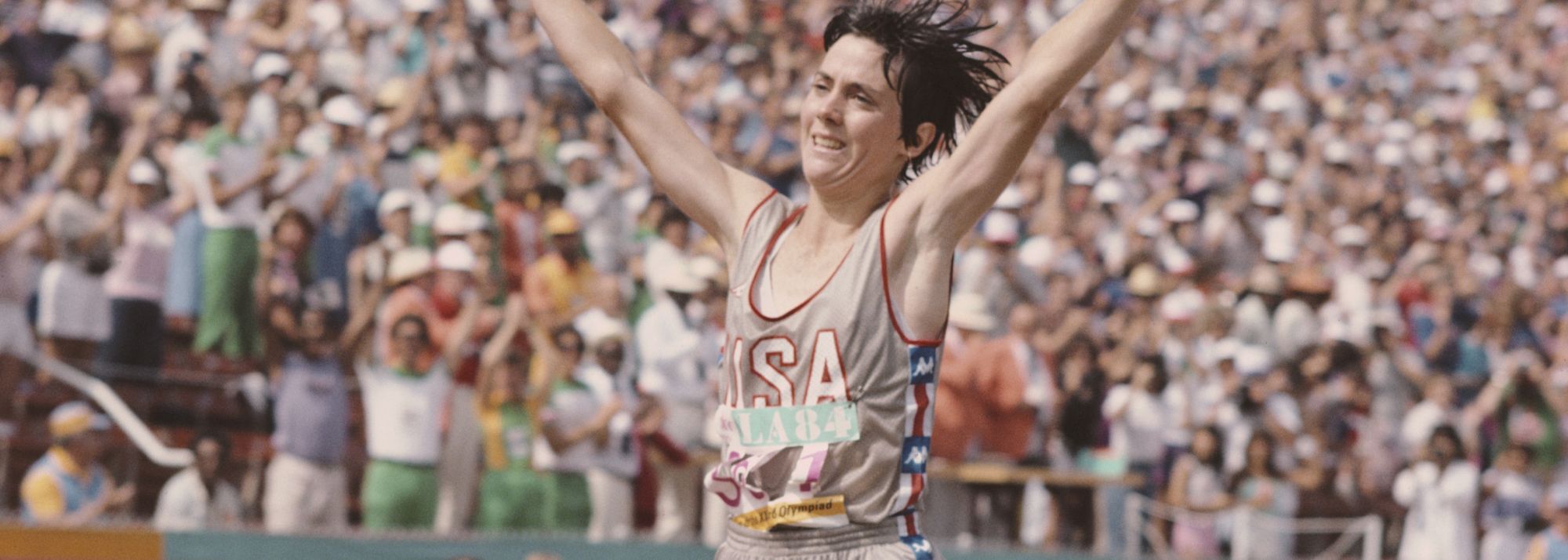


Joan Benoit wins the inaugural Olympic women's marathon title at the 1984 Los Angeles Games (© Getty Images)
One Monday morning in April 1985, Joan Benoit Samuelson made the four-mile trip from her home on the coast of Maine to pick up her mail from Freeport Post Office. Her postman had some news for her: she was no longer the holder of the women’s marathon world best.
Unbeknown to Benoit Samuelson, Ingrid Kristiansen had run 2:21:06 at the London Marathon the day before – not so much eclipsing as obliterating the world best of 2:22:43 that the US runner had recorded under her maiden name, Joan Benoit, in Boston in April 1983.
Having etched her maiden name into distance running lore as winner of the inaugural Olympic marathon for women on home ground in Los Angeles in August 1984, before marrying her college sweetheart Scott Samuelson, Benoit Samuelson was left with a burning desire to make a new name for herself.
For her first marathon as Benoit Samuelson, and as Olympic champion, the 28-year-old chose the America's Marathon in Chicago in October 1985 – ditching plans to race in New York after discovering that the new world best-holder would be in the elite women's field in the Windy City.
The duel in the Windy City
Kristiansen had been stung by the disappointment of missing out on a medal in LA, where she finished fourth behind Benoit (as she was at the time), her fellow Norwegian Grete Waitz and Portugal's Rosa Mota. She was on a trailblazing roll in 1985, following up her huge marathon world best in London by breaking the 31-minute barrier for 10,000m on the track with a 30:59.42 world record in Oslo.
The big question heading into Chicago was not just whether the Olympic champion could get the better of the in-form Kristiansen, but also whether the 26.2-mile head-to-head could produce another world best. There was even talk of the 2:20 barrier being broken for the first time.
That prospect remained alive as the two main contenders battled it out over the opening 19 miles – not quite side by side, but with Benoit Samuelson forcing the pace at the front and Kristiansen a stride or two behind.
Zipping through 10 miles in 52:42 and halfway in 1:09:33, they were still on course for a sub-2:20 clocking at 19 miles. But then the invisible elastic snapped. Kristiansen dropped back, and so did the pace. Benoit Samuelson crossed the line in 2:21:21 – just 15 seconds shy of Kristiansen’s world best in London.
Still, it was a victory to savour for Benoit Samuelson, who has kindly donated her winner’s medal to the Museum of World Athletics. Her winning time, second quickest on the world all-time list, was a North and Central American best, and her margin of victory was an emphatic 1:44.
“When Joan moved away from me, my head wanted to go with her but my legs couldn’t,” the Norwegian said. “They were going up and down instead of forward.”
A legacy across five decades
Benoit Samuelson claimed she would have hung up her racing shoes if she had broken 2:20 that day, but resolved to chase the barrier in future. “It’s definitely possible, given the right conditions and the right mental attitude,” she said.
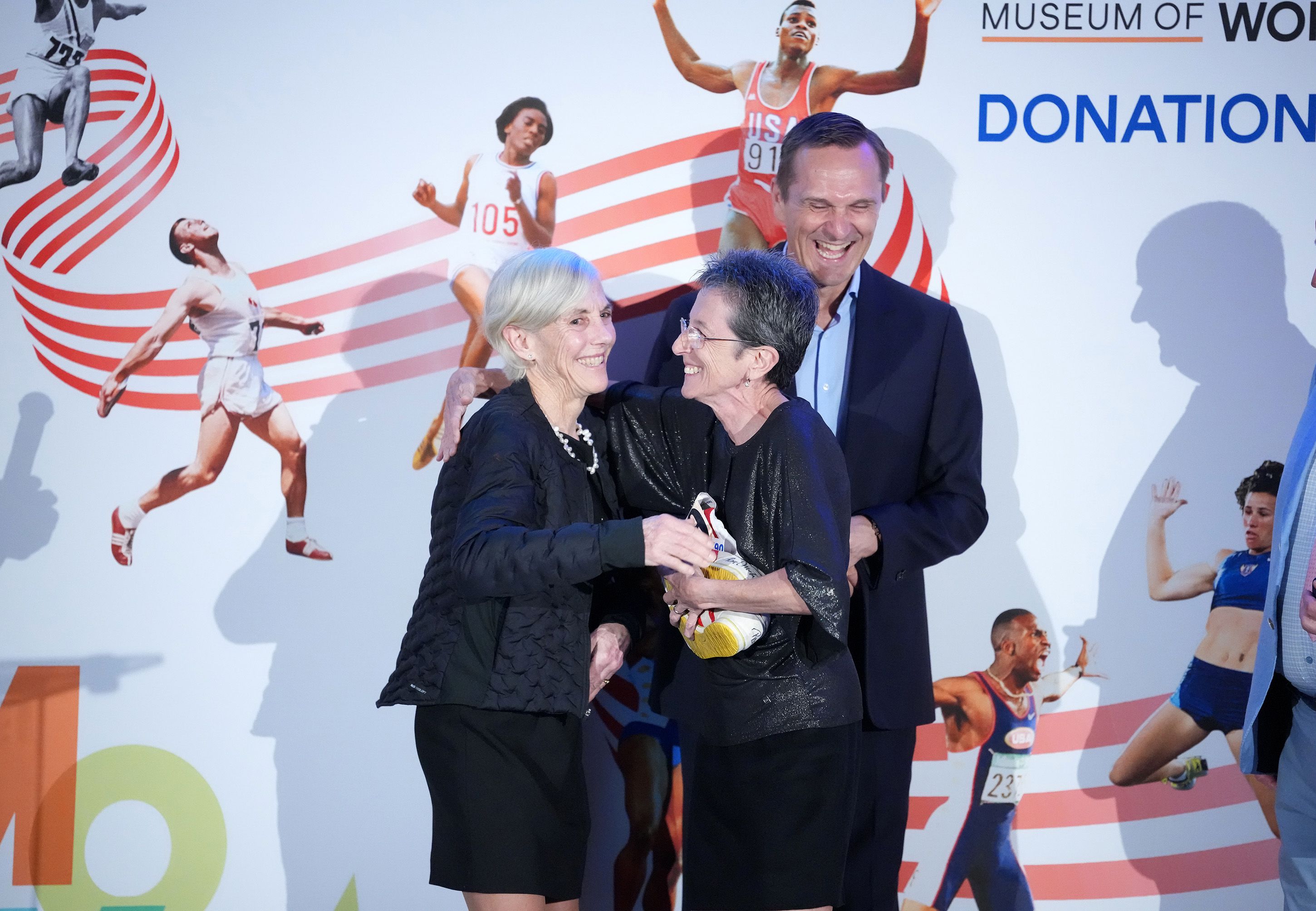
Joan Benoit Samuelson, Rosa Mota and Jon Ridgeon (© World Athletics Heritage  Errol Anderson)
There was no doubting Benoit Samuelson’s mental strength. Her father, Andre Benoit, served in the 10th Mountain Division of the US Army, fighting in the Italian Alps during World War II. He taught Joan to ski, and she harboured ambitions of becoming an Olympic skier until she broke her leg and her doctor recommended running to strengthen her leg muscles.
In 1984, she won the inaugural women's Olympic marathon in Los Angeles, having secured her place at the Games with a stunning US Trials victory just 17 days after surgery on her right knee. “Her willpower is unreal,” said her long-time coach Bob Sevene. “She’s the greatest athlete I’ve ever been around, the toughest I know. Her wheels will literally have to fall off to stop her.”
And, remarkably, the Benoit Samuelson wheels have still not fallen off. She became the first woman to run sub-three-hour marathons in five consecutive decades, from the 1970s to the 2010s. Even at 62, she came close to breaking three hours again, clocking 3:02:21 in Berlin in 2019.
In 2024, at 66, the inaugural Olympic women's marathon champion ran 3:38:37 in Tokyo, completing the full set of all six World Marathon Majors.
“I don’t have any secrets,” she says. “I just love to run… I’ll have time to rest when I’m dead.”
Simon Turnbull for World Athletics Heritage