

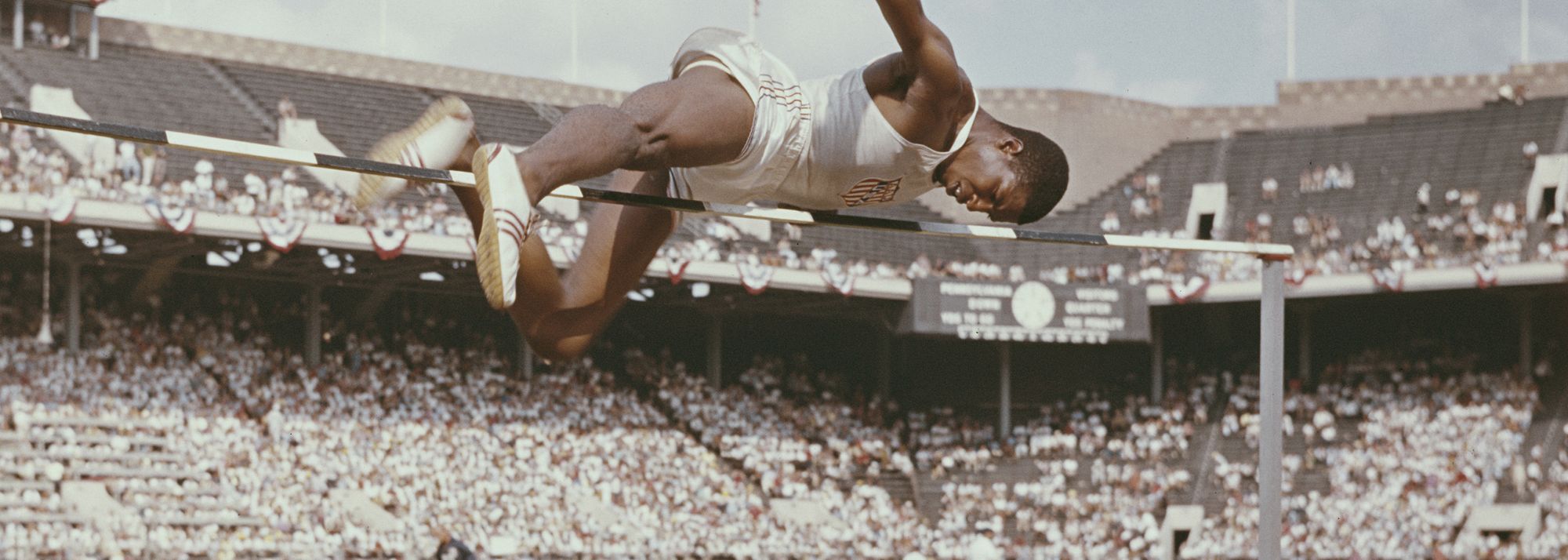


World high jump record-breaker Charles Dumas (© Getty Images)
The evening of Friday 29 June 1956 occupies a unique place in athletics history. During the opening night of the men's United States Olympic Trials at the Los Angeles Memorial Coliseum, four world records were set within two hours, a feat that has never been surpassed in a single meeting.
Conditions were ideal. United Press described the evening as "beautiful for track and field events – clear, balmy at 70 degrees and dry".
8:25pm – the world's fastest men
The drama began almost immediately.
In the first 100m heat, Ira Murchison equalled the world record with 10.2, despite running into a -1.3m/s headwind. Three official watches recorded 10.1, 10.2 and 10.3, allowing the performance to be accepted as an equalling of the global mark. Behind him, Thane Baker also ran 10.2, which would have qualified as a world record had the time been recorded by three official timekeepers. It was therefore not submitted for ratification.
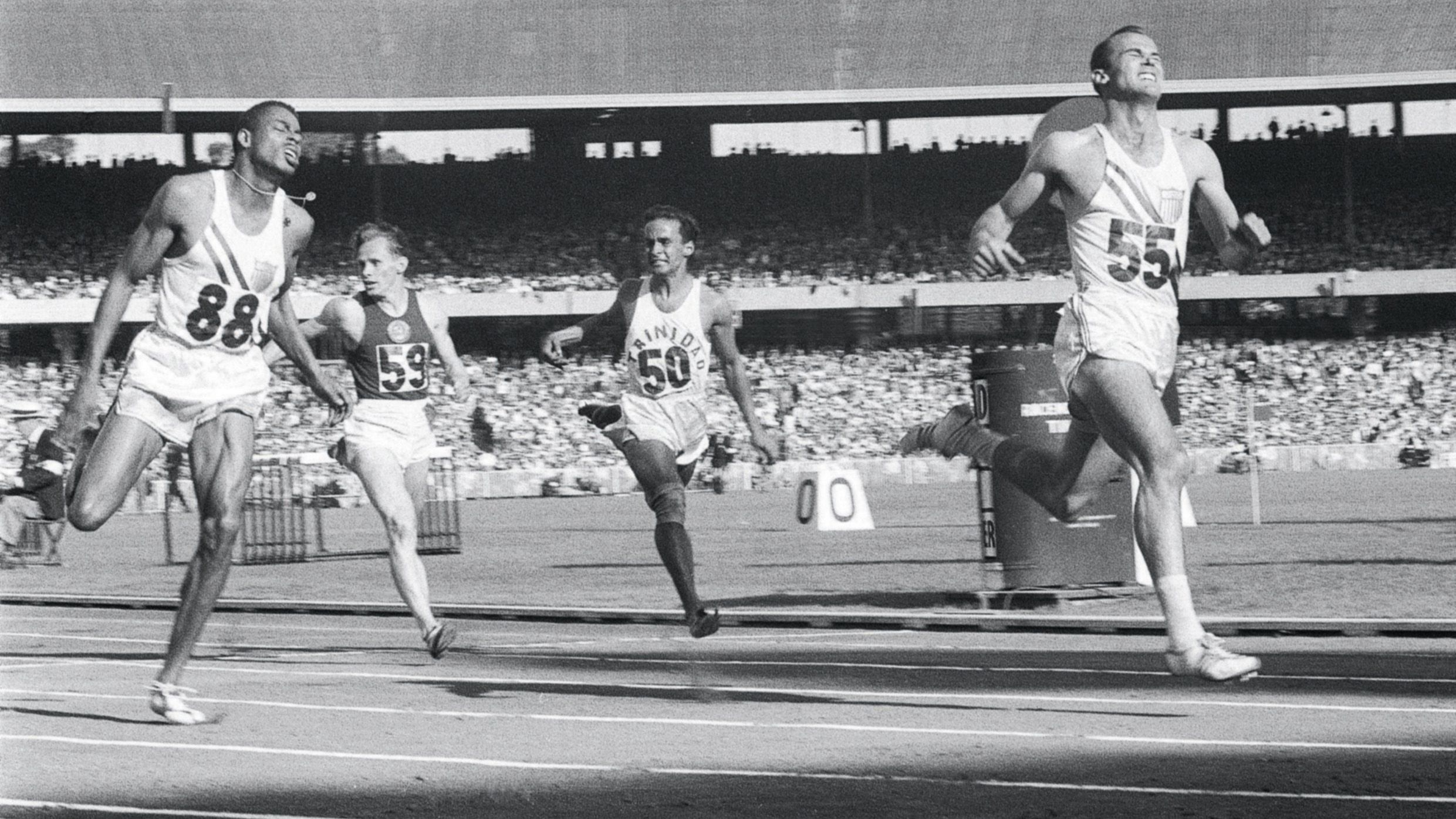
Bobby Morrow in 100m action (© Getty Images)
Just five minutes later, Bobby Morrow responded in the second heat, also clocking 10.2 (the timekeepers recorded 10.1, 10.2 and 10.2, wind -0.4m/s), again equalling the world record he already shared.
The evening final at 9:15pm brought together three men who had all run at world-record speed. Morrow won in 10.3, narrowly defeating Murchison and Baker into a strong headwind. Semi-automatic timing showed 10.28, although modern analysis of the original Pathé newsreel film suggests a performance between 10.45 and 10.50.
By the end of the heats, athletics still had eight recognised holders of the 100m world record, stretching from Jesse Owens in 1936 to the most recent additions, Morrow and Murchison.
9:30pm – Glenn Davis breaks the 50-second barrier
Ninety minutes after the heats, the 400m hurdles final produced another historic breakthrough.
Running side by side for much of the race, Glenn Davis and Eddie Southern both finished well inside the existing world record. Davis crossed first in 49.5, becoming the first athlete in history to run under 50 seconds for the event and lowering the world record by an extraordinary 0.9 seconds. Southern followed in 49.7, also inside the previous global mark.
Southern attacked aggressively from the opening hurdles and drew level with Davis by the third barrier. The pair matched each other stride for stride before Davis gradually edged ahead over the closing hurdles and extended his lead on the run-in.
When the stadium scoreboard initially displayed 49.6, the crowd erupted. The official hand timing was later confirmed as 49.5, sealing another world record.
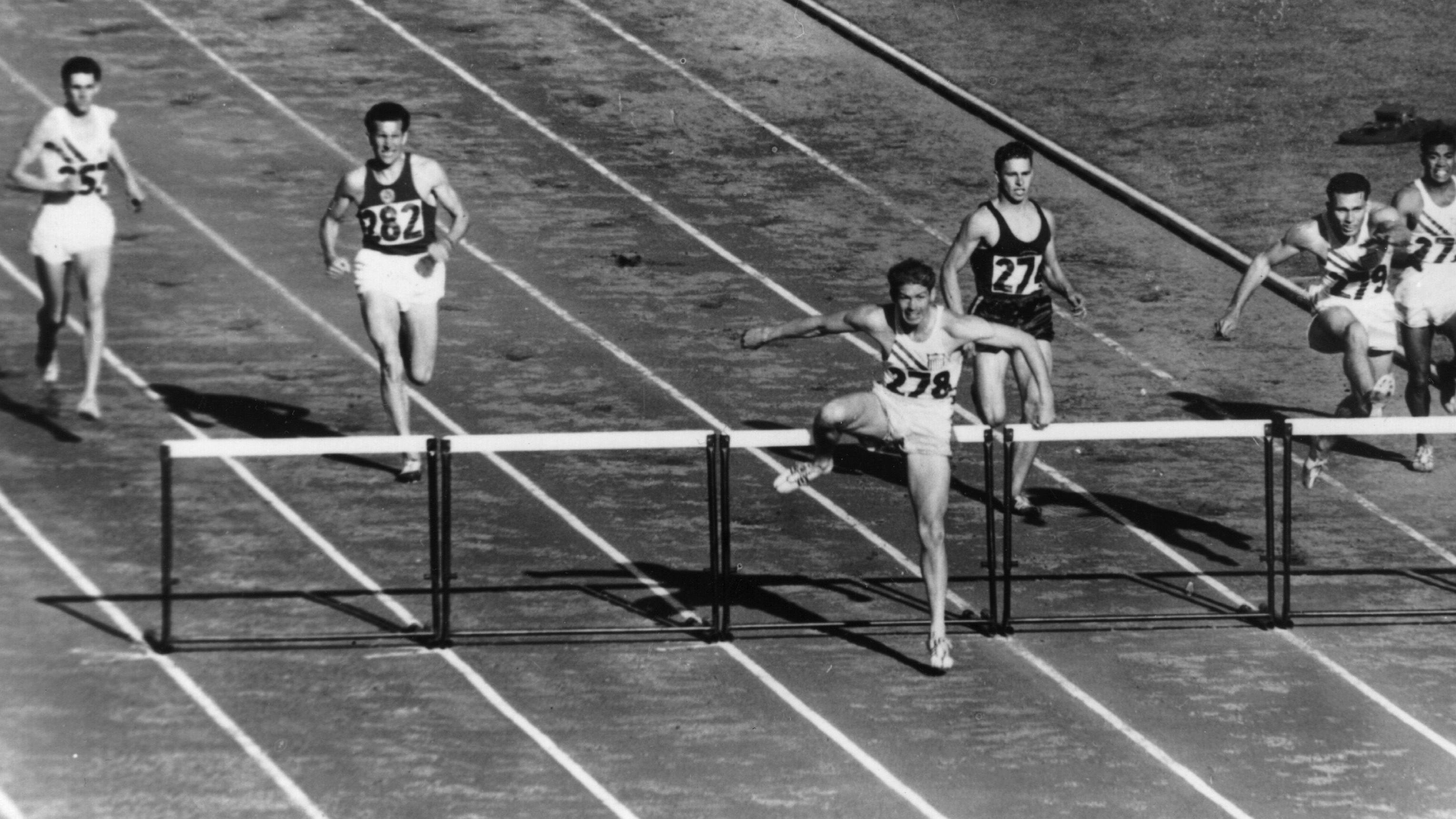
World 400m hurdles record-breaker Glenn Davis (© Getty Images)
10:17pm – Charles Dumas clears seven feet
The evening reached its unforgettable climax in the high jump.
Only 19 years old, Charles Dumas almost failed to compete at all. Arriving at the Coliseum intending to meet his coach Herschel Smith, he discovered Smith was late, paid six dollars for admission himself and persuaded officials to let him into the dressing rooms before the competition had already begun.
Using the straddle technique, Dumas cleared every height on his first attempt until 2.15m, officially recorded as 7ft ½in, although the actual measured clearance was 7ft 5/8in (2.149m) before conversion to metric for world record purposes.
After one failure, he waited five minutes before making history. Taking six measured strides followed by four rapid ones, Dumas sailed over the bar to become the first man officially to clear seven feet.
Spectators rushed towards the high jump area to embrace the young athlete.
Records almost everywhere
The remarkable evening extended well beyond the four world records.
In the shot put, Parry O'Brien threw 18.54m, matching the official world record listed in the programme. However, because his superior throws of 18.62m and 18.69m from earlier that season had yet to be ratified by the international federation, the performance was not submitted as another world record.
The other evening finals also produced a succession of championship or US records in the 5000m, javelin and hammer throw. Only the long jump failed to produce a record of any kind, although it generated its own controversy when Greg Bell and John Bennett finished tied at 7.83m. Rather than separate them on countback, as required under international rules, the organisers declared a dead heat.
The trials selected only the men's US Olympic team for Melbourne. The women's team would instead be chosen two months later, at the national championships in Washington, D.C., on 25 August.
A stadium built for history
Few venues have witnessed more moments of athletics greatness than the Los Angeles Memorial Coliseum. Having staged the Olympic athletics competitions in 1932 and 1984, and doing so again in 2028, the stadium has been the setting for 64 ratified world records, making it the second most prolific athletics venue in history after Stockholm Olympic Stadium.
The action on the evening of 29 June 1956, which was staged within less than two hours, saw four world records fall and two new barriers broken. Ironically, despite the historic performances, the occasion received no live coverage. Neither radio nor television covered Friday night’s programme; the only scheduled television coverage of the two-day trials was a two-hour telecast on Saturday, the second and final day. Those fortunate enough to be among the almost 40,000 spectators inside the Coliseum witnessed one of the greatest nights the sport has ever known.
Pierre-Jean Vazel for World Athletics Heritage