

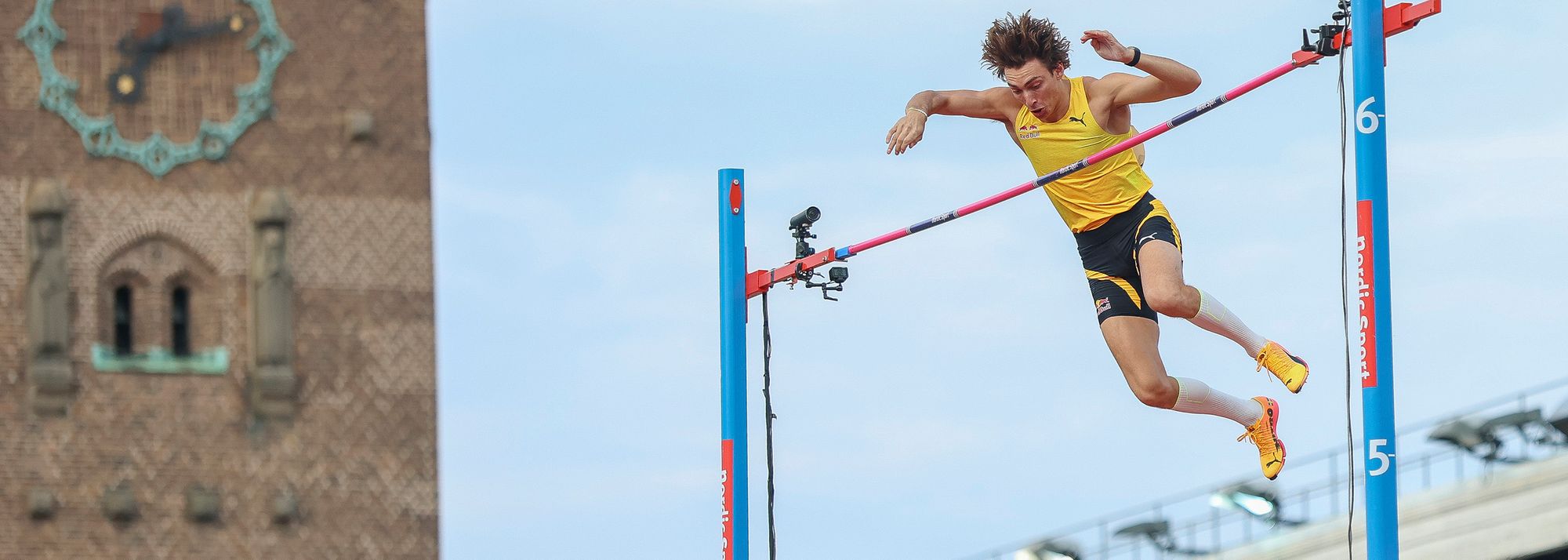


Mondo Duplantis in Stockholm (© AFP / Getty Images)
In Sweden they have a special word for the annual international track and field match that celebrates its 100th birthday in Stockholm this weekend, 22-24 August.
'Finnkampen', the Finn battle, has lived up to its name at times since it was inaugurated in Helsinki in 1925.
Back in 1931 the men’s 800m turned into a fistfight, while in 1992 the entire field for the men’s 1500m was disqualified for indulging in roughhouse tactics.
And yet, to Mondo Duplantis, one of the many stellar athletes who have graced the oldest surviving international match, the yearly fight for Nordic supremacy holds an almost mystical attraction.
In announcing his intention to fit this year’s centenary match on home soil into his preparations for the World Athletics Championships Tokyo 25, taking place in the Japanese capital from 13-21 September, the prince of the pole vault pondered: “Finnkampen, for me, it’s a folk festival and a very fun competition where the team is the important thing.
“Most often you compete alone, even if you represent Sweden at a championship, but this is completely different. There is something magical about the whole Finnkampen. There is something cool, with the long history.”
Duplantis happens to occupy a special place in the folklore of Finnkampen – or 'Ruotsi-otellu', the Sweden match, as it is known in Finland.
In 2015 he became the youngest male competitor in the long history of the contest, earning third place in the pole vault with a clearance of 5.17m at the age of 15 years 307 days.
The day before, Duplantis had vaulted 4.74m to take maximum points in his event in the U18 international that is held alongside the annual senior match.
Those were his first two appearances at the 1912 Olympic Stadium in Stockholm, where he achieved his 12th world record of 6.28m at this year’s BAUHAUS-Galan Wanda Diamond League meeting on 15 June.
The hallowed home of Swedish track and field will provide the suitably evocative setting for what is sure to be an emotionally-charged centenary tussle.
Both days have sold out and before the action on Sunday, the home team is due to perform a specially composed anthem with Swedish singer-songwriters The Tallest Man on Earth and Moonica Mac.
The beautifully written Ni ha ross I ryggen, You Have Our Backs, includes the line: “Over the rust-red temple, the sun shines yellow and sky blue.”
World Athletics Heritage Plaque
It was the blue and white of the home side that prevailed in the 1952 Olympic Stadium in Helsinki last year, Finland emerging victorious from both the men’s and women’s competitions for the first time since 1998.
Their ranks in Stockholm will be boosted by the return to international competition of world pole vault bronze medallist Wilma Murto, who underwent knee surgery in May and will take on Johanna Duplantis, Mondo’s sister, among others.
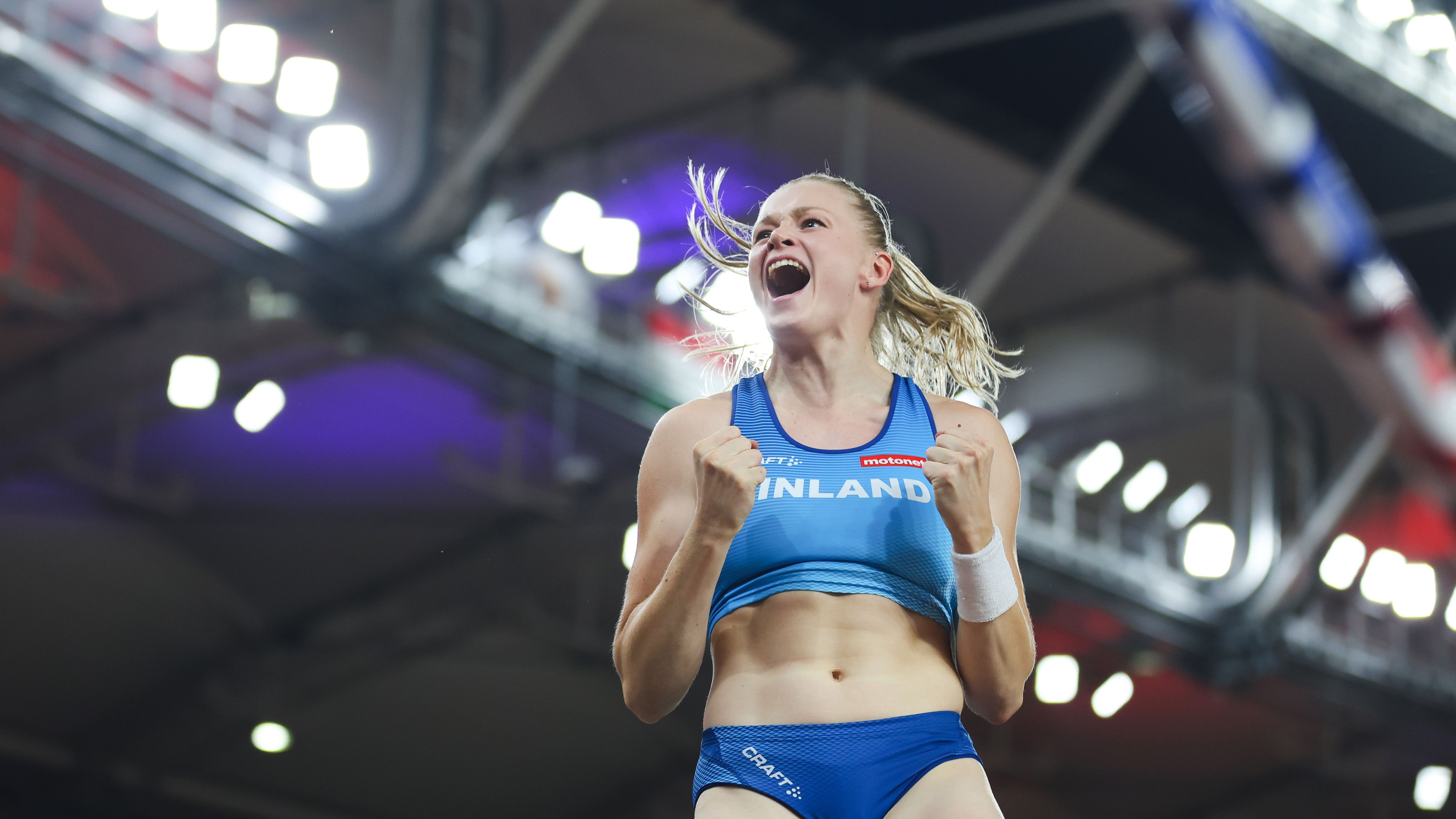
Wilma Murto at the World Athletics Championships Budapest 23 (© Getty Images)
Murto, who cleared 4.45m off a short approach at the Oulu Grand Prix on 13 August, is on the comeback trail guided by an expanded coaching team that includes Tero Pitkamaki, an eight-time Ruotsi-otellu winner in the men’s javelin.
“Tero’s helping me with the physical side of things, which is what I need support for,” Murto explained, for the benefit of those wondering why she has enlisted the assistance of the 2007 world champion in the men’s javelin.
The Finns were helped to victory by one of their all-time greats when they emerged victorious from their first encounter with the Swedes, which was held in Helsinki on 5-6 September 1925.
The Elaintarha Zoological Sports Ground, now a warm-up facility for the nearby Olympic Stadium in the Finnish capital, was presented with a World Athletics Heritage Plaque in 2022 in recognition of its role as the inaugural venue for Finland vs Sweden, which is the world’s oldest international match.
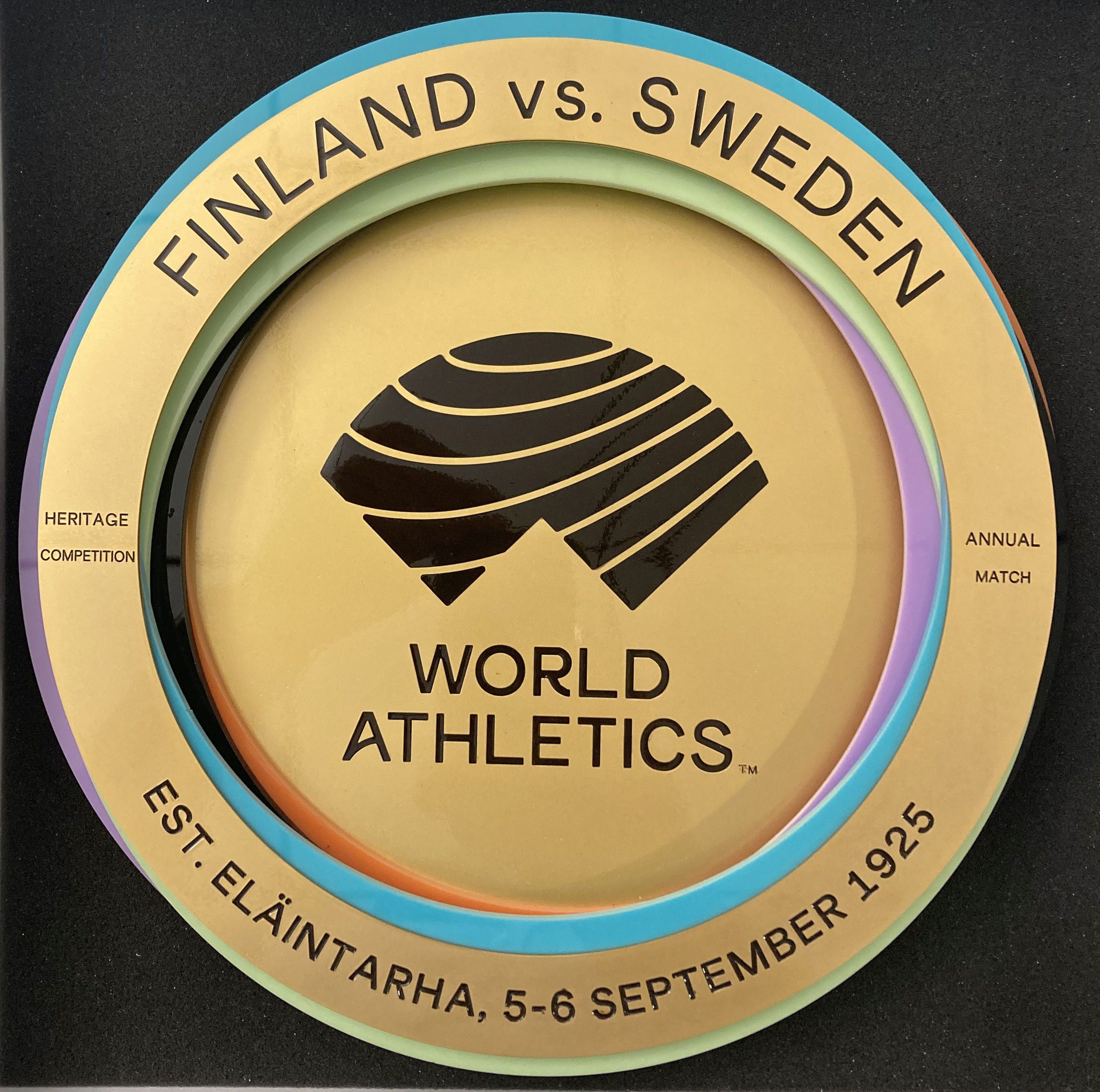
Finland vs Sweden - Heritage Plaque
Nurmi
The sylvan setting was familiar territory to Paavo Nurmi, who emerged as the star of the two-day show.
The 28-year-old from Turku had made his mark at Elaintarha in 1924 by setting world records at 1500m and 5000m within an hour of each other, in preparation for the demanding Olympic schedule in Paris, where he proceeded to plunder a record five track and field gold medals.
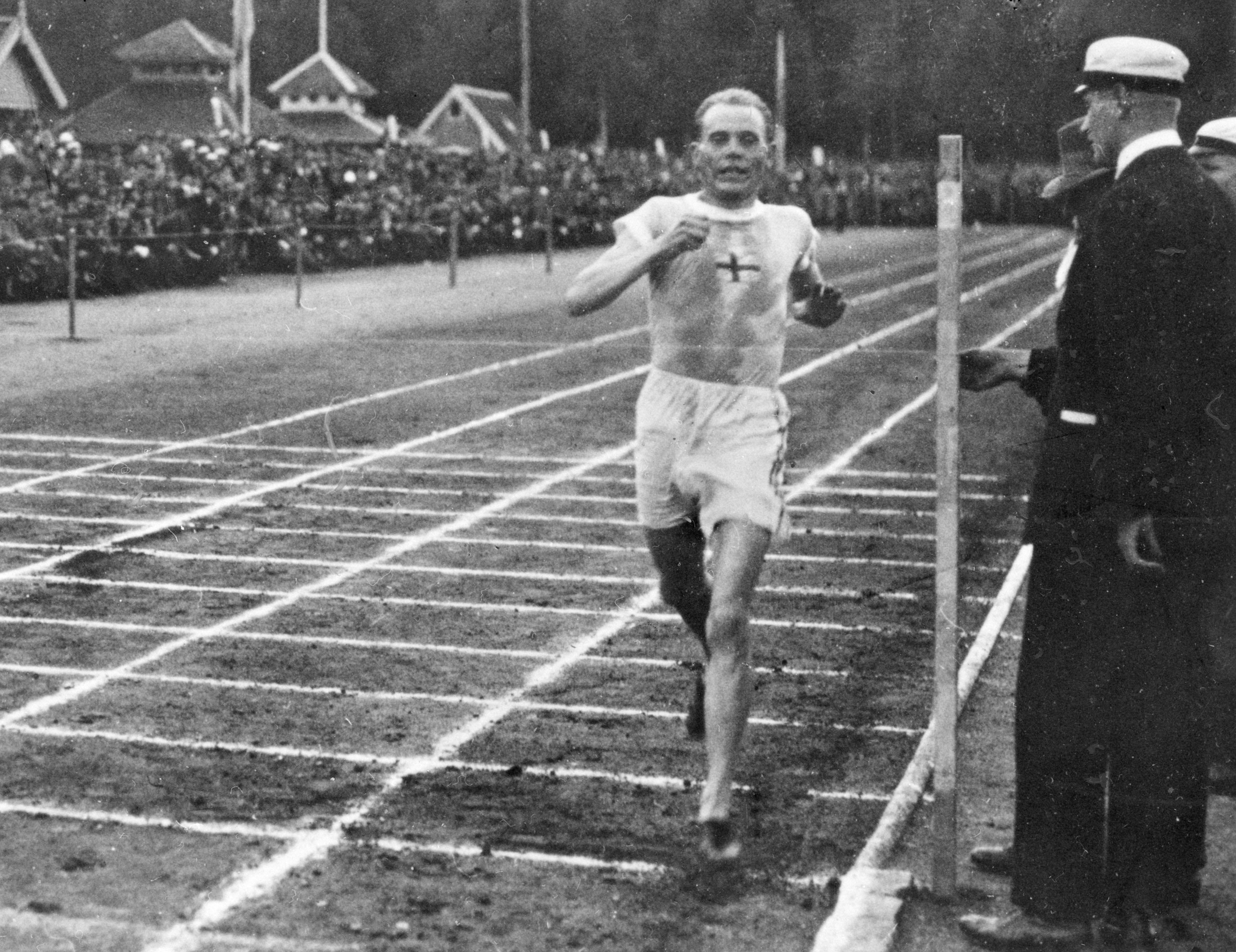
Paavo Nurmi in action in the 1925 Finnkampen (© TAHTO)
He returned to the picturesque Helsinki track in early September 1925 somewhat jaded on his legendary tour of North America in which he set 30 world indoor marks in 53 races – an epic venture superbly chronicled in the recently-published 'Phantom Finn', by the leading Finnish sports historian and author Kalle Virtapohja.
Nurmi won the 5000m and the 10,000m, looking so effortless in the opening laps of the longer event that someone shouted from the stands: “Nurmi, is your watch slow?” He won by almost a minute in 30:40.2, a time only surpassed by himself and his compatriot Ville Ritola.
Finland won the match by 99 points to 85. They lead Sweden 47-37 in the men’s competition but the Swedes have been the dominant force in the women’s section, which was introduced in 1953, with a running tally of 43-26.
Overall, the combined score stands at 80-73 in favour of Sweden.
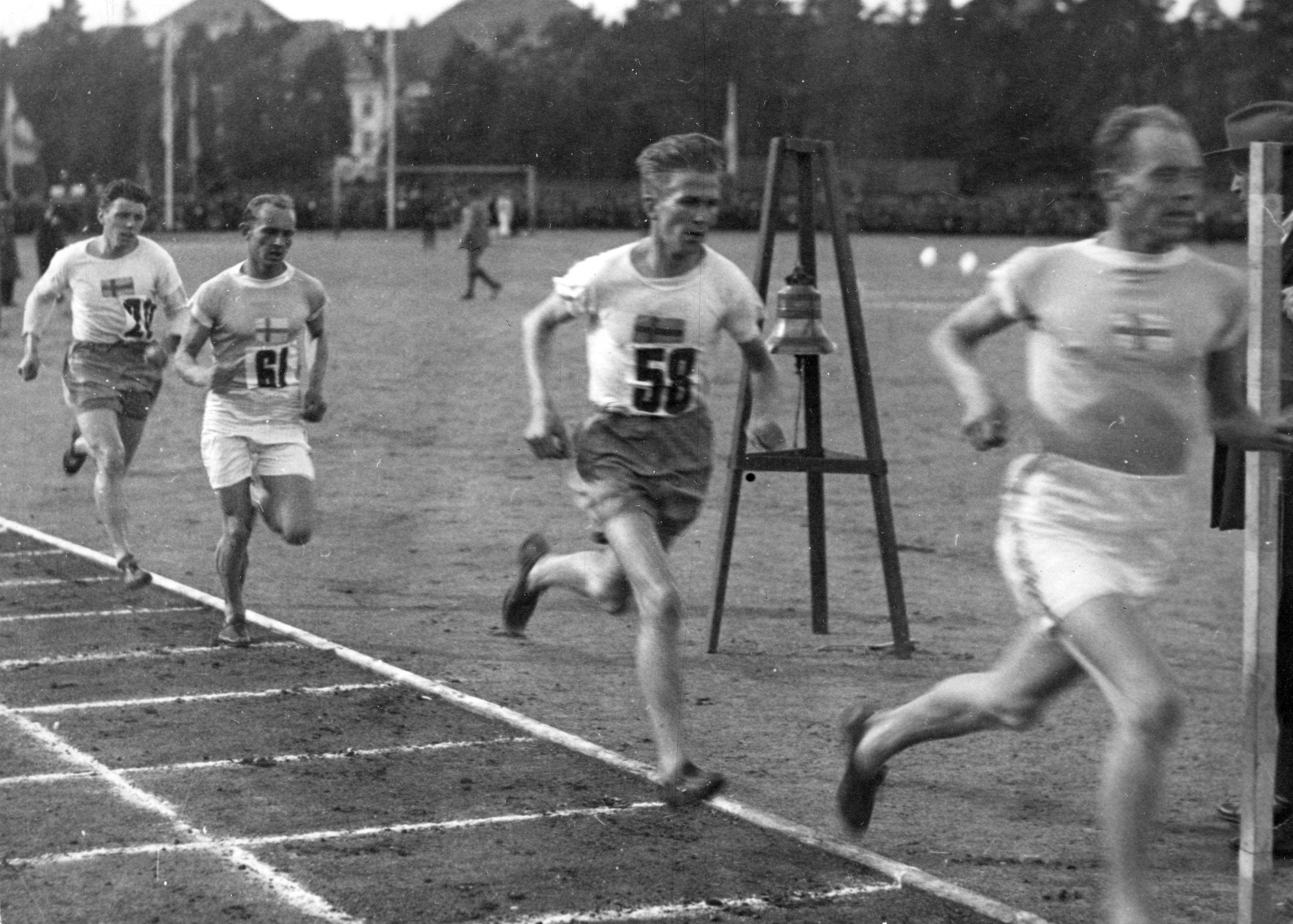
Paavo Nurmi in action in the 1925 Finnkampen (© TAHTO)
8 million spectators
The match was not held from 1932 to 1939 in the aftermath of the 800m fist fight in 1931 and the festering of a strained relationship that further deteriorated when the IAAF, led by their Swedish president Sigfrid Edstrom, banned Nurmi from the 1932 Olympics on the grounds of professionalism.
Thankfully, open antagonism has given way to a keen, respectful rivalry that has made the annual meeting a throwback to track and field days of yore, when international matches were the staple competitive fare outside of the quadrennial Olympic Games.
The two nations each field three athletes in individual events and the outcome of the match can be as dependent upon second or third-string athletes raising their game to earn precious points.
The formula, the historic rivalry and the folk festival feel has been responsible for attracting 8 million spectators to the 84 matches held so far.
Among the sell-out crowd in Stockholm for the centenary occasion will be the man who has plundered the most points in the 100-year history of the event.
A world indoor silver medallist at 200m and 400m, Johan Wissman racked up a record tally of 167.25 points during 16 Finnkampen competitions.
“It’s one of the cooler sporting achievements I have,” said the former Swedish sprinter, now a 42-year-old firefighter and 3:16 finisher in this year’s Stockholm Marathon.
Simon Turnbull for World Athletics Heritage