

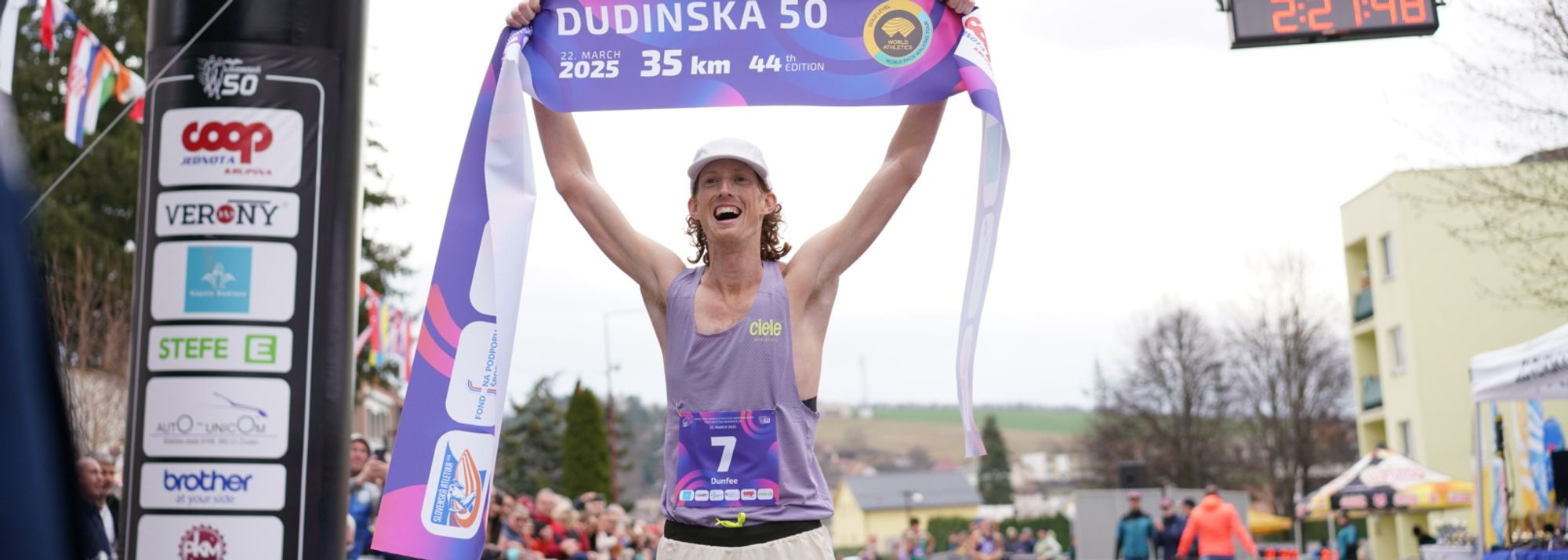


Evan Dunfee in Dudince (© Milan Duroch)
When Evan Dunfee was a fourth-grade student at Kingswood Elementary, his teacher would give him a popsicle stick for every 500m lap of the school yard that he ran during recess or lunch break.
It motivated the nine-year-old son of an Olympic swimming coach and great, great nephew of an Olympic marathon runner to join a sports club, with the aim of making it to the very top one day.
‘Inside a world-record schedule’
Within a year, Dunfee was winning age-grade race walks as a member of the Kajak Track and Field Club in Richmond, British Columbia – across the Fraser River from Vancouver in the south west corner of Canada.
It took the popsicle stick kid two-and-a-half decades to reach the global pinnacle in his sport.
Dunfee was into his 35th year when he set out on the first of 35 laps of the men’s 35km at the prestigious ‘Dudince 50’ World Athletics Race Walking Tour Gold meeting on 22 March last year.
This time, on each circuit of the southern Slovakian spa town, the Canadian was rewarded not with tally tokens but with kilometre splits inside world record schedule.
Passing 1km in 4:09, 3km in 12:15, and 5km in 20:18, he was 76 seconds clear of the field when he reached 10km in 40:22.
Dunfee crossed the Dudince finish line in 2:21:40 – seven seconds inside the global mark set by Japan’s Masatora Kawano in Takahata in October 2024.
“I was well under pace but lost a little time over the last seven kilometres,” he reflected. “I got a little stressed out then, but it was a dream come true in the end.”
Champion through pain
A world record-holder at the age of 34, Dunfee fulfilled another dream four months later, pushing through the pain barrier to become a world champion for the first time.
Despite tearing his left hamstring with two kilometres to go, he gritted his teeth and held on to win the men’s 35km race walk, the opening event of the World Athletics Championships Tokyo 25.
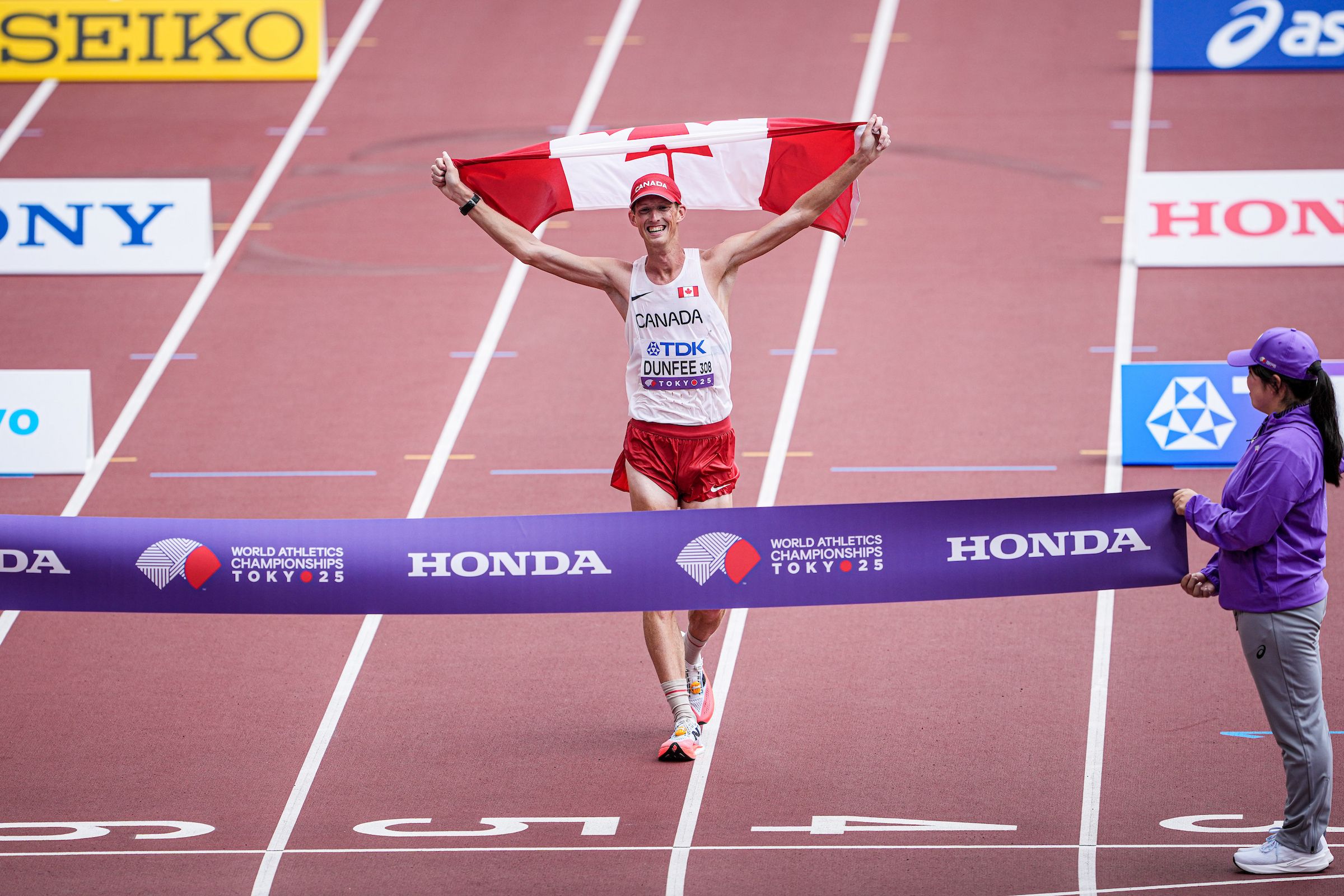
Evan Dunfee wins the 35km race walk in Tokyo (© World Athletics  Pamela Smith)
Upon arrival in Japan, Dunfee kindly agreed to donate mementoes from his world record performance in Dudince to the Museum of World Athletics.
The bib and cap he wore that day stand in the glittering Heritage collection as tokens of the prolonged resilience and determination that can be required to make it to the very top in athletics.
More marathon than sprint
Dunfee first wore the Maple Leaf motif at global level at the World U18 Championships in Ostrava in 2007, placing a modest 23rd in the 10,000m track race walk.
At those same championships, Grenadian schoolboy Kirani James finished runner-up in the 400m final. Just four years later, he was a senior world champion at the age of 18.
Dunfee’s path to the global summit has been more of a marathon sojourn than a sprint.
“My coach and I have been together since I was 10,” he reflected in the aftermath of his Tokyo triumph, referring to his long-time guiding light, Gerry Dragomir.
“We set goals to become world champion and to set a world record and we managed to do both this year. It really is a dream come true.
“I am turning 35 this year but I just feel like I am getting better and better.”
Dunfee turned 35 just 15 days after his victory in the Japanese capital. He’s no longer a world record-holder, his 35km time in Dudince having been eclipsed by Italian Massimo Stano’s 2:20:43 in Podebrady in May.
A bronze medallist at 50km at both the 2019 World Championships and delayed 2020 Olympics, the veteran Canadian would seem ideally suited to the marathon distance that, together with the half marathon, will become a standard major championship race walk event from 2026 onwards.
He happens to be blessed with the sporting genes of not just his father, Don Dunfee, an international swimmer who coached the Canadian swimming team at the 1972 Olympics in Munich, but also those of his great, great uncle, William ‘Rover’ Forsyth, who finished 15th in the 1912 Olympic marathon in Stockholm.
Nicknamed for his penchant for roaming the wilds of the Canadian countryside, Forsyth also won titles at state and national level as a discus thrower and pole vaulter, earning a place in the Saskatchewan Sports Hall of Fame.
Rover’s great, great nephew – Evan Forsyth Dunfee – race walked the 2025 Vancouver Marathon in 2:58:57 in May, affording the wider athletics fraternity a keen perspective on the scope of his talent.
“I’m working really hard on being better at being proud of myself, and this was an effort I’m proud of,” he confessed on Instagram. “Sub-three-hour marathoner – that has a really nice ring to it.”
Dunfee has done a good deal more to make his family truly proud of him.
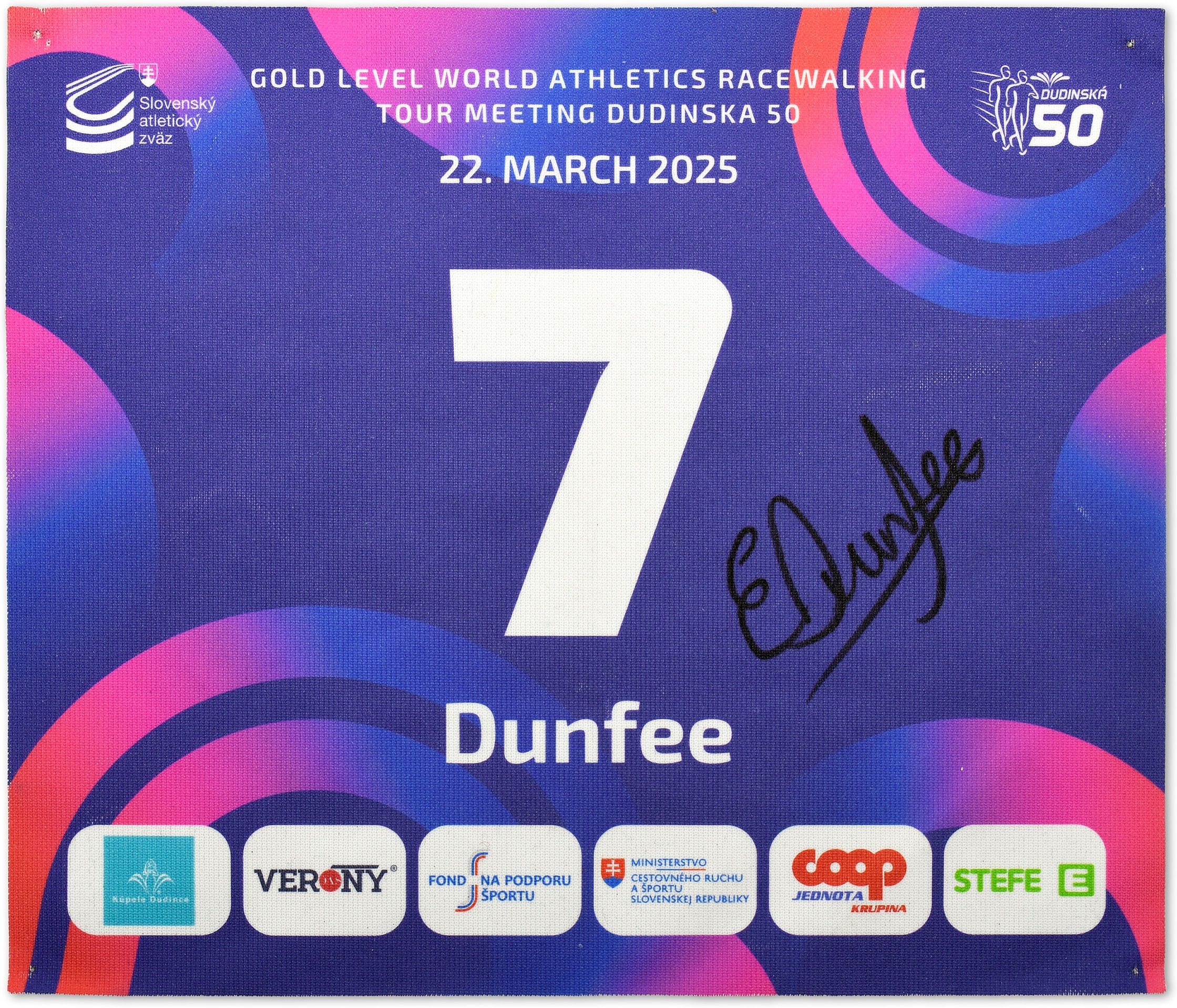
Evan Dunfee’s signed race walk world record bib (© MOWA)
Integrity and giving back
After crossing the line an exhausted fourth in the men’s 50km event at the 2016 Olympics in Rio de Janeiro, he was briefly promoted to the bronze medal position when the race referee ruled that Hirooki Arai had made contact with Dunfee in their neck-and-neck battle for third spot.
When a Japanese appeal overturned the disqualification, Dunfee dissuaded the Canadian team from appealing the case to the Court of Arbitration for Sport, fulsomely congratulating his rival on securing bronze.
“Contact is part of our event and I don’t believe this was malicious or done with intent,” he said. “I will sleep soundly tonight, and for the rest of my life, knowing I made the right decision.”
A shining role model, Dunfee raised more than $50,000 for the Canadian charity KidSport by marking its 25th anniversary by walking 25km a day for 25 days. He also spoke to 100,000 children at 25 schools about the value of sport and goal setting.
As a coach at the Richmond Kajaks, also the club of world and Olympic hammer champion Camryn Rogers, Dunfee is determined to further inspire the next generation at grassroots level.
Like his father before him, he has already coached to Olympic level, guiding fellow British Columbian Olivia Lundman to selection for the marathon relay mixed race walk in Paris last year.
Simon Turnbull for World Athletics Heritage