

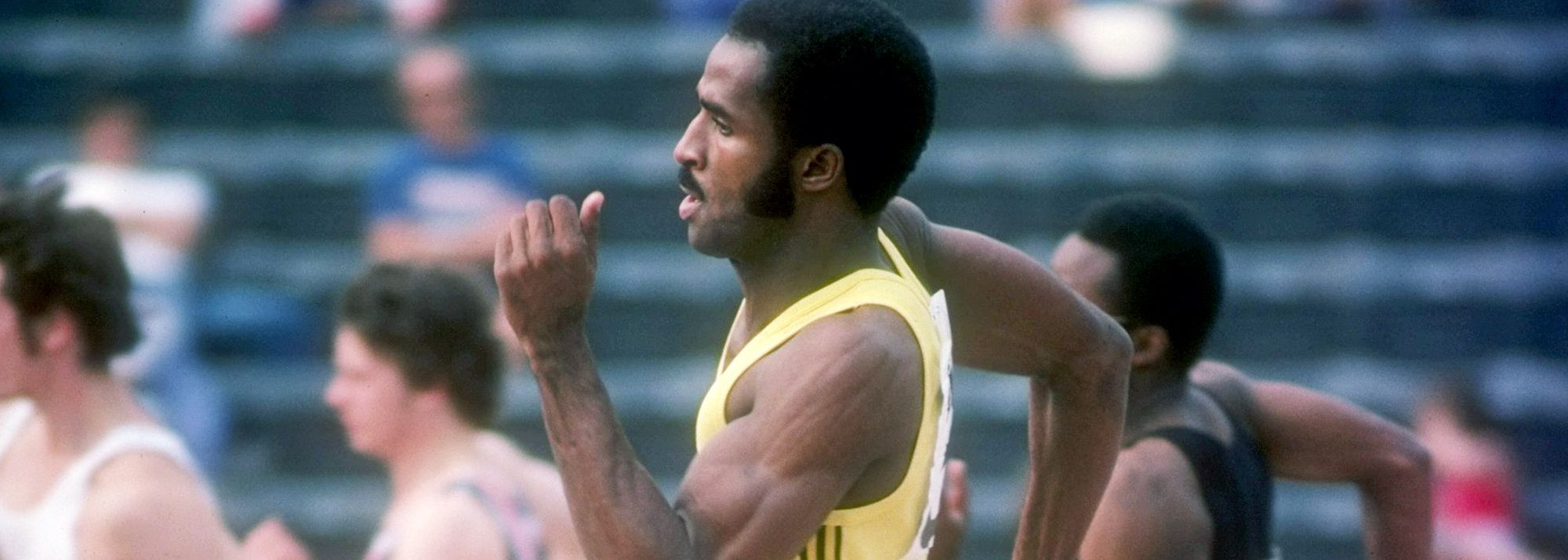


Jamaican sprinter Don Quarrie (© Getty Images)
After a restless night in the athletes’ village, during which he had got up to change his kit six or seven times, read the Bible and ultimately been tied to his bed by his Trinidad and Tobago teammates, Hasely Crawford breezed into the call room ahead of the men’s 100m final at the 1976 Olympic Games, singing at the top of his voice.
“Don Quarrie turned to me and said, ‘You’re crazy’,” Crawford recalled in Neil Duncanson’s classic television documentary The Fastest Men on Earth. “I said, ‘You think I’m crazy! See how crazy when I go out there with you!’”
Halfway down the home straight, Quarrie – running in lane four – caught sight of Valeriy Borzov in front of him. “I thought, ‘Oh, no! He’s not going to win again?’” he later recalled.
In Munich four years previously, the Soviet sprinter had achieved the 100m-200m double, prompting the New York Times headline: “The Fastest Human is a Commie.”
Quarrie had been in Borzov’s 200m semifinal in Munich but pulled a hamstring and was wheeled away on a stretcher. Four years before that, the smooth-striding, placid-natured Jamaican had been selected for the 4x100m relay as a 17-year-old, but was injured in training and missed the Mexico Olympic Games of 1968.
In the 100m final in Montreal, Quarrie shifted up a gear and caught Borzov. “In going by him, I figured I got it won,” he said, recalling the glint of golden promise that July day in 1976. “But then I saw Hasely...”
Running in lane one, Crawford had stolen a march on the field. Quarrie made one last effort, but as he lunged for the line he looked across to see Crawford raising his right arm in triumph. His Caribbean rival prevailed by 0.01: 10.06 to 10.07. Quarrie’s Olympic curse had struck again.
It didn’t last much longer.
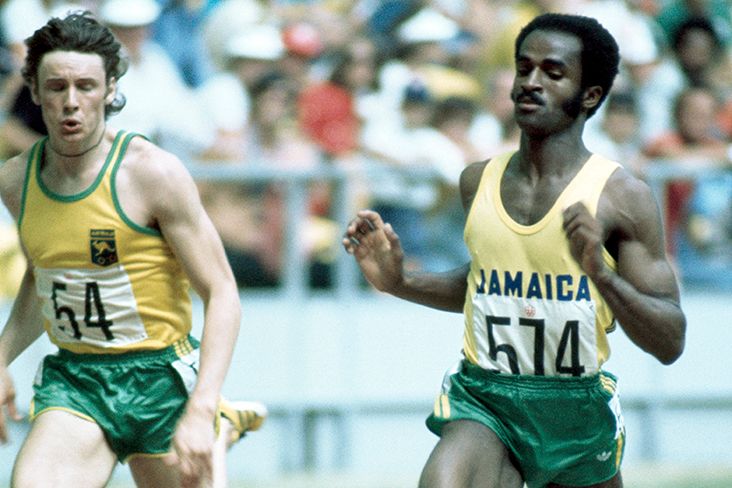
Jamaican sprinter Don Quarrie
In the 200m final two days later, Quarrie was a class apart. Drawn in lane two, with Italy’s Pietro Mennea inside him, he sailed around the curve in his customary graceful fashion, pulling a stride clear of his closest pursuer, Millard Hampton.
The 20-year-old US sprinter reduced the gap down the home straight, but Quarrie had the strength to resist his challenge, crossing the line in 20.23. Hampton was second in 20.26, with his 17-year-old US teammate Dwayne Evans third in 20.43 and Mennea fourth in 20.54.
Wearing the bright yellow Jamaican team tracksuit he has kindly donated to the Museum of World Athletics, together with a 1976 Olympic participant’s pin badge, 25-year-old Donald O’Reilly Quarrie – the pride of his native Kingston and beyond – finally got his hands on Olympic gold.
“When I crossed the finish line I remember thinking Jamaica will be happy, especially after the disappointment of 1972 and the build-up of me being the favourite for Montreal,” he recalled in an interview with Sports Jamaica. “I was happy that I could win for the country.”
And Jamaica was happy for him.
A bronze statue of Quarrie was erected at the entrance to the National Stadium. A school was named after him in eastern Kingston. And reggae artists Bongo Herman, and Joe Gibbs and The Guerrillas, both struck up tracks in his honour. “Tribute to Donald Quarrie” celebrates how the Kingston boy “beat them all, up at Montreal.”
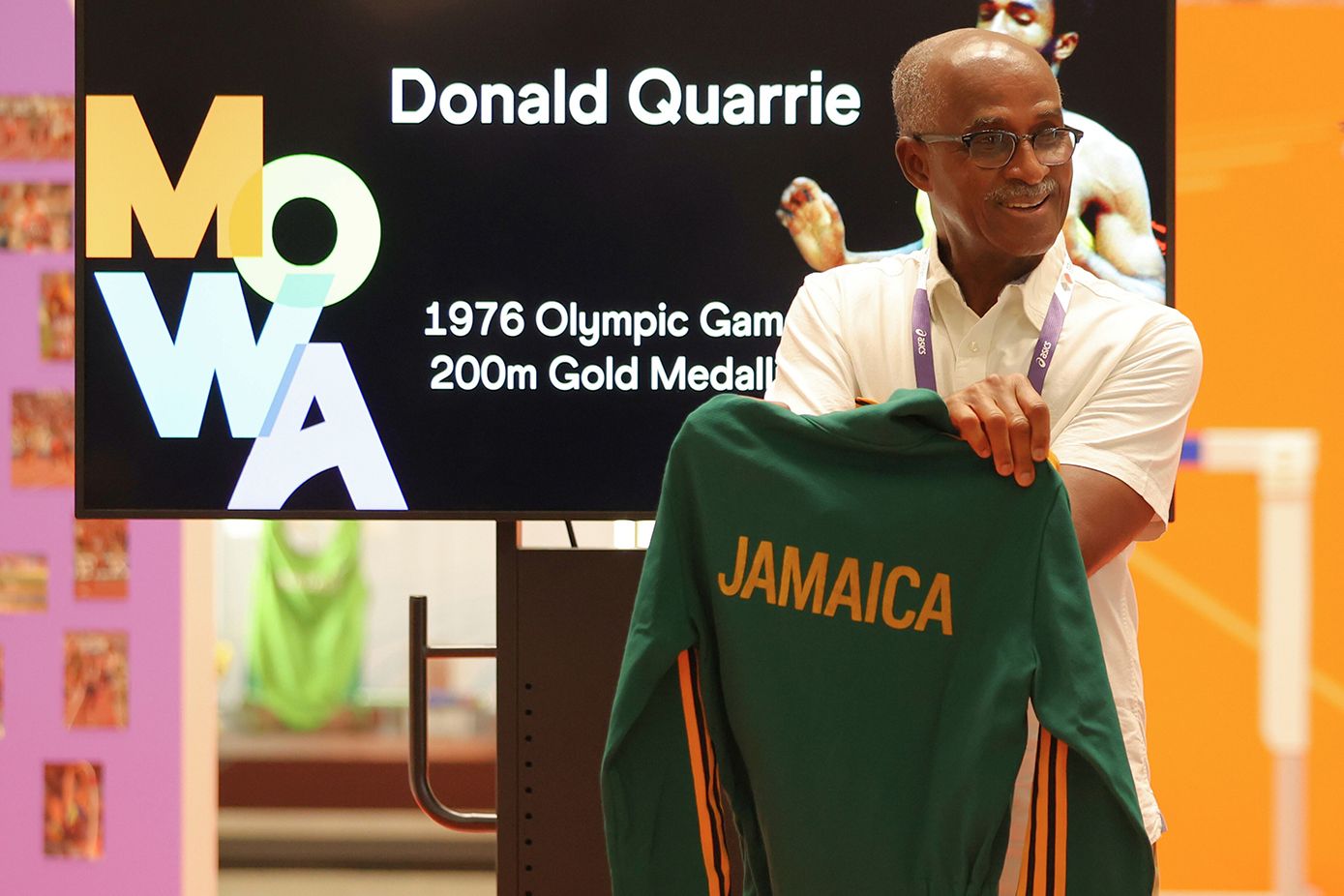
Don Quarrie donates his 1976 Olympic tracksuit to MOWA
Not that anyone noticed at the time, but there was a fleeting moment when Quarrie missed a beat in that 200m final in Montreal: when Crawford, outside him in lane five, pulled up injured after 50 metres.
“I had an excellent start,” Quarrie recalled. “I got out well. But I backed off a bit as I saw Hasely jump up. It was a reflex action, that pause. I think that’s why I did not come off the curve better.”
He came off well enough, though, before drawing on the strength that had long been a hallmark of his sprinting. That endurance, he suggested in an interview in World Athletics’ Legends of Athletics series, had been forged in the summer holiday after he took up sprinting in his second year at Camperdown High School.
“I spent my whole summer getting up and running three or four miles, up in the hills or on the beach,” Quarrie recalled. “That made me so much stronger that once I got into the High School Championships, I more or less dominated it.”
Quarrie’s potent blend of speed and strength took him to two further Olympic medals: 200m bronze behind Mennea and Britain’s Allan Wells in Moscow in 1980, and 4x100m relay silver in Los Angeles in 1984.
In a long career of sustained sprinting excellence, he racked up six Commonwealth Games gold medals: 100m, 200m and 4x100m relay as a 19-year-old in Edinburgh in 1970, 100m and 200m in Christchurch in 1974, and 100m in Edmonton in 1978.
The sprint and relay treble Quarrie achieved at the 1971 Pan American Games in Cali included a 19.8 200m, equalling Tommie Smith’s hand-timed world record. His automatic time of 19.86 was just 0.03 outside Smith’s winning time from the 1968 Olympic Games in Mexico City.
Having spent several years mixing it with the best of the US as a collegiate sprint star at the University of Nebraska and the University of Southern California, Quarrie also claimed a share of the 100m world record when he clocked 9.9 at Modesto in May 1976 – two months before striking Olympic gold in Montreal.
It was one of nine hand-timed 9.9 performances to be ratified as a world record, alongside those by US sprinters Jim Hines, Ronnie Ray Smith, Charlie Greene, Eddie Hart, Ray Robinson, Steve Williams and Harvey Glance, and Cuba’s Silvio Leonard. Quarrie’s was the last of them.
Simon Turnbull for World Athletics