

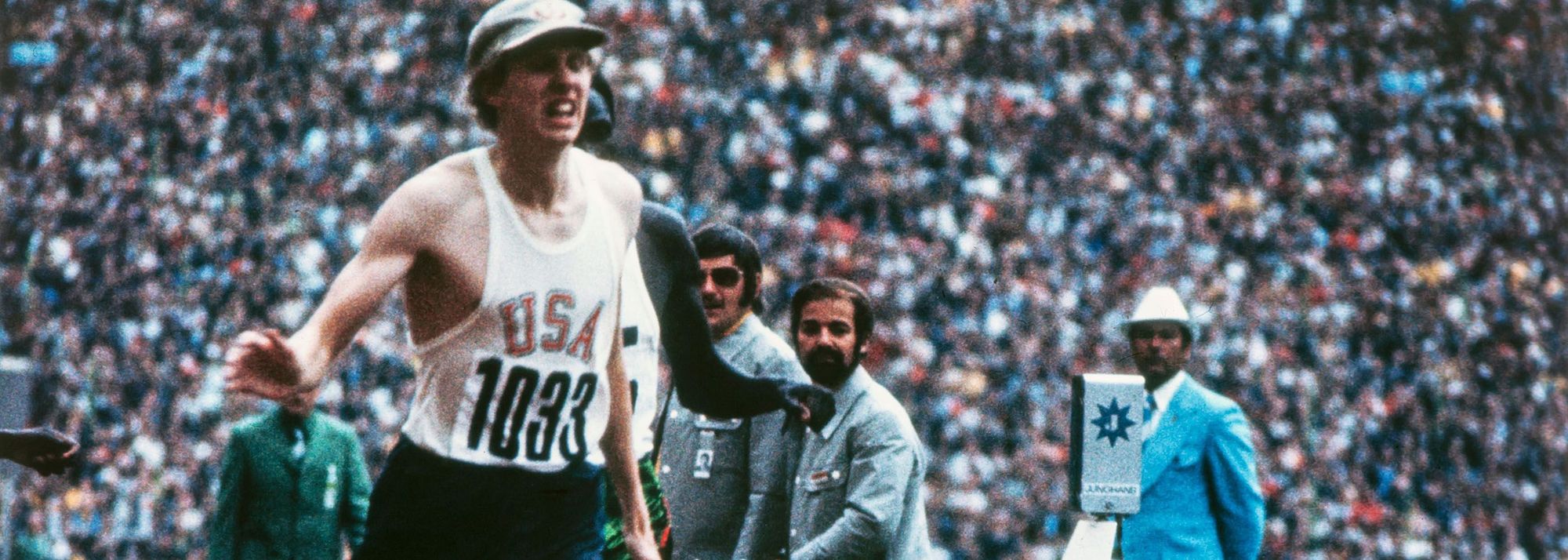


Dave Wottle wins the Olympic 800m title at the 1972 Games in Munich (© AFP / Getty Images)
It was 1 August 1972, a month after Dave Wottle had stunned himself and the global track and field community by equalling the world 800m record at the US Olympic Trials in Eugene. On the eve of a two-day pre-Olympic international meet in Oslo, however, the 21-year-old Bowling Green State University history student appeared to be on a very different trajectory.
Filing his despatch for The New York Times, Neil Amdur put it starkly: “The honeymoon is still on for Dave Wottle, but his hopes for an Olympic gold medal may be over.”
Interviewed in his second-floor dormitory at the local university housing the USA track and field team, Wottle told the man from The New York Times that he had been unable to train properly for three weeks because of chronic tendonitis in his left knee. The 21-year-old Bowling Green State University history student had withdrawn from the 3000m at the Bislett Stadium meet, the opening date on his pre-Olympic European schedule. He was seriously contemplating withdrawing from the 1500m in Munich and was gravely concerned about his prospects of being fit for the 800m.
“I’m down psychologically, because I’ve missed so many workouts,” Wottle confessed. “Unless I get in a few good workouts and races between now and the Olympics, I’ll go into the races in Munich thinking I’m out of shape and can’t stick with the pace.”
Prophetic words, given what was to unfold on the opening lap of the miraculous 800m final in the Olympiastadion just four weeks later, on Saturday 2 September.
On that opening day in August, however, a week ahead of his 22nd birthday, the stricken Wottle was at a low ebb. “I am kind of down now,” he conceded. “I don’t think my chances are that good, I feel my body getting out of shape and I can’t do anything about it.”
Memories were quickly fading of Wottle’s sensational world record-equalling victory in his secondary event in the trials at Hayward Field exactly one month earlier. He only entered the 800m as a sharpener for the 1500m, having scraped the qualifying time by 0.2 with a winning PB of 1:47.5 at the AAU Championships in Seattle, and his sole aim was to “hypnotise” himself on the back of Jim Ryun, whose world record-breaking deeds as a teenager inspired him to take up track, and see what happened.
What transpired was Ryun searing through 200m in 25.2, 400m in 52.2 and 600m in 1:17.7 (with a vital 25.5 split) before Wottle catapulted past the 1500m, mile and 880 yards world record-holder off the final bend to finish some five metres clear of the field in 1:44.3, matching the global mark jointly held by the New Zealand icon Peter Snell and Australia’s Ralph Doubell. The 13,000-strong crowd were as stunned as Ryun, who faded to fourth in 1:45.2 – overtaken by Rick Wohlhuter (a distant second in 1:45.0) and Ken Swenson (third in 1:45.1) – and indeed as the winner himself, who jogged casually back round the track seemingly in a daze.
Wearing what was to become his trademark cream-coloured golf cap, Wottle the Throttle had eclipsed the one-time Wichita Wunderkind. “I didn’t even know what the world record was for 800m,” he said. “I never thought I could run that fast over two laps. I’m not a half miler. I’m a miler.”
Winner of the Dream Mile ahead of a struggling Ryun at the International Freedom Games in Philadelphia in May, Wottle subsequently secured his Olympic place at 1500m as runner-up to the 1968 silver medallist. Then he married his girlfriend, Jan, taking his bride with him to Europe on honeymoon for the build-up and duration of the Munich Games.
As well as battling tendonitis, he had to contend with the ire of the US team’s head coach. On the day of Wottle’s wedding, six days after the trials, Bill Bowerman boomed: “He’s traded gold medal for a wife.”
A further tirade was to come from the legendary Oregon coach and co-founder of Nike when the US team made it to Munich, which Wottle happily managed to do. Running on the fumes of a 13-15-mile weekly training regime (drastically down from his customary 70-75), he tested himself over 800m in Stockholm on 14 August. His time was a modest 1:48.7 (behind Wohlhuter’s 1:48.2) but he was back on a competitive track – in a singlet he has kindly donated to the Museum of World Athletics, marking a significant step in his unlikely Munich success story.
He also tested his endurance with a 14:25 trial over 5000m at the US squad’s Bavarian training base on 18 August. Not that Bowerman was impressed.
“Dave Wottle is having a nice honeymoon, but he’ll be lucky to get past the first round of the 800m,” the head coach told the press, upon arrival in Munich. “I don’t want anyone to get the idea that I’m a prude; I’m as interested in sex as anybody,” he added. “But the most important thing we’re doing here is competing in the Olympic Games. We should remember that.”
The rest is track and field history. Wottle got past the first round of the 800m, and the semi-final – just, sneaking through on the inside to qualify after being boxed in fourth at the head of the home straight.
Then, after being 15 metres adrift of the field after 200m and still last at the bell, he managed to work his way through from fourth off the last bend in the final to snatch victory from the Soviet favourite Yevgeny Arzhanov – unbeaten in three years – with his final stride. A week later he was unable to make up the last ground in his 1500m semi-final, but the golf-capped crusader had his gold medal and his place in the history books.
“I went out so slow, I was thinking, 'You’re going to go home in disgrace,” Wottle recalled of his two-lap tour de force in later years. “All I wanted to do was get back to the pack and make it respectable. At the start of the home straight I was going all out for the bronze medal. I didn’t realise I was going for the gold medal until three metres from the line...
“There I was, a little hick from Canton, Ohio – a 4:20 miler in high school – and I managed to win an Olympic gold medal.”
Simon Turnbull for World Athletics Heritage