

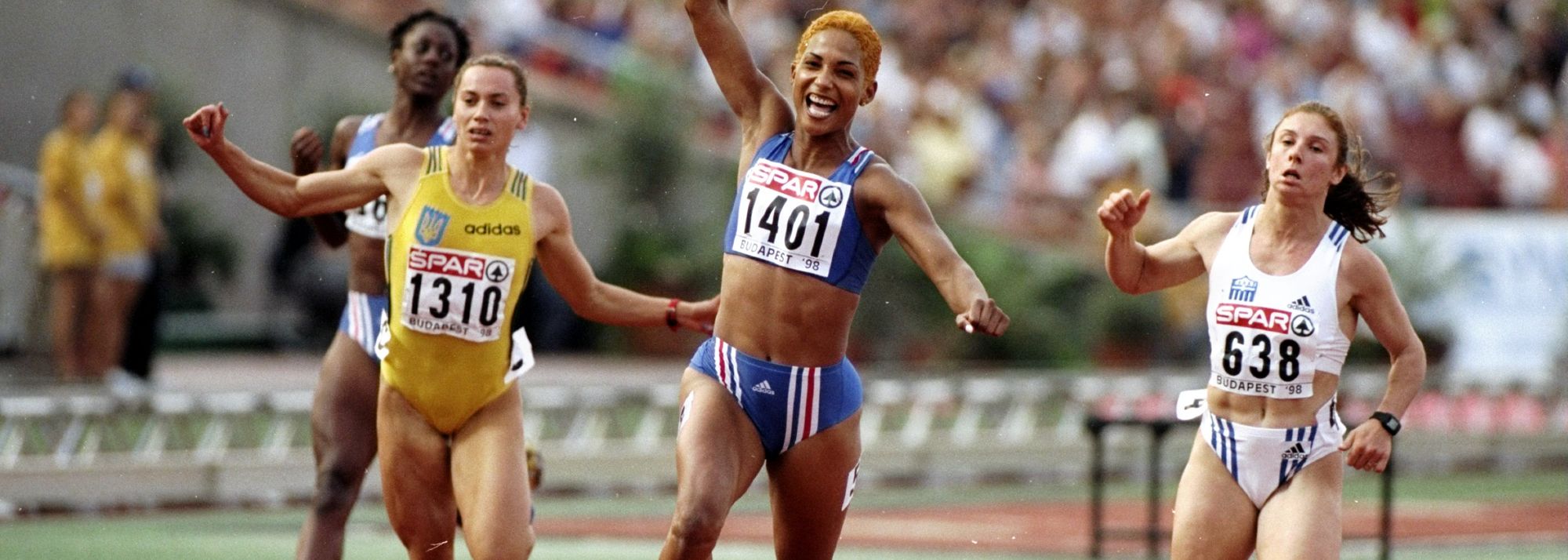


Christine Arron wins the 1998 European 100m title (© Getty Images)
At the halfway stage of the women’s 100m final at the 1998 European Championships in Budapest’s Népstadion, Christine Arron was outside the medal frame in fourth place.
Irina Privalova, the Russian world indoor 60m champion and world record-holder, was way out in front in lane three – two strides clear of her closest pursuers, Ekaterini Thanou of Greece and Melanie Paschke of Germany.
But then Arron found another gear. The Guadeloupe-born Frenchwoman finished with devastating effect, her graceful and composed sprint style carrying her a tenth of a second clear in 10.73, 0.04 inside Privalova’s European record.
More than 28 years later, Arron’s winning time still stands at the top of the continent’s all-time list. The spikes that took her flying past Thanou, Paschke and Privalova in the Hungarian capital that day have been kindly donated to the Museum of World Athletics by the retired French sprint great.
For the record, Privalova took silver in 10.83, with Thanou third in 10.87, Ukraine’s Zhanna Pintusevich fourth in 10.92 and Paschke fifth in 11.07. The following wind was exactly 2.0m/s.
One month shy of her 25th birthday, Arron had emerged at the pinnacle of European sprinting and among the very best in the world.
At the time, only Florence Griffith-Joyner, with her 10.49 world record run in questionable windless conditions at the 1988 US Olympic Trials, and Marion Jones, with a handful of 10.71 and 10.72 performances earlier in the 1998 season, had ever recorded faster wind-legal 100m times.
“After the semi-final, I thought I had a good shot at the gold if I got a good start,” Arron reflected. “Halfway through, I saw Privalova from the corner of my eye and accelerated between 60m and 80m.”
Some flippantly pointed to the colour of Arron’s closely cropped hair as a sign of her golden breakthrough. “It’s not gold, or bronze,” she retorted. “It’s blonde middle copper.”
Arron herself pointed to her performance in the semi-finals as the key.
She had arrived at the stadium without her bib and reached the call room in a stressed state, before an official gave her a blank replacement and assured her: “Don’t worry. You’re going to win.”
After scribbling the digits 364 on to her new bib, the relieved Arron was so chilled she was not unnerved by three false starts before shooting out of the blocks and haring down the track in 10.81, a French record.
It remains her most treasured track performance. With the wind gauge at 1.3m/s, she got off to the best start of her career and felt so effortless throughout that she believes it was an even better run than her final.
Not that Arron was finished wowing the watching world in Budapest.
On the anchor leg of the 4x100m final, she took the baton a good five metres down on Privalova, with Germany’s Andrea Philipp also ahead of her. What happened next – “the most electrifying burst of the championships,” according to Athletics Weekly – drew gasps from the crowd.
Arron catapulted past both women to complete a stunning victory in 42.59. Her flying split of 9.67 left Privalova in such a state of disarray that the 200m champion was overtaken by Philipp for second place. With Katia Benth, Frédérique Bangué and Sylviane Félix on the first three legs, it was France’s first ever victory in the event.

Christine Arron donates her spikes from the 1998 European Championships
Arron’s major advance came in her first season concentrating on the 100m since her junior days. Though in 1997 she improved from her 1992 PB of 11.51 to 11.03 in her first race in five years, and finished fourth at the World Championships, she had hitherto seen herself as a 200m/400m runner.
Born and raised on the French Caribbean island of Guadeloupe, Arron spent two years as a karate exponent before turning to track, winning U17 100m bronze at the Carifta Games aged 14, before moving to Paris in 1992 to train at the National Institute of Sport, Expertise and Performance (INSEP), following in the footsteps of fellow Guadeloupe native Marie-José Pérec, who was still based there.
Her debut in a French vest came at the 1992 World U20 Championships in Seoul, where she clocked 11.77 in finishing third behind Jamaica’s Merlene Frazer and Britain’s Katharine Merry in her quarter-final before exiting at the semi-final stage.
The move up in distance followed a succession of injuries while training for the 100m. “They came one after another,” Arron recalled. “The reason was simple: I didn’t know how to run. My technique was terrible.”
That sprint technique was steadily honed under the guidance of a succession of coaches: initially Jacques Piasenta, then Guy Ontanon, and ultimately Pierre-Jean Vazel. “I regret not having known Pierre-Jean sooner,” Arron said in an interview in Le Monde, reflecting on her career in 2017. “He knew how to listen to me and respect my body.”
As it was, apart from that golden 100m run on the European stage in Budapest and world bronzes at 100m and 200m in Helsinki in 2005, Arron’s major championship medal successes came as a 4x100m relay runner of supreme distinction.
After France took world bronze in Athens in 1997, European gold in Budapest in 1998 and world silver in Seville in 1999, she memorably anchored her country to home gold ahead of the USA at the 2003 World Championships in Paris – a year after giving birth to her first child, Ethan – wearing the same shoe model as the spikes she has donated to the Museum of World Athletics.
Arron hung up her spikes after the 2012 European Championships. More than a decade later, she remains the fastest European woman in history – even though she insists the 100m was never her natural event.
“I’m rather slow and soft by nature,” Arron told Le Monde. “Sprinting forces me to wake up, to force myself.
“Even my mother couldn’t understand how I could run so fast but be so slow to eat and get ready. It’s a struggle even today. I can be quick for some things but it’s against my nature.”
Simon Turnbull for World Athletics Heritage