

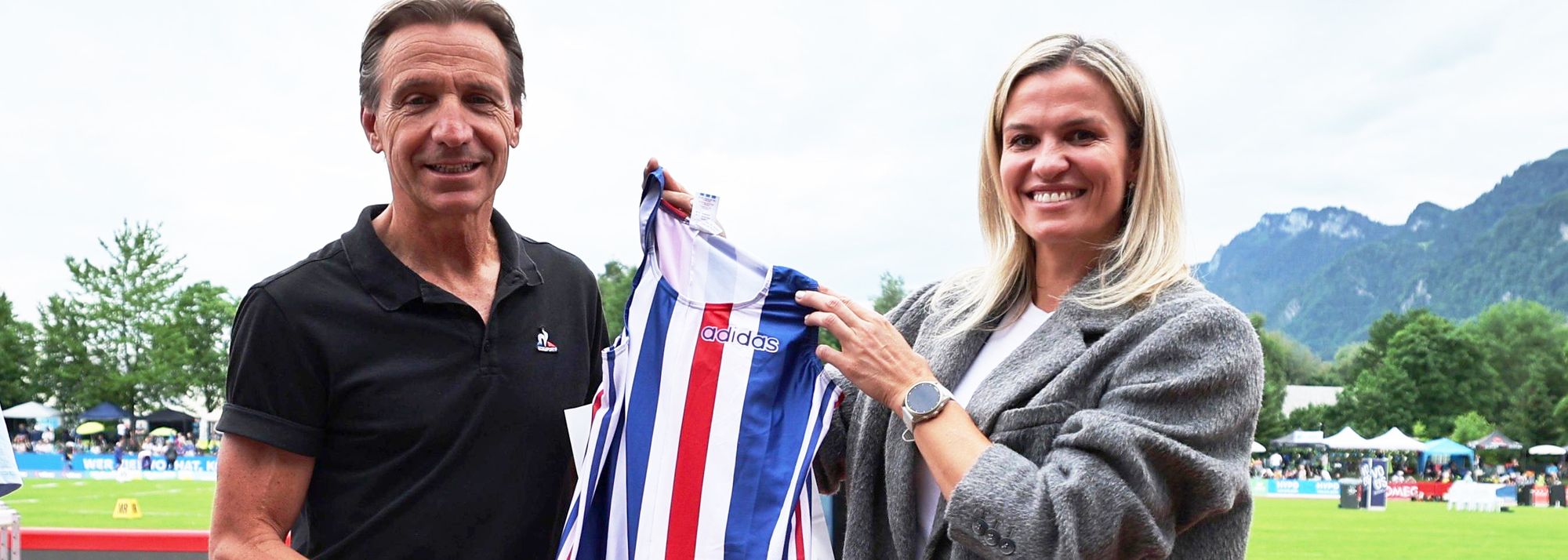


Christian Plaziat hands his French bodysuit to World Athletics Council Member Nataliia Dobrynska (© World Athletics  James Rhodes)
By the time Christian Plaziat made it back to Barcelona for the 1995 World Athletics Indoor Championships, his quest for a global medal had reached epic proportions.
Hailed as a future golden boy of French track and field after narrowly missing the decathlon podium at the 1987 World Championships in Rome and at the Olympic Games in Seoul a year later, the flamboyant multi-eventer had still yet to find a Midas touch on the global stage – or a silver or bronze one, for that matter.
He was 31. The litany of heartache stretched back to the rich promise of his early 20s.
Lying second at the halfway stage in Rome in 1987, the 23-year-old Lyonnais faded to fourth. In Seoul in 1988 he was second after eight events but ended up fifth after fluffing the javelin with what he called a “shameful” 52.18m.
A resounding victory at the 1990 European Championships in Split raised hopes so high for the 1991 World Championships in Tokyo that Plaziat proclaimed the presence of the rising US star Dan O’Brien would push him to the decathlon title with a world record score. He finished ninth with 8122 points, 690 behind the victorious O’Brien.
Then came the crushing disappointment of the 1992 Olympics in Barcelona. Regarded as one of the leading contenders in the absence of O’Brien, who had no-heighted in the pole vault at the US trials, Plaziat dropped out after four events, suffering from knee cartilage damage.
And so – following a sixth-place finish at the 1993 World Championships in Stuttgart – he returned to Barcelona for the World Indoor Championships in 1995.
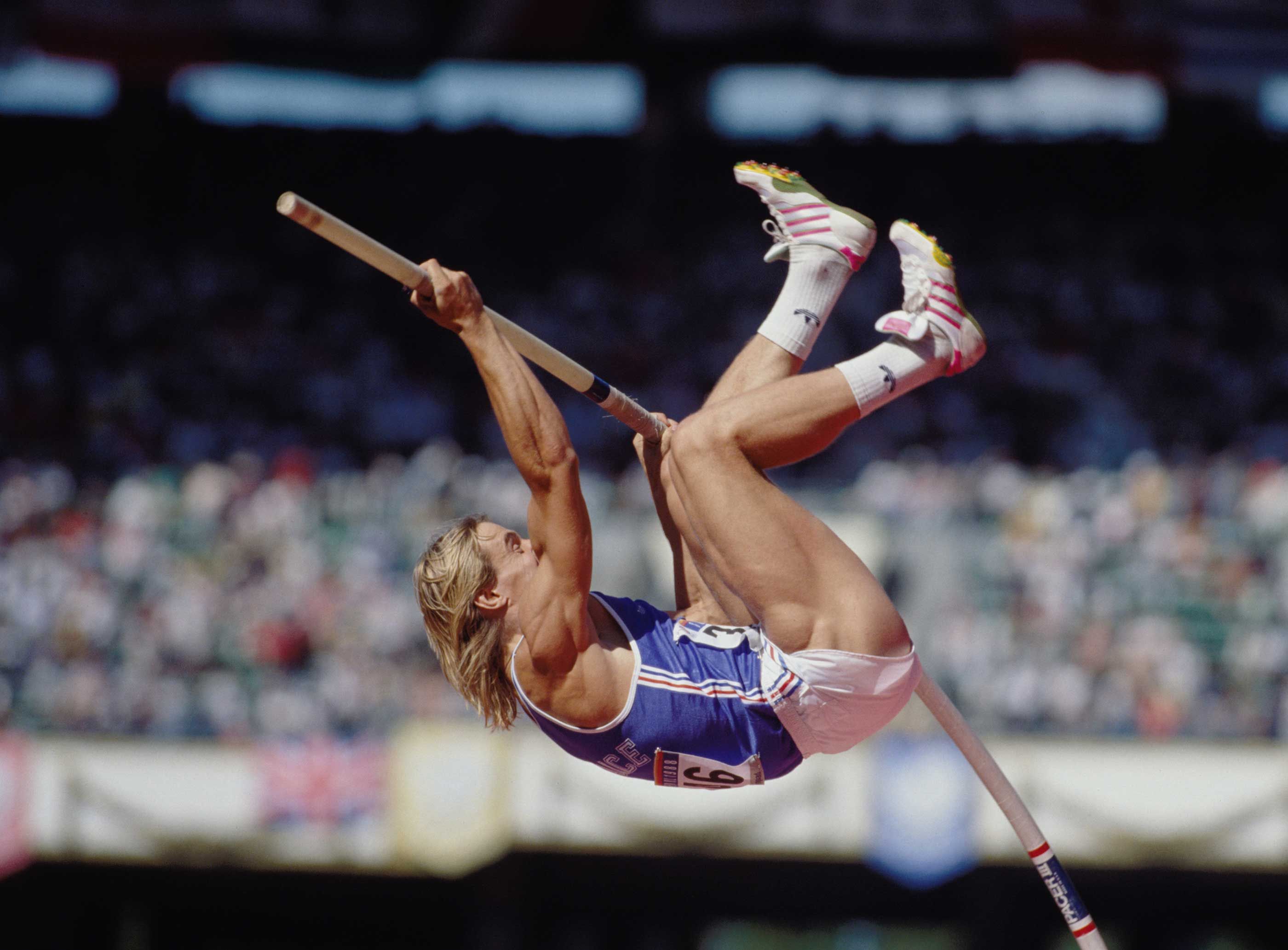
Christian Plaziat in action (© Getty Images)
For the 31-year-old Plaziat, the road to redemption happened to be a five-minute stroll from Montjuic Stadium, the scene of his 1992 Olympic calamity, to the Palau Sant Jordi.
The déjà vu must have been unsettling. There he was, back on the Barcelona Olympic complex, with O’Brien a notable absentee once again – the decathlon world champion and world record-holder having suffered a hamstring injury – and with the pressure of expectation again on his shoulders.
Still, the indoor heptathlon was a stronger combined events suit for Plaziat than the outdoor decathlon. Without any of the long throwing events to contest, he had set two world indoor records and one indoor best in the heptathlon and another world indoor record in its predecessor, the octathlon. He had also collected two European indoor crowns.
The team uniform he wore in the Palau Sant Jordi suited him, too. Often dubbed “the French Hercules” Plaziat looked the part in a natty blue, white and red striped French bodysuit that brought to mind the extravagant blue and white striped pants worn by the Gallic cartoon strongman Obelix.
Like Asterix’s muscular sidekick, Plaziat – or Plazman, as he became known by the French public – proceeded to summon the strength he needed to see off his opponents, before pulling his uniform down to his waist on a bare-chested lap of honour.
That distinctive bodysuit is now on display in the Museum of World Athletics, thanks to the generosity of the colourful French character who achieved a permanent place in track and field posterity when he finally struck global gold in Barcelona.
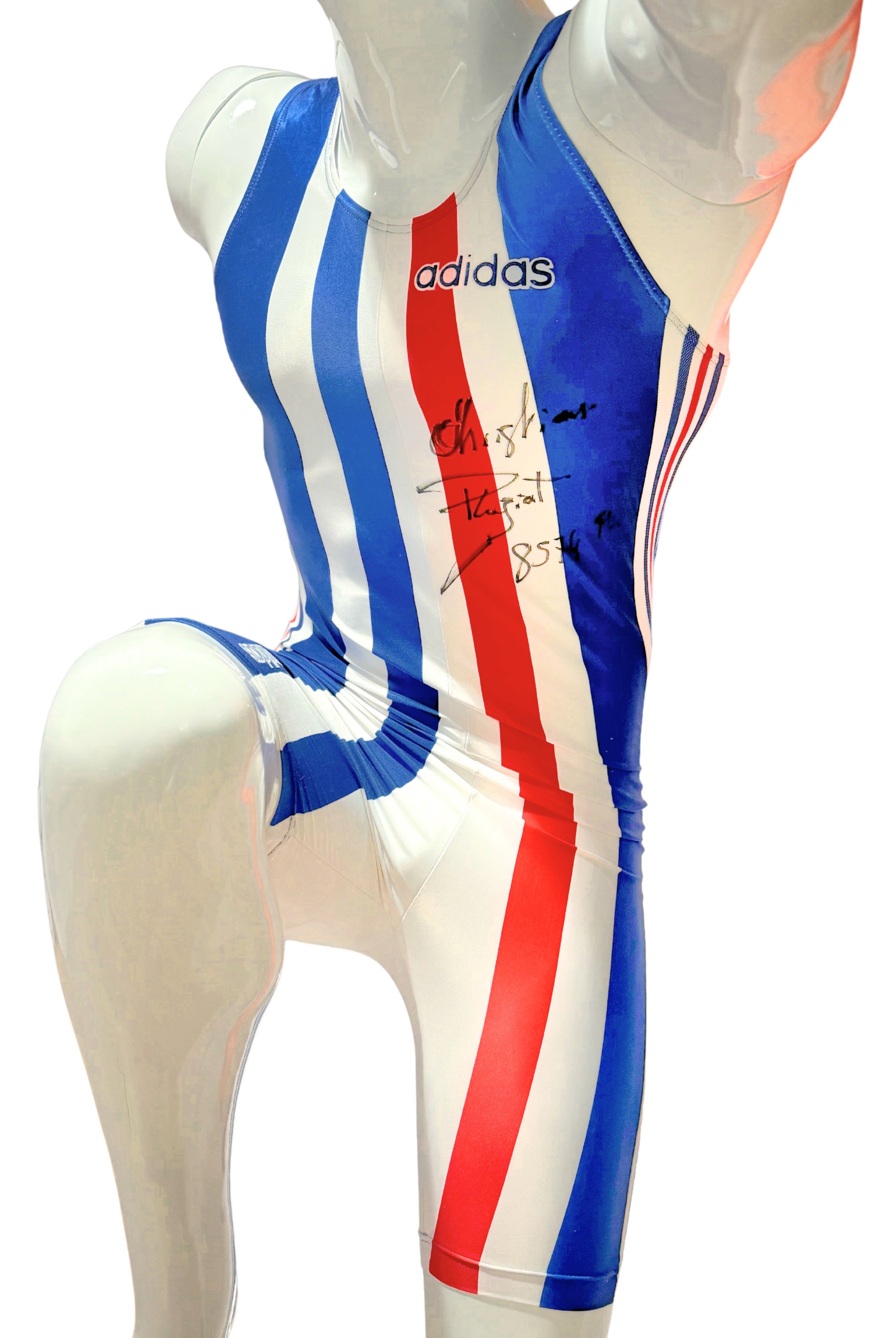
Christian Plaziat's 1995 World Indoor Championships bodysuit (© MOWA)
It was the first time the men’s heptathlon was contested as an official medal event at the World Indoor Championships, the event having been held as a demonstration competition in Toronto in 1993, O’Brien topping the finishing order.
Plaziat was handily-placed throughout but only hit the front on day two, proving too strong for his rivals to dislodge thereafter.
After opening with 6.96 for 60m and following up with a 7.52m long jump, he settled into second place behind the Estonian Erki Nool, who proceeded to blow his 64-point lead in the shot put. Struggling with an injured hand, the future Olympic champion managed to scrape only a 10.46m final effort and dropped out of contention.
Plaziat threw a steady 14.92m to remain in second, 15 points down on Swede Henrik Dagård, and then cleared 2.04m in the high jump. That left him in second spot at the end of day one with 3462 points, just six points behind new leader Sheldon Blockburger of the USA.
Day two, Sunday 12 March, could hardly have gone better for the big French hope. Plaziat flew out of the blocks in the 60m hurdles, clocking 7.85 to secure his first – and subsequently only – event ‘win’ of the competition.
More importantly, he also took the lead for the first time – his running tally of 4482 points furnishing him with a healthy lead over the emerging Tomas Dvorak of Czechia (4455), Dagård (4437) and USA’s Ricky Barker (4411).
Plaziat was worried about losing ground, and pole position, to Barker in the pole vault but was guided smoothly through the competition by Sébastien Levicq. His French teammate topped the order with a 5.30m clearance, while successfully guiding Plaziat through to 5.10m, which Barker matched but was unable to better.
Plaziat started the final event with a 71-point lead over Barker and could afford to cruise through the 1000m, finishing fifth in 2:44.56 – four places and 5.16 seconds ahead of Barker. The French athlete took the gold with 6246 points, with future decathlon world record-breaker Dvorak coming through for silver (6169) and Dagård sneaking the bronze (6142) ahead of Barker (6120).
Serenaded by horn-blaring, tricolour-waving friends, family and supporters, Plaziat savoured the golden moment to the full.
“I’ve never really performed well without that sense of communication between the crowd and me,” he said. “When you saw me take my suit off at the end, it was more about the pleasure of being able to breathe – those suits are suffocating – than putting on a show.
“My victory is important to me. It’s a reward for 20 years’ work.”
Two years later, his multi-events work was over. Sixth at the 1995 World Championships and 11th at the 1996 Olympics, Plaziat hung up his spikes after finishing fifth at the 1997 World Indoor Championships) in Paris.
He retired from track and field, initially to run a pub in Annecy, but his legend lived on.
The French decathlon record of 8574 points he set in 1990 in Split stood for more than a quarter of a century – until Kevin Mayer notched 8834 as Olympic silver medallist in 2016.
“I’m happy that it lasted so long,” Plaziat reflected. “At 52, I’ve spent more time living with the French record than without it.”
Simon Turnbull for World Athletics Heritage