

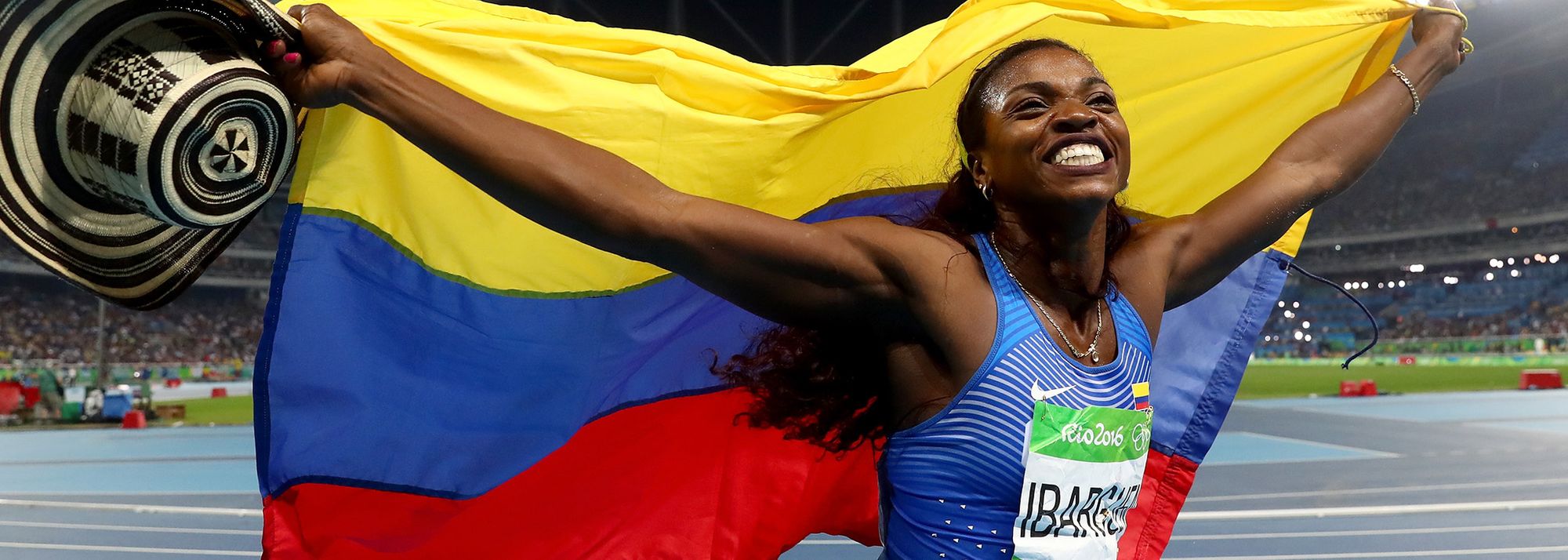


Caterine Ibarguen in Rio (© Getty Images)
The young Caterine Ibargüen cut a disconsolate figure as her heels dislodged the bar with her third and final attempt at 1.89m in the high jump qualifying round at the 2004 Olympic Games in Athens.
The 20-year-old Colombian needed to clear a minimum of 1.92m to make it to the final. Instead, she finished joint last in qualifying group B – 30th overall – with 1.85m.
It was not the only painful Olympic baptism in the Greek capital. The 17-year-old Usain Bolt exited at the first-round stage of the men’s 200m, suffering from a hamstring injury as he struggled across the line fifth in his heat in 21.05.
Twelve years later, in Rio de Janeiro, the Jamaican sprint phenomenon completed his third successive Olympic 100m-200m double and anchored his country’s 4x100m team to victory.
Ibargüen’s own Olympic journey also turned to gold in Rio. The high jumper who had finished 30th in qualifying in Athens returned as a 32-year-old triple jump great, claiming a history-making title for Colombia.
Already a two-time world champion in the hop, step and jump – and beaten just once in her previous 36 competitions – Ibargüen took the lead with a second-round effort of 15.03m. She proceeded to nail down the gold medal, her country’s first in Olympic athletics, with a fourth-round jump of 15.17m. Venezuela’s Yulimar Rojas took silver with 14.98m.
“It’s the biggest dream for me to achieve this,” Ibargüen declared. “I’m very happy and very proud.”
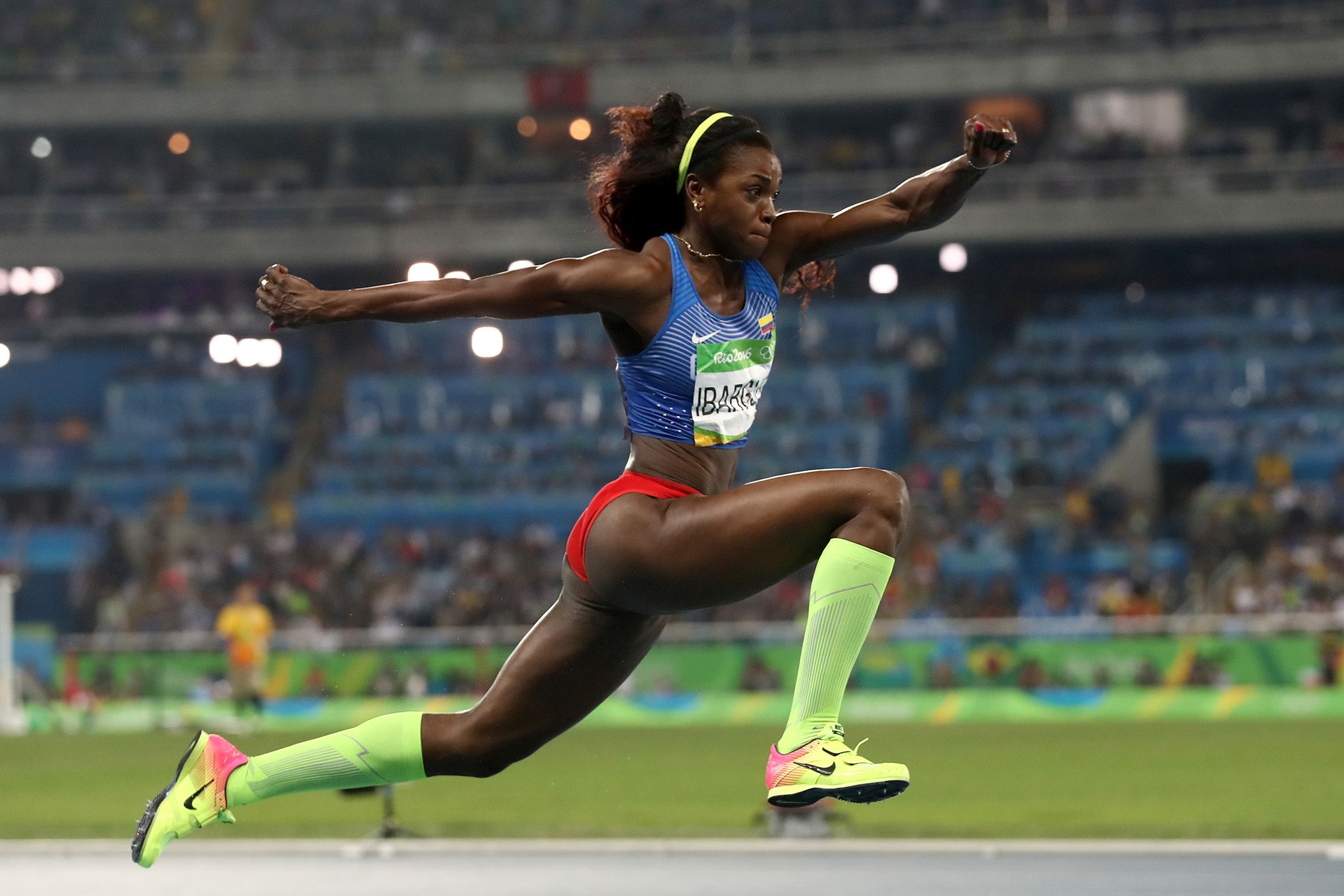
Caterine Ibarguen in action in Rio (© Getty Images)
It was quite some transformation. But Colombia’s first Olympic athletics champion had long since shown the resilience required to make such a reinvention possible.
Ibargüen was raised by her grandmother, Ayola Rivas, after her parents fled the armed conflict raging around her home town of Apartadó in north-west Colombia in the 1980s. Her father, William, settled in Venezuela; her mother, Francisca, moved to the port city of Turbo.
Her natural sporting prowess, initially as a volleyball player, earned her a place at the Villa Deportiva high-performance sports centre in Medellín.
Her ability as a high jumper, however, was soon discovered. In 1999, aged 15, she won bronze at the South American Championships, held in the Colombian capital, Bogotá, clearing 1.75m.
She also took silver that year at the Area U20 Championships in Concepción, Chile, and competed at global level for the first time, placing 15th in qualifying with 1.73m at the inaugural World Youth (U18) Championships in Bydgoszcz, Poland, where the winning clearance was 1.89m.
Ibargüen continued as a high jump specialist as she progressed into the senior ranks, following her Olympic debut in Athens with appearances at the 2005 World Championships in Helsinki (23rd in qualifying with 1.85m), the 2006 World Indoor Championships in Moscow (17th in qualifying, 1.81m) and the 2009 World Championships in Berlin (28th in qualifying, 1.85m).
As early as 2001, though, she started to expand her jumps repertoire. As well as claiming high jump gold (1.77m) at the South American U20 Championships in Santa Fe, Argentina, she also earned long jump silver (5.87m), triple jump bronze (12.65m) and 4x100m silver.
In 2003, aged 19, Ibargüen’s spring and versatility took her to a high jump (1.80m) and triple jump (13.17m) double at the South American U20 Championships in Ecuador. That year, she also claimed long jump silver (6.04m) and triple jump bronze (13.07m) at the senior South American Championships in Venezuela, finishing fourth in the high jump with 1.80m.
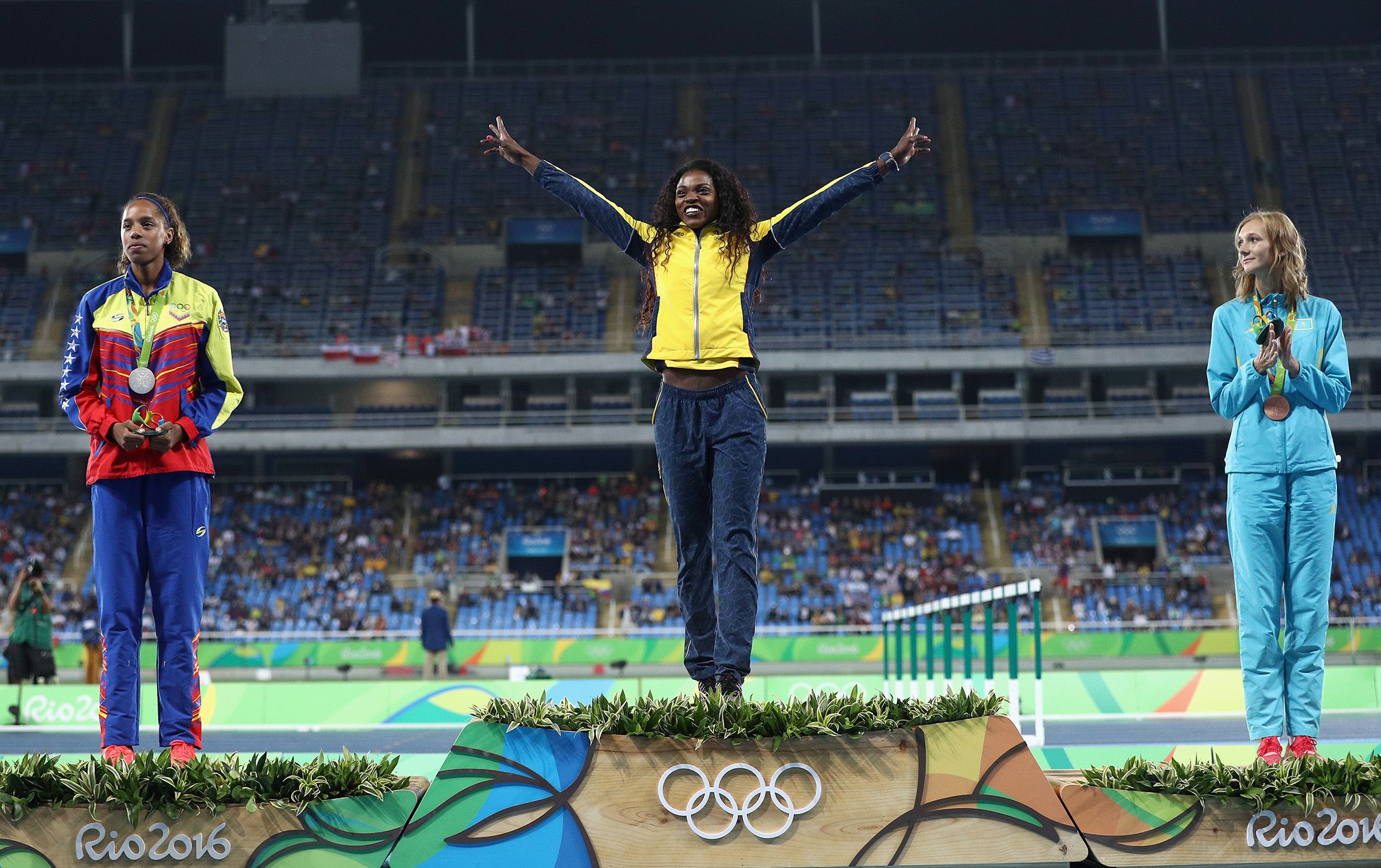
Caterine Ibarguen on the Olympic podium in Rio (© Getty Images)
Between 2005 and 2009, Ibargüen won four South American titles as a high jumper. The 1.93m she achieved at the 2005 championships in Cali stood as the Colombian record until 2019, when María Murillo jumped 1.94m.
The transition to triple jump specialist began at the end of 2008.
After failing to qualify for the Beijing Olympics, Ibargüen considered quitting athletics before deciding to move to Puerto Rico to study nursing and train under the guidance of Ubaldo Duany, an 8.32m long jumper who finished seventh for Cuba at the 1989 World Indoor Championships.
Duany saw her as an athlete of greater potential in the triple jump and, after a last high jump appearance in the qualifying round at the 2009 World Championships in Berlin, the switch was made.
“We had to start from scratch,” Ibargüen recalled. “We had to correct the major technical mistakes I was carrying. It was pretty hard for me but I always remained optimistic, thanks to the support of a great coach.”
As a secondary option, Duany introduced his charge to the heptathlon, in which she showed her all-round prowess with an impressive PB of 5742 points. The big breakthrough, however, came in the triple jump in 2011.
Ibargüen improved the Colombian record on nine occasions, and the South American mark on six. She captured Colombia’s first World Championships field-event medal, claiming triple jump bronze in Daegu with 14.84m – behind Olha Saladukha of Ukraine (14.94m) and Kazakhstan’s Olga Rypakova (14.89m). Olympic silver followed a year later in London, with a 14.80m jump, behind Rypakova (14.98m).
From 2013 to 2016, Ibargüen reigned supreme in the women’s triple jump. She won back-to-back world titles, in Moscow in 2013 (14.85m) and Beijing in 2015 (14.95m), racked up a winning streak of 34 competitions, then claimed that historic Olympic gold for her country in Rio in 2016.
Ibargüen was beaten by the fast-rising Rojas at the 2017 World Championships in London, finishing runner-up to her South American rival, but she regained global dominance in 2018.
Unbeaten in her specialist event, she swept to the Diamond League and Continental Cup titles in both the long jump and triple jump, improved her national long jump record to 6.93m and earned the World Athletics Female Athlete of the Year Award.
Rojas proceeded to establish herself as the greatest women’s triple jumper of all time, but Ibargüen still emerged from injury to land world bronze behind the Venezuelan in Doha in 2019 before concluding her glittering career with 10th place at the delayed Tokyo Olympics in 2021.
“I’ve achieved more than I ever dreamed of,” the retiring Colombian great reflected.
From Athens high jump disappointment to Rio triple jump gold, Ibargüen had completed one of athletics’ great reinventions.
Simon Turnbull for World Athletics Heritage

