

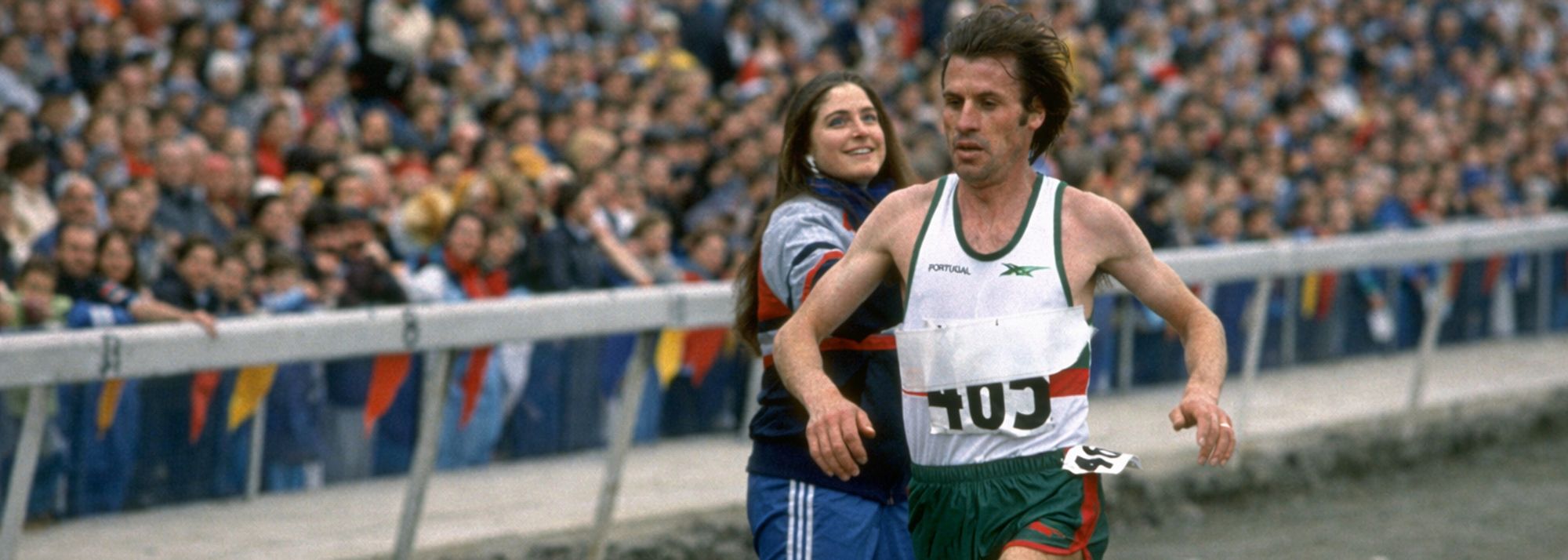


Carlos Lopes in action at the World Cross Country Championships (© Getty Images)
Carlos Lopes: the living legend who inspired Homer Simpson to get off his couch, lay down his can of Duff Beer and run in the Springfield Marathon.
That ultimate accolade came to pass in 2001, in season 12 of The Simpsons… Homer watches an Olympic Games documentary and is motivated by the story of Lopes winning marathon gold at the age of 38.
In fact, Lopes was only 37 when he won the Olympic marathon in Los Angeles in August 1984. He was 38 when he broke the marathon world best, and the 2:08 barrier, in Rotterdam in April of the following year.
Looking back on the career of the diminutive Portuguese distance running phenomenon, it is similarly striking to consider that Carlos Alberto de Sousa Lopes was 29 when he first made a name for himself on the international scene.
As Ron Marshall of The Herald noted in his report of the 1976 World Cross Country Championships: “The individual winner of the senior men’s race came with no reputation worth repeating but surely left smothered with respect.”
The 12km race was held on 28 February at Chepstow Racecourse, a prestigious venue for thoroughbred horse racing on the Welsh border with England. Just 10 days past his 29th birthday, Lopes lined up with a racing pedigree that could best be described as modest.
He had been a bit-part player in the epic 10,000m final at the 1971 European Championships, trailing in 30th. He also failed to make it past the heats of the 5000m and 10,000m at the Munich Olympics in 1972 and failed to finish the European 10,000m final in Rome in 1974, where fast-finishing Briton Tony Simmons closed to within 0.04 of the victorious East German Manfred Kuschmann.
Simmons was widely fancied for the world cross-country crown at Chepstow. Born in Wales but a member of the strong England team, he was coached by Harry Wilson, the guru behind Steve Ovett’s success.
According to Marshall’s account, “Simmons got himself into knots trying to break Lopes in the first 10 minutes but the Portuguese assumed command with his graceful, flowing stride.”
With one kilometre to go, the relentless Lopes had a lead approaching 200 metres. The scrap for silver and bronze reduced the gap in the closing stages but the Lisbon bank clerk still finished 16 seconds clear, crossing the line in 34:48, with Simmons in second and Bernie Ford of England pipping Belgian Karel Lismont for bronze.

Portugal's 1984 Olympic marathon champion Carlos Lopes (© Getty Images)
“I was surprised to win,” Lopes said. “I thought I would finish no higher than fifth. My previous highest position at the World Cross Country Championships was 24th [in 1973].”
Lismont, runner-up to Frank Shorter of the USA in the 1972 Olympic marathon, went on to claim marathon bronze at the 1976 Olympic Games five months later. Lopes, having catapulted from obscurity to the top of the world cross country podium in Chepstow, maintained his progress with a brilliant run in the 10,000m final in Montreal, running the legs off all of his rivals bar Finland’s Lasse Viren for a hard-won silver medal.
Born the eldest in a family of eight children in Viseu in central Portugal, Lopes left school at 13 and worked as a stonemason’s assistant and metal worker before moving to Lisbon and joining the celebrated Sporting Clube de Portugal.
Coached throughout his career by Mario Moniz Pereira, one-time holder of the national triple jump record who became a leading Portuguese songwriter in later life, he made his big 1976 breakthrough after securing part-time terms in his job as a bank clerk and stepping up his training to twice daily.
His major triumphs came almost a decade later, after upping his training again in pursuit of success at the marathon – an event that had assumed a historical air of trepidation in Portuguese athletics, following the collapse and subsequent death of Francisco Lazaro in the 1912 Olympic race in Stockholm.
Lopes did not enjoy the happiest of debuts, dropping out of the 1982 New York Marathon at 21 miles after crashing into a spectator. He then suffered a collision with a Mercedes-Benz while out training for the 1984 Olympic marathon.
“As I watched my elbow go through the windshield, I thought, ‘There goes the Olympics’,” he told Track & Field News. “I was lucky not to be seriously injured.”
Just 15 days later, the ‘lucky’ Lopes ran away from Ireland’s John Treacy and Britain’s Charlie Spedding to take gold in Los Angeles in 2:09:21, an Olympic record.
In The Simpsons episode, Lopes is so old the weight of the gold medal around his neck sends him plummeting off the podium to his death.
Happily, in real life, he scaled two more major peaks as a veteran of 38 in the spring of 1985.
On home ground in Lisbon in March, Lopes won the world cross-country title for a third time, having followed his Chepstow success in 1976 with victory in New York in 1984.
Then, in Rotterdam in April, he took 53 seconds off Steve Jones’ world best with a time of 2:07:12. Smashing through the 2:08 barrier, the pride of the Portuguese nation had secured his status as a Homeric hero of the marathon.
Simon Turnbull for World Athletics Heritage