

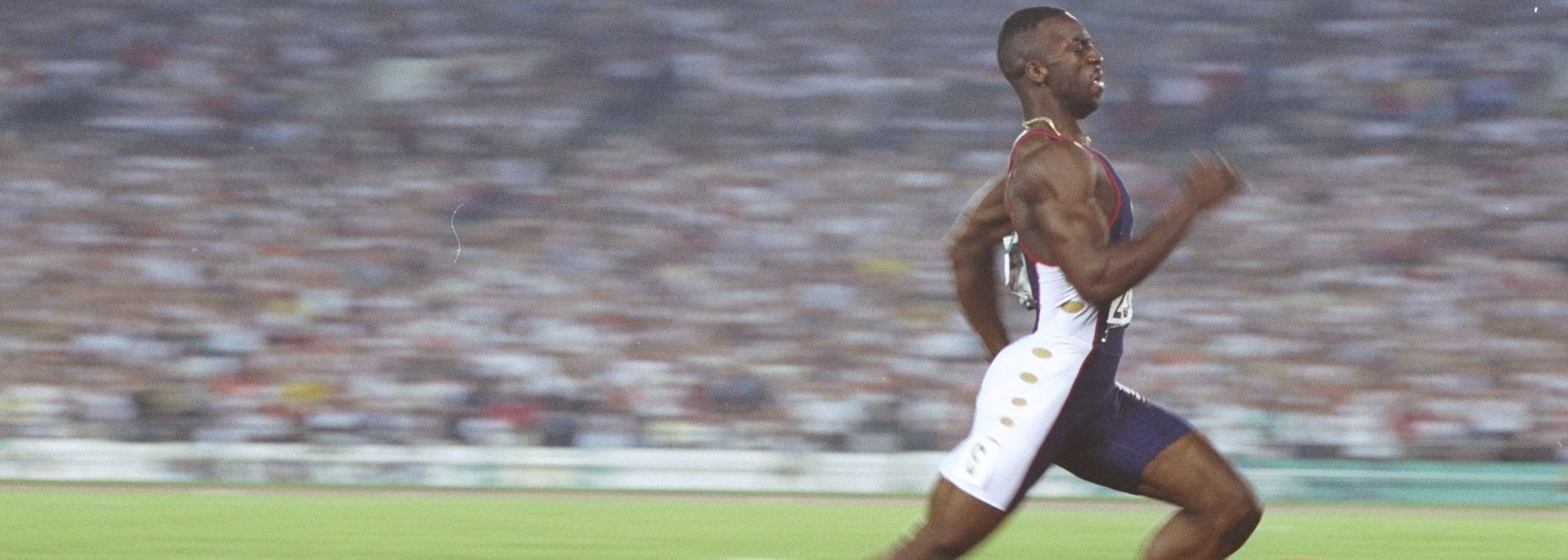


Michael Johnson in action at the 1996 Olympic Games (© Getty Images)
As Michael Johnson hurtled into the home straight of the Centennial Olympic Stadium on 1 August 1996, his gold spikes were a blur in the Atlanta night. His principal rival in the men’s 200m final, Frankie Fredericks, was already half a stride behind.
A historic men’s Olympic 200m-400m double was as good as in the bag for the US golden boy. What came next reduced the mind to the kind of boggle that Usain Bolt would induce a dozen years later.
Ian Thomsen captured it beautifully in his dispatch for the International Herald Tribune: “His head and his legs were curved back as if his belt buckle had been tied to a speedboat yanking him along. Except for this: Michael Johnson wasn’t wearing a belt. He was on land. He was running under his own power, faster than anyone has ever run before.”
Blistering through the second 100m in a staggering 9.20, the Texan with the idiosyncratic upright stance flashed across the line in 19.32. Jaws dropped all around the capacity 85,000-seater arena.
Johnson had taken 0.34 off the world record of 19.66 he had set on the same track at the US trials five weeks earlier. Fredericks, a close runner-up in the world record 100m final and a 200m winner ahead of Johnson in Oslo the previous month, finished more than a third of a second down, setting an African record of 19.68 in second place.
Ato Boldon of Trinidad and Tobago, third in 19.80, bowed down in awe as he approached the prostrate Johnson.
Asked how it felt to run that fast, Johnson replied: “My dad bought me a go-kart when I was a kid and I could make it go fast going down a big hill at the end of our street. It’s the only thing that compares.”
A member of the victorious, world record-breaking US 4x400m team at the 1992 Olympic Games, but beaten by food poisoning in the 200m semifinals in Barcelona, Johnson had claimed his first individual gold three days earlier, clocking an Olympic record 43.49 to win the 400m by 0.92 from Britain’s Roger Black.
The 200m world record came at the cost of a hamstring injury that ruled Johnson out of the 4x400m in Atlanta, but he was happy enough with his unprecedented double. “The world record is a bonus on top,” he said. “The most important thing is making history.”
Pérec completes double in graceful stride
On the same night that Johnson completed the first half of his twin mission, Marie-José Pérec made Olympic history of her own, clocking a Games record of 48.25 ahead of Australia’s Cathy Freeman (48.63) to become the first woman to retain the 400m title.
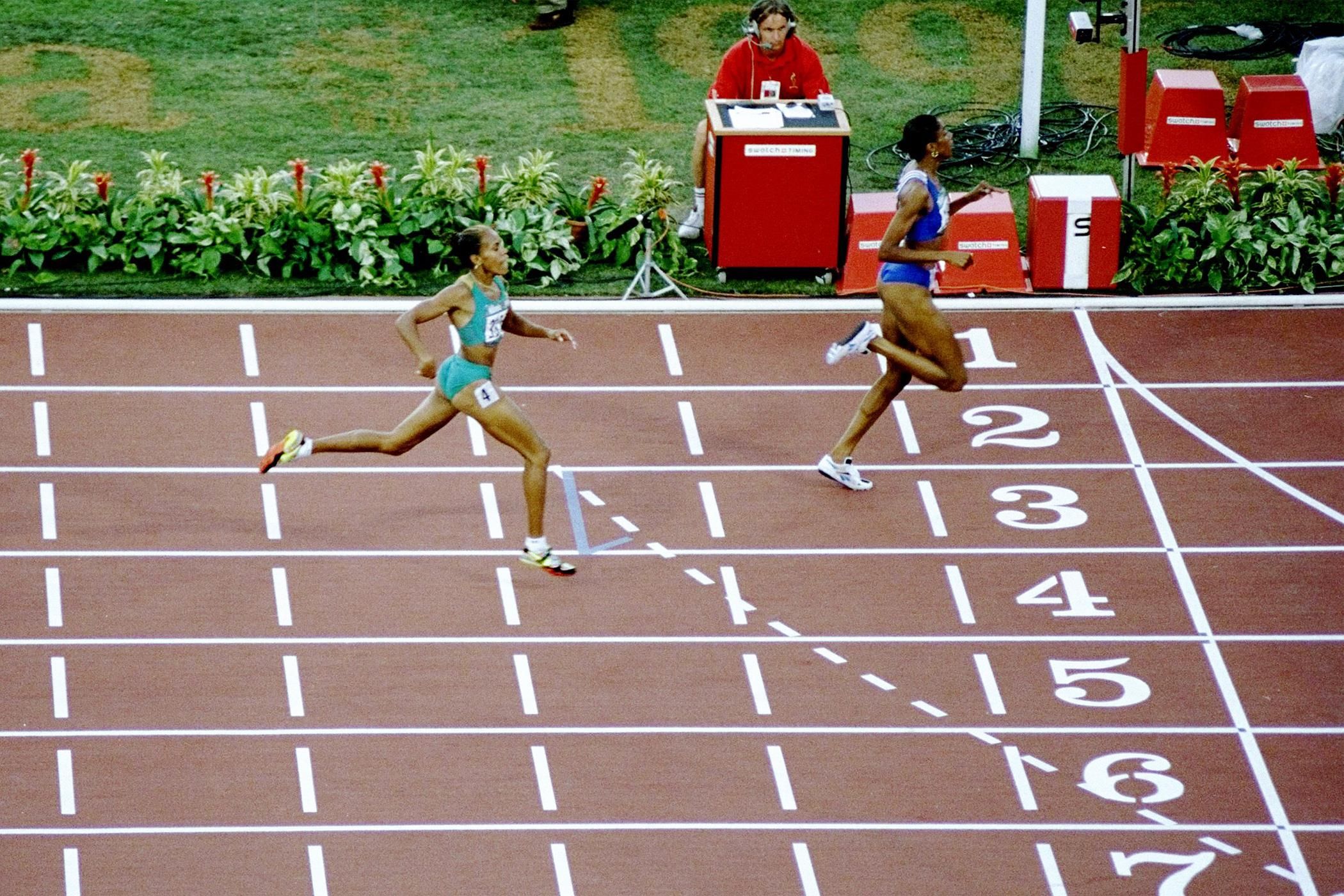
Marie-Jose Perec and Cathy Freeman in the 1996 Olympic 400m final (© Getty Images)
On the evening Johnson smashed his 200m world record, the 28-year-old Frenchwoman became the second athlete to claim the women’s 200m-400m double, emulating the feat first achieved by Valerie Brisco-Hooks of the USA in Los Angeles in 1984.
The Guadeloupe-born Pérec, dubbed La Gazelle by the French press because of her graceful 2.5m stride, overhauled Merlene Ottey to secure victory in 22.12, 0.12 ahead of the Jamaican.
Jean Galfione claimed the men’s pole vault title on countback with an Olympic record 5.92m, a height also cleared by Igor Trandenkov and Andrei Tivontchik, leaving France with three gold medals, a tally only bettered by the USA, with 13.
Bailey blasts to 100m record as Lewis bows out with ninth gold
Slowest out of the blocks in the men’s 100m final, and only fifth after 20 metres, Donovan Bailey blazed to victory in 9.84, shaving 0.01 off the world record held by Leroy Burrell. The Canadian sprinter also clocked a scorching 8.95 anchor leg to take his country to an upset 4x100m victory over the USA, 37.69 to 38.05.
Carl Lewis was deemed surplus to requirements for baton duty by the US team, but the 35-year-old carved his own niche in Olympic history, leaping 8.50m to win his fourth consecutive long jump crown – only the second track and field athlete to achieve a quartet of victories in the same individual Olympic event. He also joined Finnish distance running legend Paavo Nurmi with a record track and field tally of nine Olympic gold medals.
Aside from Johnson’s famous double and Lewis’s momentous success, the dominant US men’s team collected seven other gold medals, three of them with Olympic records: Allen Johnson in the 110m hurdles (12.95), Charles Austin in the high jump (2.39m) and Kenny Harrison in the triple jump (18.09m). The others included Dan O’Brien’s decathlon triumph with 8824.
Devers edges Ottey to emulate Tyus
In the city that became her home after retirement, Gail Devers became only the second woman to win back-to-back Olympic 100m titles, emulating her compatriot Wyomia Tyus, who prevailed in 1964 and 1968. The great US sprint hurdler – who came close to having a leg amputated before being diagnosed with Graves’ disease, the autoimmune disorder that causes an overactive thyroid – did so by the slenderest of margins.
The fast-starting Devers was caught by Merlene Ottey at 60 metres and the two women fought neck-and-neck all the way to the line. Both were clocked at 10.94, but the photo-finish picture gave the verdict to Devers ahead of her Jamaican rival by a margin of 0.005, just five centimetres. It was a repeat of the 1993 World Championships final in Stuttgart, where Devers’ right shoulder earned her the verdict by 0.001.
The margin was more clear-cut in the 4x100m final, Devers collecting another gold medal with a second-leg run in a US quartet that finished clear winners in 41.95, with The Bahamas second in 42.14 and the Jamaican team, featuring Ottey, third.
Devers was not the only athlete to claim two golds in Atlanta. Svetlana Masterkova produced a middle-distance masterclass, the Russian taking the 800m title in 1:57.75 ahead of Cuba’s Ana Quirot and Mozambique’s Maria Mutola, then winning the 1500m in 4:00.83.
The men’s 800m featured a surprise win for Norway’s Vebjørn Rodal in a Games record 1:42.58, while Algeria’s three-time world outdoor champion and world record-holder Noureddine Morceli emerged victorious from a dramatic 1500m final, outsprinting Spain’s Fermín Cacho to win in 3:35.78 after his emerging young Moroccan challenger Hicham El Guerrouj tripped and fell.
Gebrselassie and Tergat duel as gold-medal spread widens
The men’s 10,000m final featured the first of two epic Olympic 25-lap duels between Ethiopia’s Haile Gebrselassie and Kenya’s Paul Tergat, Gebrselassie prevailing in a Games record 27:07.34. In all, African athletes claimed 11 gold medals, five more than the previous best at Seoul in 1988. Vénuste Niyongabo’s 5000m triumph gave Burundi its first Olympic title and underlined the widening global reach of the Olympic athletics programme at the centennial Games.
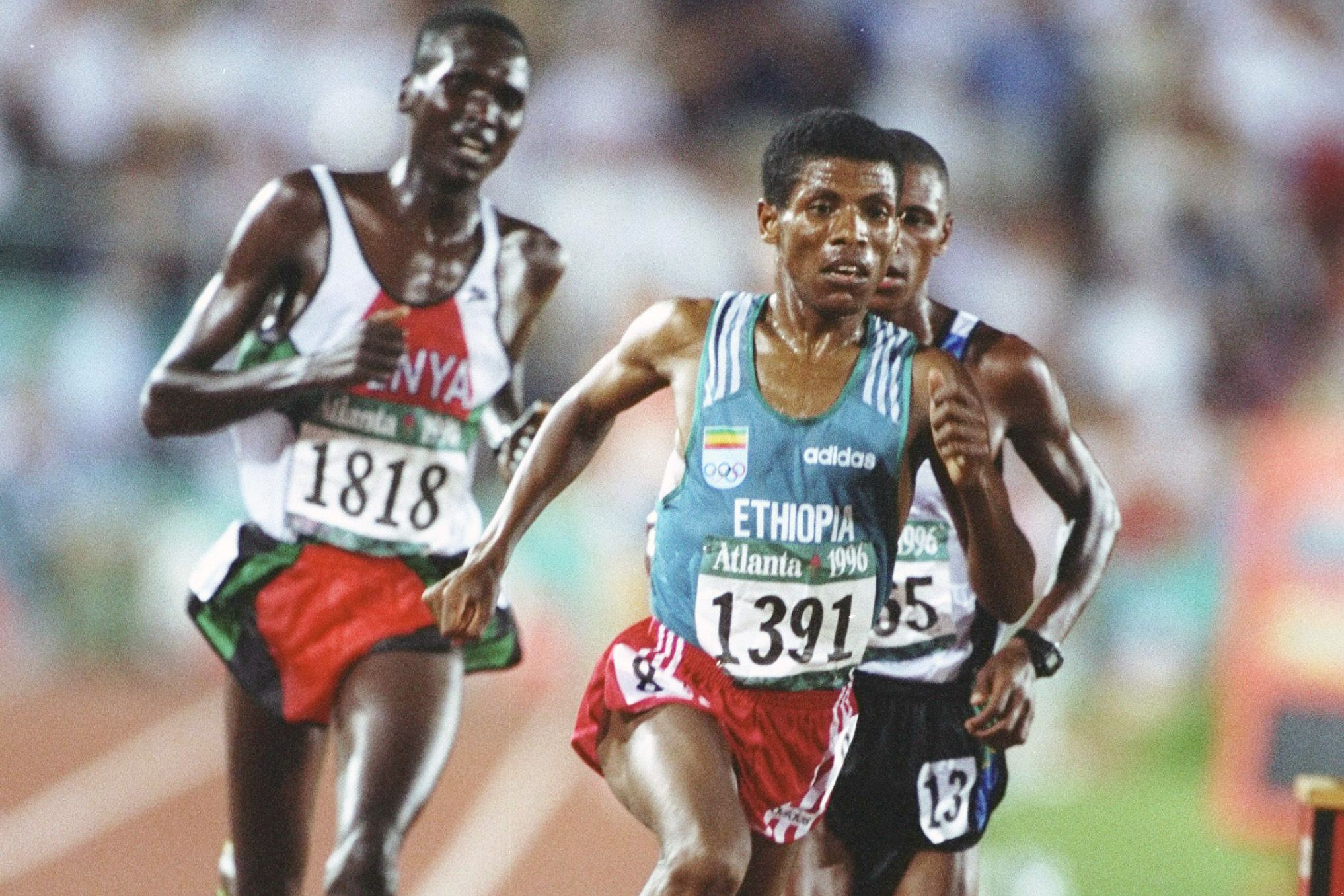
Haile Gebrselassie in action in the 1996 Olympic 10,000m final (© Getty Images)
The gold medal spread spanned 24 countries, six more than in Barcelona in 1992 and double the figure from Seoul four years before that. The record tally crept to 25 in London in 2012, was matched in Tokyo in 2021, and rose to 27 in Paris in 2024.
There were global breakthroughs all over the programme. Ghada Shouaa became Syria’s first Olympic champion, winning the heptathlon with 6780. Deon Hemmings became the first Jamaican woman to win an Olympic gold medal, taking the 400m hurdles in a Games record 52.82. Chioma Ajunwa of Nigeria took long jump gold with 7.12m, Africa’s first Olympic field event gold by a woman. Ethiopia’s Fatuma Roba became the first women’s marathon champion from Africa, finishing two minutes clear of the field in 2:26:05.
In the men’s marathon, Josia Thugwane became South Africa’s first black Olympic champion, beating Lee Bong-Ju of South Korea by three seconds in 2:12:36, while Jefferson Pérez’s 20km race walk victory in 1:20:07 represented Ecuador’s first Olympic gold medal in any sport.
In other events, Czech javelin great Jan Železný retained the men’s title with a second-round throw of 88.16m, while there were victories with Olympic records for Bulgaria’s Stefka Kostadinova in the women’s high jump (2.05m) and Portugal’s Fernanda Ribeiro in the women’s 10,000m (31:01.63).
Thirty years on, Atlanta 1996 stands as both Johnson’s Games and one of athletics’ broadest Olympic showcases – a meeting of record-breaking speed, enduring champions and a gold-medal map expanding further than ever before.
Simon Turnbull for World Athletics Heritage