
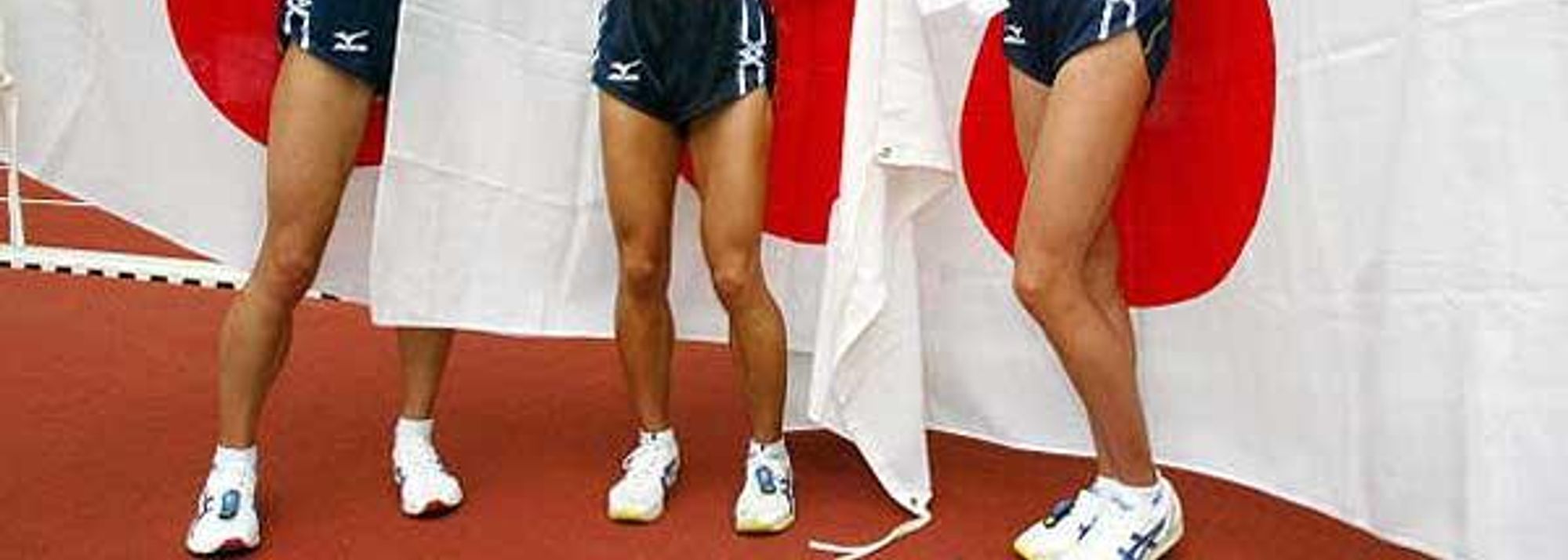


Masako Chiba, Mizuki Noguchi and Naoko Sakamoto (© Getty Images)
Mizuki Noguchi, Masako Chiba and Naoko Sakamoto finished second, third and fourth respectively at the women’s marathon in the World Championships. While Noguchi and her coach Nobuyuki Fujita were ecstatic because she made the Olympic Marathon team, immediately after the race in the mixed zone, Chiba said, “I guess I have to run another marathon.” Despite winning a bronze medal in Paris, Chiba was not guaranteed a position in the Olympic Marathon team. Such is the depth in women’s marathon running in Japan.
Earlier this year the Japan AAF announced that the Japanese women’s Olympic marathon team will be selected based on the performances at the World Championships in Paris, the Tokyo Women’s Marathon in November, Osaka Women’s Marathon in January, 2004 and Nagoya Women’s Marathon in March, 2004.
The criteria for the selection at the World Championships were spelled out precisely - the first Japanese to finish the race is automatically selected, provided she wins a medal in Paris. Thus Mizuki Noguchi, who won a silver medal in Paris, was selected as she crossed the finish line. The criteria for selection in the three domestic marathons, however, were not spelled out precisely. If the history is of any guidance, this could cause controversy. In the last three Olympics, at least one runner worthy of the Olympic team berth was left out of the team each time. Had they been a citizen of any other country, they could have run in the Olympics.
In 1992, Akemi Matsuo was left off the team despite recording 2:27:02 (fifth fastest time of the year going into the Olympics) when she finished second in the Osaka Ladies Marathon. In 1996, Hiromi Suzuki was left off the team despite running 2:26:27 (second fastest time of the year going into the Olympics) when she finished second (first Japanese) in the Osaka Women’s Marathon on her debut. It has been rumored that her coach Yoshio Koide muttered, “Suzuki can win gold in Atlanta.” In her race of redemption Suzuki won the World Championships marathon in 1997. Also left off the 1996 marathon team was Ikuyo Goto who finished third in the Osaka race with 2:26:37. In 2000, Harumi Hiroyama was left off the team despite running 2:22:56 (third fastest time of the year going into the Olympics) when she finished second (first Japanese) in the Osaka Women’s Marathon.
Of the 24 runners who have broken 2:23 in the history of the marathon, eight are Japanese; except for Mizuki Noguchi (2:21:18), who already is on the team, they - Naoko Takahashi (2:19:46), Yoko Shibui (2:21:22), Masako Chiba (2:21:45), Naoko Sakamoto (2:21:51), Eri Yamaguchi (2:22:12), Reiko Tosa (2:22:46) and Harumi Hiroyama (2:22:56) - are all expected to compete for the Olympic berth by running in one of the three domestic marathons.
Several runners with superb credentials at shorter distances are also expected to compete for the Olympic marathon team. Among them, Miwako Yamanaka, who was fourth at the 2002 World Cross Country Championships, Mari Ozaki, reigning 5000m national champion who recorded 2:23:30 in her debut marathon, Haruko Okamoto, who was 9th at 10000m in Edmonton and recorded 2:27:01 in 2002, Megumi Tanaka, who was 10th at 5000m in Sevilla and recorded 2:28:10 debut marathon in 2002 and Kazue Ogoshi, who recorded world junior best at 20Km (1:06:25), are serious contenders to make the team.
The defending Olympic Champion, Naoko Takahashi has announced her intention to run the Tokyo Women’s Marathon. Eri Yamaguchi who finished seventh in Sydney is also expected in the race. Reiko Tosa, Edmonton silver medalist at the marathon, was originally scheduled to run in Tokyo, but had to pull out due to an injury she sustained while high altitude training at Kunming, China. She is now scheduled to run in the 2004 Nagoya Women’s Marathon.
By far the most intriguing race is the 2004 Osaka Women’s Marathon in January. Perhaps by then only one spot may be left on the team.
Masako Chiba and Naoko Sakamoto, who finished second and third respectively in the 2003 edition of the race are returning to the venue of their personal bests. Chiba was a bronze medalist at 10,000m in the 1997 Worlds, while Sakamoto holds national marathon debut record (2:21:51). Yoko Shibui, the national record holder at the 10,000m who made a stunning marathon debut (set the world marathon debut record, 2:23:11) in the 2001 Osaka Women’s Marathon is also entered the race.
Harumi Hiroyama, who was 4th at 10,000m in Sevilla, was overlooked four years ago; she is a sentimental favorite. Miwako Yamanaka, who dropped out with an injury she sustained during the 2003 edition is expected along with her teammate Kazue Ogoshi. They set personal bests at 10000m (31:24.00 for Ogoshi and 31:32.10 for Yamanaka) recently. It should be noted that runners who finished second in Osaka were eft off the last three Olympic teams despite recording one of the fastest time of the year.
In the final qualifying race, Nagoya Women’s Marathon, in addition to Reiko Tosa, Takami and Hiromi Ominami, with the personal bests of 2:23:43 and 2:26:17 respectively are expected to race. Yasuko Hashimoto, who won the Berlin Marathon in apersonal best of 2:26:32, is also expected to run in Nagoya.
With Mizuki Noguchi already selected, the most likely scenario is that Naoko Takahashi take the second spot on the Olympic marathon team by winning the Tokyo Women’s Marathon and the third and the final spot will go to the winner of the Osaka Women’s marathon. However, the most interesting scenario may develop if the second place runner in Osaka runs much faster than Takahashi’s time in Tokyo.


