
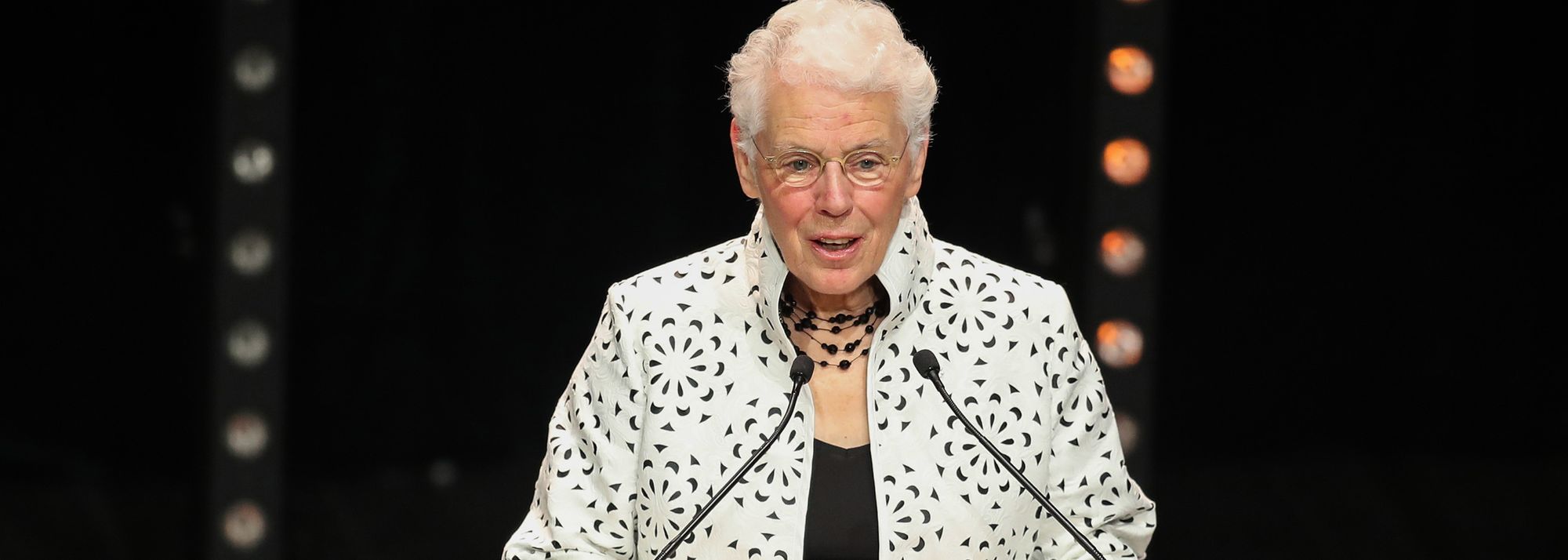


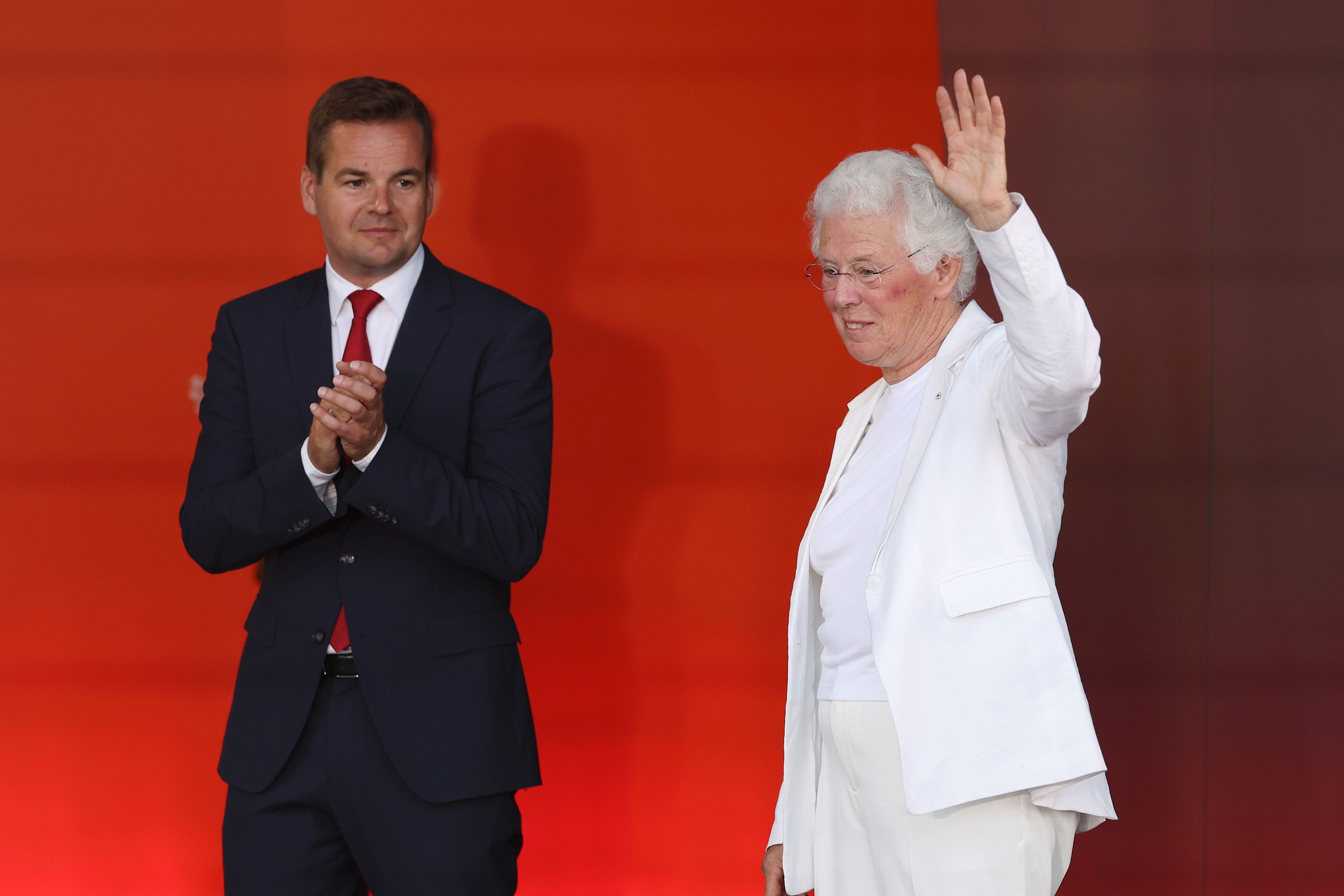
Abby Hoffman delivers a speech prior to giving out the Female Athlete of the Year award in 2019 (© AFP / Getty Images)
Abby Hoffman has always been a trailblazer.
Born into an unconventional family in Toronto, she was nine years old when she made her first stand for gender equality, although her motivation was simply that she wanted to play.
In the 1950s, young Abby had set her sights on playing ice hockey, like her two older brothers, but when her parents took her to the sign-up night for children in Toronto, they were told that there was no competition for girls. However, Hoffman took matters into her own hands while they were making enquiries and “managed to inveigle myself into a lineup” and was registered as ‘Ab Hoffman’.
She was assigned to a team and happily played most of the first season without anyone in officialdom noticing that she was a girl. In fact, she played well enough to be selected on an All-Star representative team to compete against other leagues, at which point her family was asked to provide her birth certificate which identified her as a female. That spelled the end of her hockey career.
Both Hoffman and her “non-conformist” parents found the decision unfair and they tried to get the league to organise teams for girls. Her case became a “bizarre cause celebre” in the media. The result was that Hoffman’s resolve to ensure girls and women had equal opportunities in sport was established at a very young age.
From there she channelled her competitive instincts into swimming, her mother’s sport, and became a “fairly successful” swimmer, training in a high-performance club alongside Olympians and international swimmers. She was 14 when her swimming coach sat her parents down and told them that she did not have the ability to be a great swimmer and suggested that she try athletics instead.
She had done some running at school, and both her brothers were athletes, so she turned her attention to distance running. Her club and coach organised longer distance road races for women, even though the athletics authorities at the time didn’t permit longer distance events for women. At that time, the longest competitive distance for women was 800m, so she focused on that event.
“I have always had an affinity for the pace and tactics (of the 800m),” she recalls.
Already a highly trained athlete, she found success immediately. Just two years later she was selected to run for Canada at the 1962 Commonwealth Games in Perth, Australia, and then at the 1964 Olympic Games in Tokyo, where she competed on the same track as her childhood hero, the 1956 triple Olympic champion Betty Cuthbert, who won the 400m at that Games.
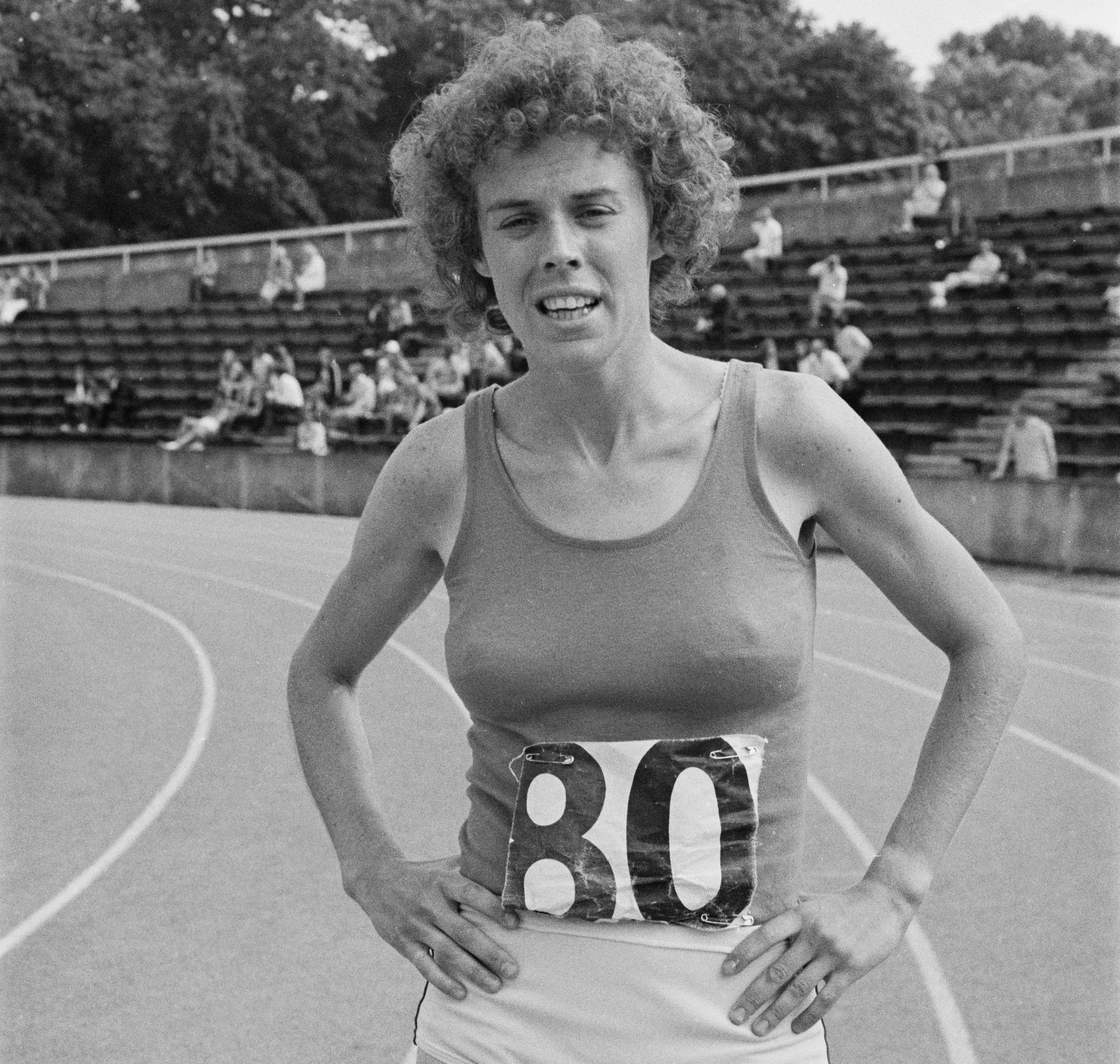
Canadian athlete Abby Hoffman in 1971 (© Getty Images)
Hoffman combined her athletics with university studies in politics and economics, and then an academic career, over the next decade. She won a Commonwealth Games gold medal in 1966 and went to three more Olympic Games, reaching the Olympic finals in both Mexico City and Munich, before finishing her career in Montreal during a period of societal upheaval when conventions were being questioned or overturned. This cultural revolution eventually made its way into sport.
Hoffman had an unusually long sports career for her time because she was able to use graduate student scholarships, fellowships and teaching assistant positions to cover her living costs. But as a home Olympic Games beckoned in Montreal in 1976, she concluded that the government support offered to athletes was inadequate for the demands being placed on them.
“In 1971 and then in 72, there had been some big dust ups about athlete selection for teams – what the criteria should be, how those criteria should be applied, what recourse existed, the relationship between the Canadian Track and Field Association and the National Olympic Committee and who really gets to decide who goes to the Olympic Games,” she recalls.
“And that was the beginning of the formation of a movement of activist athletes. If you think about the broader social environment at the time, many young people were in a state of rebellion, and so it was in sport too. In 1971, we formed the first athletes committee inside the Canadian Track and Field Association, and I helped spearhead that with a number of other people.”
In the lead up to Montreal, more resources were pumped into the Canadian sports system for coaching, sports science, and warm weather and altitude training camps, but without the living allowances that would allow then amateur athletes to train full-time.
“There was a radicalisation of the athlete community at that time, and again, myself with a number of colleagues in different sports really started rattling the cages in the lead up to the Montreal Olympic Games,” she says.
“But over the whole period, starting right after Munich, we were advocating and agitating and basically making the point that if you want top performances from the Canadian team in 1976, you are not going about it the right way. You cannot expect athletes to devote their lives to sport by centralising at various training locations away from their homes and travelling to competitions for months at a time without sufficient support for their basic living costs.
“This was a pretty successful movement. We generated considerable public sympathy through the media and exerted a lot of political pressure on the federal government, the Canadian Olympic Committee and the various sport bodies, and a lot of new money did
eventually arrive that was not just for technical programming, but also for athletes to live at a decent level.
“These kinds of issues had a profound galvanising and energising effect on me. I wasn’t shy about taking on the powers-that-be. I didn’t set out to lead a movement, but just naturally I emerged as a leader.”
Hoffman became an athlete representative on both the board of the Canadian Track and Field and the Canadian Olympic Association, before being offered a role administering financial assistance for athletes. She moved into other sports administration roles with the provincial government in Ontario, before she was appointed as the director-general of Sport Canada, Canada’s national sport agency and primary sport funder in 1981. She did that job for 10 years, during which she was also appointed to the Women’s Committee of the IAAF (now World Athletics), her first formal introduction to the governing body of international athletics.
Her experience of this committee was that it was “half window dressing and half impactful”. The Women’s Committee put a lot of pressure on the IAAF to add the missing events for women, including longer distances, the full programme of jumps, hurdles and throwing events, steeplechase and race walks. And, away from the field of play, the International Olympic Committee and major international sports federations came to the realisation in the 1990s that their male-dominated governance structures were out of step with the drive towards gender equality in civil society, so they began to create opportunities for women to be elected and to set targets (albeit very modest ones initially) for female representation.
In 1995, under the leadership of autocratic IAAF president Primo Nebiolo, Hoffman stood for what eventually became three positions for women on the IAAF Council. She was elected alongside Morocco’s 1984 Olympic 400m hurdles champion Nawal El Moutawakel as the first two female members of the Council. The great Polish sprinter Irena Szewinska joined them in 1999.
However, Hoffman’s first term on the Council was frustrating as Nebiolo had concentrated power in the presidency. She found the input of the Council “inconsequential” at that time.
“It was not the driving force of the organisation, that’s for sure,” she says.
Nebiolo died in office in 1999, and the former long jumper Lamine Diack of Senegal was elected to replace him. Diack had a different leadership style and was “considerably more open” to the participation of Council members in decision-making roles.
“For people that he trusted or liked, or who he thought could deliver on something he thought was worth pursuing, he was very open to their participation, and there was a lot more engagement of Council members,” she recalls.
“I was involved in the medical and anti-doping commission, there was an anti-doping taskforce that reviewed all of the cases, many things that the AIU (Athletics Integrity Unit) does today but as an independent organisation,” Hoffman says.
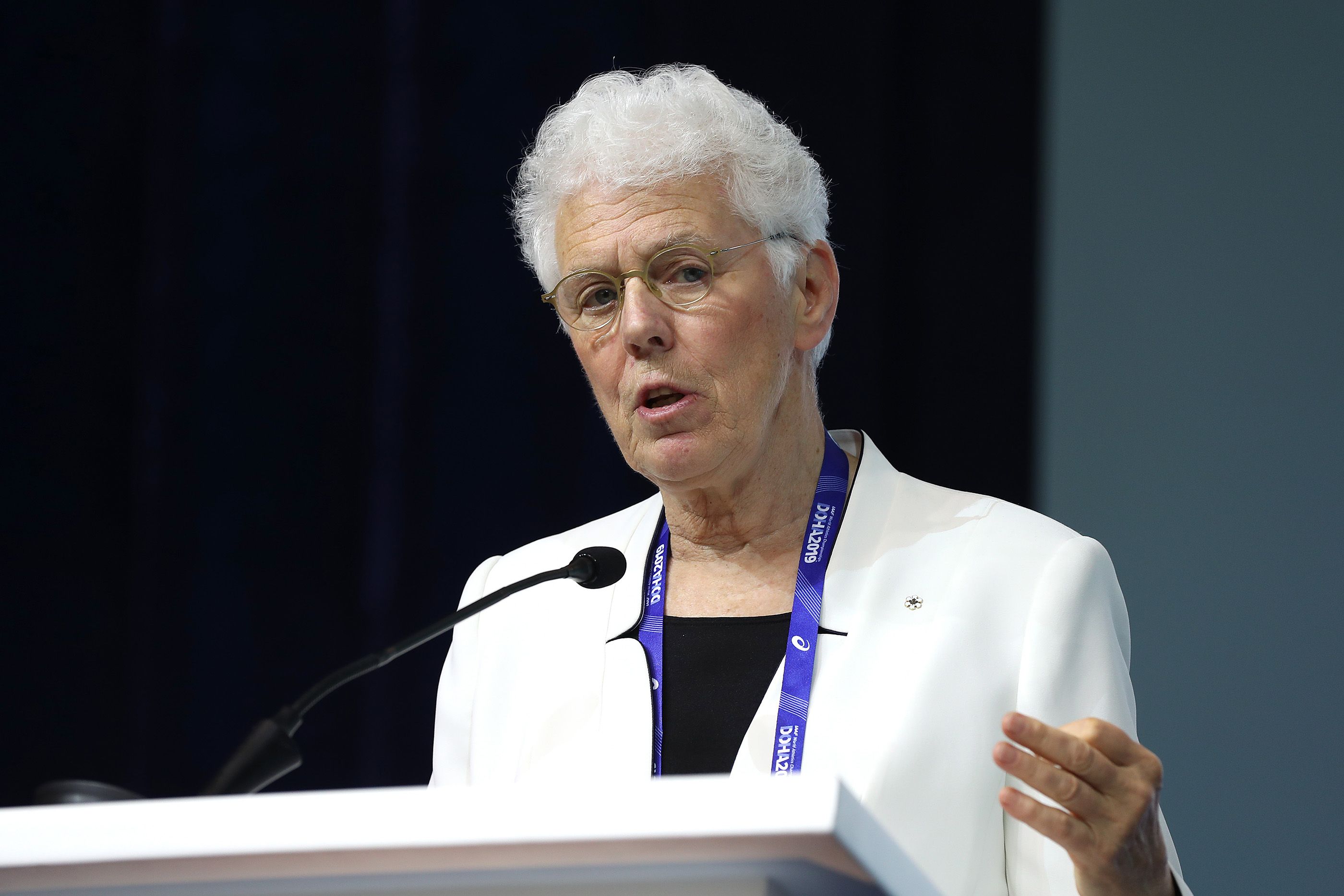
Abby Hoffman speaks during the 52nd Congress in Doha (© Getty Images)
Diack also championed more female representation on the Council and gave experienced Councillors like Hoffman more responsibility. She was part of the group that recommended future sites for the World Athletics Championships and a member of the Competition Commission.
“There were things like that which were very positive, and maybe it caused some of us to be blind to things we should have been more aware of, about what was really going on behind the scenes on financial matters and commercial contracts, among other things,” Hoffman says.
Diack led the IAAF until 2015, when he stepped down and the IAAF was immediately embroiled in a corruption scandal involving him and his family. That led to much soul-searching within the Council and the imperative for a massive reform process led by the new president, Sebastian Coe. Coe reinvented the governance and leadership of World Athletics, the name the organisation adopted in 2019.
“I think the Council members of the Diack era have to bear some fault for what happened prior to 2015,” Hoffman says. “A lot of what came to light couldn't possibly have been known to Council members because so much authority had been concentrated in the President’s office for a very long time. But there were things we should have asked more questions about; we should have probed deeper and been less trusting.. People didn't by-and-large challenge the president or the dangerous centralisation of authority. This tendency was something I observed from my very first day as a Council member.”
When the extent of the corruption became apparent, Hoffman says she was “mad at myself, and the Council and the Executive Board”.
“Why had we slept through this, when there were all these signs?” she asks. “And now, in retrospect, those signs weren't just a dim amber light on the horizon, they were actually flashing red, blindingly, right in front of us.’’
She channelled her anger into making amends, working hard on governance reform and championing the new president, Sebastian Coe’s resolve to reform the organisation.
“His job became restoring not just the reputation but the integrity of the organisation in terms of how it operated and what its policies were, rooting out corruption, which was not confined to Lamine and his family. It had unfortunately become the lifestyle choice of some other people and the organisation’s policies and processes and historic lack of transparency and accountability allowed corruption to persist,” she says.
“We needed to basically tear up both the official and the unwritten modus operandi of the organisation and its key institutions and take a blank, clean piece of paper and start over again on a design that provided the most credible combination of representation, integrity, accountability, assignment of appropriate roles to appropriate bodies, and the right relationships among these different bodies.
“And because this whole thing started with scandals about doping, the decision was taken pretty early on that there needed to be some sort of separate, arm's length entity that would look after anti-doping and ensure it was not subject to interference motivated by political or personal interests. This ethos led to the establishment of the Athletics Integrity Unit.
“It’s amazing when I reflect back to when the new constitution was adopted by the members at the special meeting of Member Federations convened in Monaco (in December 2016) … how much was actually done in a very short period of time. We were just on it constantly, responding to proposals, meeting, reworking things, drafting Terms of Reference, engaging all MFs and ultimately drafting the new constitution and all of that.
“It was very exciting because it's not that often that something so cataclysmic happens that you basically have to toss everything overboard and start again. It wasn't easy, but given the breadth of transformation the organisation was undergoing it wasn't a monumentally impossible task to build in equality in the Constitution as well.”
World Athletics Council Member Abby Hoffman at the World Athletics Championships in Budapest (© Getty Images)
The reform process laid out a schedule for the Council to reach full gender equality in stages, with the first female vice president to be elected in 2019, and the female representation on Council to increase to 40% in 2023 and reach full parity in 2027.
Hoffman says she favoured a faster, more radical reform, but the majority preferred a steadier pace. Her attitude was, and is: “If you have to break a few eggs to make this omelette, so be it. Go for it.”
As it turned out, the Council reached parity four years ahead of schedule, at the 2023 Congress in Budapest, where 13 female and 13 male candidates were elected.
But while the Council now has equal female representation, she points to inequalities in the system that still need to be addressed to reach true gender parity, noting as an example that athletics has never had a female area president.
“I think there are still issues that are taking a while to surface and be dealt with in an effective way,” she says. “We have these huge challenges still on coaching and technical roles in the sport. We know there are some areas where safeguarding is a tough sell. Of course, not all safeguarding is connected to females, but a significant portion of it certainly is. So, it can be tough to get uptake on that work.
“And when it comes to the area presidents, I don't see a lot of preparedness to cede power and it's partly because they are such political positions. So, I would say the more political the position is, the less likely it is to embrace gender equality as a value or practice. It will be interesting to see how long it will take to achieve real change.”
In the meantime, she is excited by the new female talent that has been elected to the Council in the last two years and is hopeful that the experience these new members gain will help them assume other leadership positions, both in their own regions and at the world level.
Equality and integrity, on and off the field of play, remain essential cornerstones of Hoffman’s value set. They are essential in their own right, but Hoffman also sees them as key features of a modern organisation committed to expanding the reach of the sport, acquiring the resources needed to better support athletes, and presenting more engaging and entertaining events which retain current athletics enthusiasts while attracting legions of new fans and participants.
As always, she is up for the challenges ahead.
World Athletics career
· World Athletics Council Member (1995-present)
· World Athletics Safeguarding Working Group Chair (since 2021)
· World Athletics Russia Taskforce Member (2015-2023)
· Executive Board Member (2019-present)
· Executive Board Remuneration Committee Chair (2019- present)
· World Athletics Competition Commission Member and then Chair (2011-15 and 2015-2019)
· World Athletics Working Group on Integrity & Governance Reform Member (former)
· World Athletics Medical/Anti-doping Commission Member (former)
· World Athletics Doping Review Board Member (former)
· Women’s Committee (former)
· World Athletics – Chair, Jury of Appeal at major World Athletics Competitions and the Olympic Games (ongoing)
Nicole Jeffery for World Athletics