
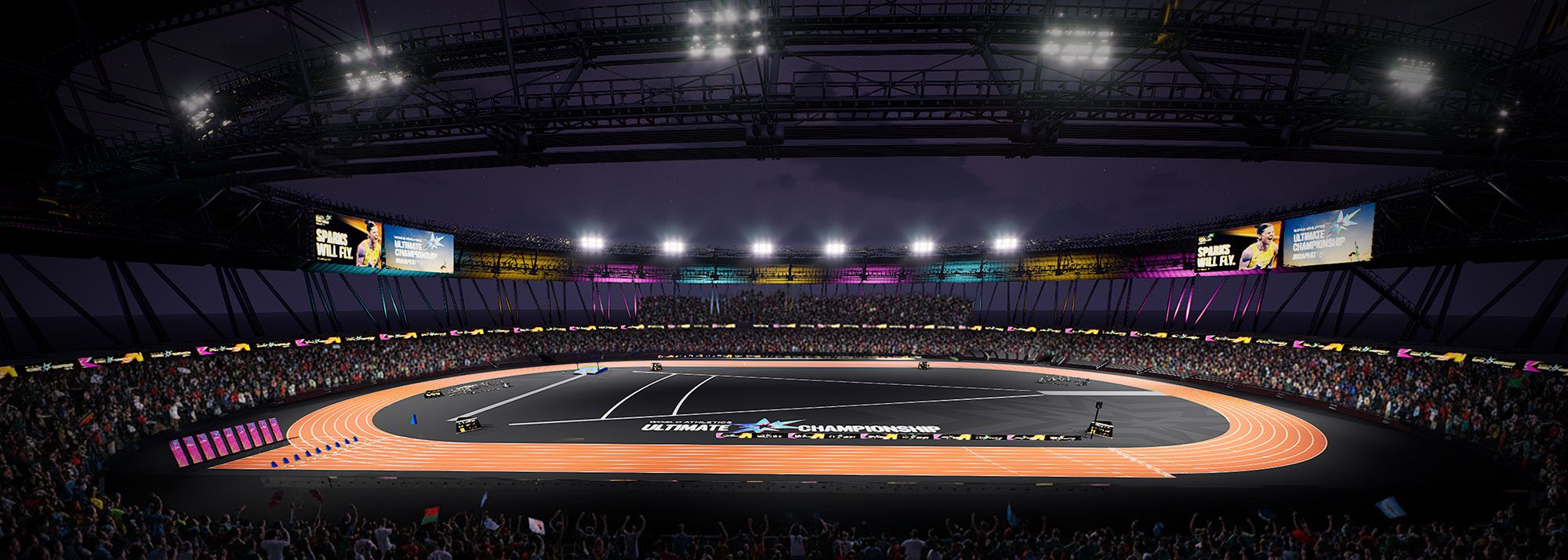
World Athletics Ultimate Championship
The inaugural World Athletics Ultimate Championship gets under way in Budapest in the coming days, but the event has been three years in the making.
Central to the development of the new-look competition has been World Athletics' Innovation and Research and Development Unit, headed by Jakob Larsen. He explains how science, research and data analysis have helped shape some of the key decisions behind the Ultimate.
What was the remit of the unit when it was set up?
Originally, the focus was at the sport level. We spent time looking at things such as which new disciplines could be introduced. The mixed 4x100m relay at the Ultimate is one result of that work.
We used the World Championships in Budapest to carry out a lot of our initial analysis and generate insights that could help drive change. From there, we moved on to looking at new opportunities such as the Ultimate and the World Athletics Marathon Championships.
With the Ultimate, we had the opportunity to put some of the insights and knowledge we had gained to hopefully good use.
How does something go from an idea to reality?
The usual process starts with a lot of data collection and analysis, both internally and externally. We look at what that tells us and what we can learn from it.
From there, an idea can develop into a proposal and eventually make its way to the World Athletics Council.
How do you decide which events to include in the Ultimate and which to leave out?
Some might think it's purely a popularity contest, but the line-up of disciplines is based on several considerations.
One is the popularity of each discipline, based on global fan surveys and entertainment surveys conducted in stadiums. But there are other sources too, such as looking at how TV viewers behave minute by minute when particular disciplines are being shown.
We've carried out research across numerous championships, which means we're able to identify certain patterns. At several championships, we also conducted emotional-impact analysis and biometric measurements with TV viewer panels to assess levels of excitement through things such as sweat response and pulse rate.
Putting all of that together gave us an indication of the effectiveness of certain disciplines – not just in isolation, but in how they work alongside one another. There has to be an interaction between track and field.
Can you explain more about the viewer tests? What did they involve?
We conducted research with international panels using hand-mounted devices. Panellists watched the Budapest 2023 World Championships and the Paris Olympics at home, and we collected their reactions second by second.
We could then match that data against specific competition moments – a foul compared with a valid jump, for example, or the minutes immediately after a race – as well as non-competition elements such as TV graphics, athlete introductions, interviews and studio segments.
That gave us insights into the impact of almost everything: heats compared with semi-finals and finals; fouls compared with valid jumps; whether a long jump is competitive, valid but not competitive, or invalid.
We could also look at nationality – whether watching an athlete from your own country increases engagement, for example, and whether that effect differs between track and field.
It's a level of detail we simply haven't had before.
We then combined the behavioural data with the panels' survey responses, allowing us to compare what people say they like with how they actually react. That turned out to be an important element.
People sometimes report the preferences they think they should have, while their measured reactions point somewhere slightly different. That gap between conscious and subconscious preference is valuable. It gives us another lens through which to look at competition design, beyond simply asking people what they want.
We're still at an early stage with this kind of analysis, but we've already put some of those insights to work in designing the Ultimate.
Were there other factors in deciding the programme?
Another consideration is the layout of the stadium and the need to have something happening for everyone.
It's almost like a five-ring circus: two bends, two straights and the field. You need entertainment across those five areas inside the stadium in Budapest.
Then there are the obvious constraints of having just nine hours of competition, compared with around 55 hours at a World Championships.
Are the disciplines set in stone from one Ultimate to the next?
No. For one thing, the layout of the next stadium might be completely different, and that will have an impact.
We've only begun to scratch the surface of how the various disciplines affect each other. It's not like a football match, where there's one competition taking place. We have several competitions happening at the same time. Some will amplify each other and work well together; others less so.
Are there different considerations around the field events?
We've tended to group all field events together, but there are important differences.
In the vertical jumps, the best tends to happen last. In the throws and horizontal jumps, that's not necessarily the case. There is a set number of attempts and the decisive moment can come at any point.
Throws and horizontal jumps are therefore useful when you're scripting the competition. Vertical jumps are less predictable because you can't control their duration in the same way, and they tend to have this emotional peak at the end.
They're almost like a joker in the pack – you can't script them to the same extent.
Fans have been central to your thinking throughout, haven't they?
I'm a fan of athletics, but I've made a point of looking at the fans rather than just the field of play.
In my opinion, the ideal team would have half of its people looking at the competition and the other half looking at the fans. Sometimes you need to turn your back on the competition and watch the audience instead.
This event has also been tailor-made for broadcast, so during the competition some of the team won't be watching it live in the stadium. They'll be watching on television to understand how the product works from a broadcast perspective.
Is the world of athletics fans an easy one to navigate?
It's a complicated landscape. There's an appetite for change, but people are also worried about the consequences.
Whenever you change something, most people's first question is: what does that mean for me and for the things I care about?
Is there a risk in staging a new event like this?
There is, but I'd argue that not doing it comes with an even greater risk.
Look at the sports industry as a whole. Things are clearly changing, and the way people interact with sport has changed. Not changing would therefore be counter-intuitive.
What was the thinking behind some of the innovations we're going to see in Budapest?
Budapest in 2023 was one of the best World Championships we've seen. Going back to the same location meant we agreed very early on that we needed to do something different, otherwise there was a risk of unfavourable comparisons.
You either want to be a better version or a different but equally good version. So we needed to send a clear message that this is something different.
Not every innovation will work, will it?
There's an inherent risk and that comes with the territory, but we're not simply pulling ideas out of a hat. There's a theory behind all of this.
But it is still theory, and we have to see how it plays out in real life.
Some things will be brilliant and will make it into the next edition of the Ultimate, or into other competitions. With others, we might conclude that it was a great idea but, for whatever reason, it didn't work.
What are you most excited about with the Ultimate?
It sounds boring, but it's the scripted approach to the timetable.
Historically, athletics timetables have been based largely on functional design principles. This time, we reversed that. We looked at the emotional-impact data and found that, while the average level of excitement when watching athletics is quite high, the peaks aren't necessarily structured in the right way.
That led us to rethink the timetable principles.
Each session will open with a proper A-list track final, which is something we've never really done before. Usually the programme is backloaded to build towards a climax.
This time, each hour has been designed to work almost as a standalone unit. We've gone for something that feels pulsating throughout.
Are there any innovations or ideas that didn't make it into the Ultimate that you'd like to have seen?
I'm tempted to say thousands!
One idea was to offer athletes in the throwing events – the hammer, for example – customised, painted implements. Maybe that will be one for round two.
The long jump take-off zone was another idea that we ultimately decided not to introduce.
We've also initiated several technology-related projects that were originally intended for the Ultimate but, because of the time constraints, will now be introduced at a later stage.


