
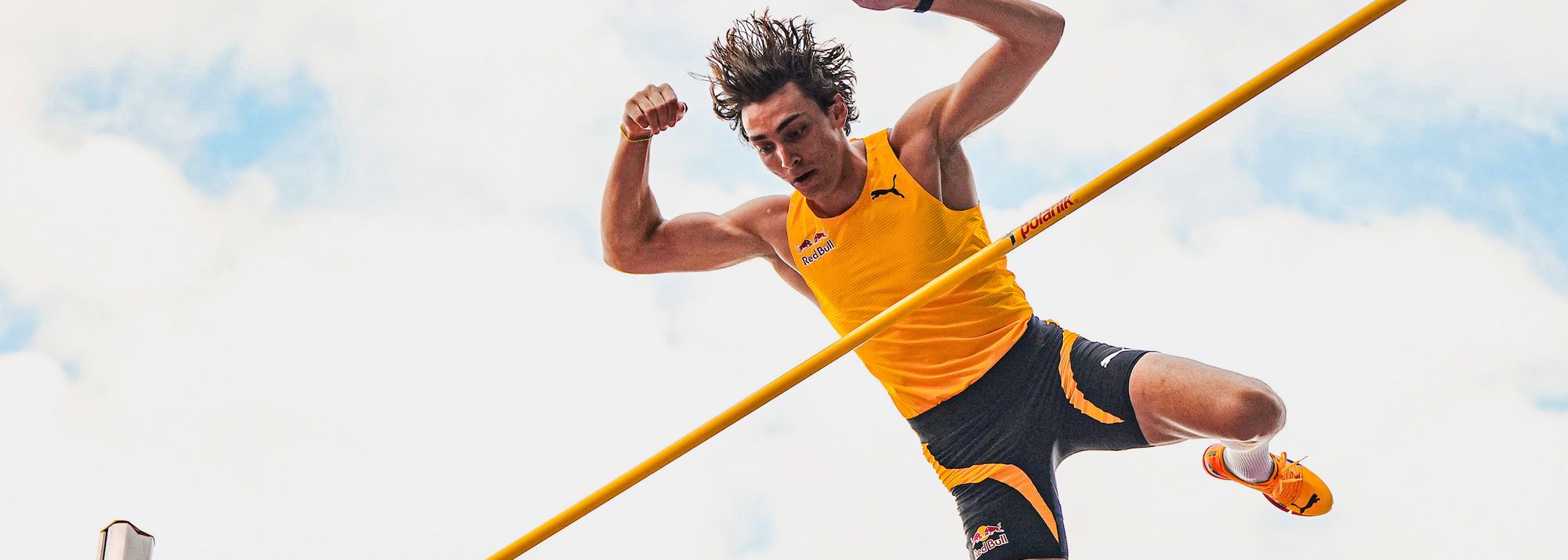
Mondo Duplantis, winner of the pole vault in Ostrava (© Sonya Maleter)
Mondo Duplantis can often make the pole vault look easy as he clears world-record heights. But as Athanassios Bissas explains, there is so much more complexity to it. The Greek professor unpicks the science behind the perfect pole vault.
Speed on the runway
Speed is understandably of the essence on the runway and no one is quicker than Duplantis. In 2024, he was timed at a top speed of 10.31 metres per second and an average of 10.05 during the last three steps, having been measured seven years earlier at 9.5. As Bissas says: “He’s the only person I’ve seen from my records that has exceeded 10 metres per second. This is one of the key determinants of why he’s so special… it’s his speed.” His rivals will typically be around the 9.5 m/s range, giving Duplantis about a 12% kinetic energy advantage at the same body mass. Even if some of that is lost during the final transition, he can still carry an advantage into take-off. But it’s not just about outright speed, it’s also about remaining in control.
Lowering the pole
Interestingly, that top speed does not typically drop when lowering the pole, only dipping in the last step of the run-up. “When you’re interacting with the pole, you want to carry as much momentum as possible into the pole plant and, with body mass essentially constant, that mainly comes down to speed, so the higher the speed the better,” adds Bissas, who likens the instant the pole engages with the planting box to a collision. “You have to redirect that forward movement as you prepare to take off.”
Planting the pole and take-off
Some athletes take off with the foot roughly beneath the upper hand, others slightly ‘under’ with the foot closer to the box than the top hand, while others use a free take-off like Renaud Lavillenie. Duplantis, says Bissas, is an “under person although there’s nothing especially distinctive about the way he plants the pole”. He points out: “Through the pole you’re going to face large reaction forces transmitted from the planting box. At the same time, by your take-off posture position you’re trying to start manipulating the pole to start lifting your body and leaving the ground.” Athletes vary with their grip width. “So far, the equation is about how fast you are,” he says. “Then when you start manipulating the pole and ground and start elevating yourself. The strength of upper body, upper torso and shoulder muscles are quite important, the grip as well. You try to compress the pole and bend at the same time as you move into the take-off position.”
Pole loading
While take-off is crucial to the fate of the jump, with effective take-off angles often around 18-20 degrees, what happens immediately afterwards is just as important. Athletes now have a chance to add further energy to the vault beyond that generated during the run-up. “You start bringing one leg and then the other close to the pole until you get to the point of maximum bending,” says Bissas. “You stay relatively long through the early swing before beginning to tuck. Whatever energy you possess in runway running you’ve got to transfer that to the pole. While compressing and bending through the muscles that’s also adding more energy into the system. This is where you start to differentiate the good, better and elite.” In the case of Duplantis, in particular, he keeps working with the pole throughout this phase rather than simply riding its recoil.
Becoming a gymnast
The Greek professor likens this phase to transferring from being a sprinter to becoming a gymnast. “You coil your body, bringing it into a more compact position,” he explains. “You have to rock back, start inverting, extending and going all the way up. This is where you have to be aligned and synchronise yourself with the behaviour of the pole. Some of the energy stored in the pole will be dissipated. As you rock back, you reduce your moment of inertia by bringing your body parts closer to the pole. Then, as the pole unbends, you stay close to it and follow its timing before extending upwards. It’s a highly coordinated gymnastic movement – rocking back, inverting and becoming almost like an inverted pendulum.”
Clearing the bar
“The last push is important because you don’t simply let go of the pole – you actively push away from it to gain the final bit of height and position yourself for the crossbar,” says Bissas. “That also requires gymnastic skills and Mondo is very good at it. You have to turn, shape the body around the bar, but you still need enough forward movement to travel over the bar.” As for the limits to how high Duplantis or his peers can go, Bissas says recent research by some colleagues in France explored whether 6.50m might be possible, concluding that it is theoretically achievable, although improbable.

