







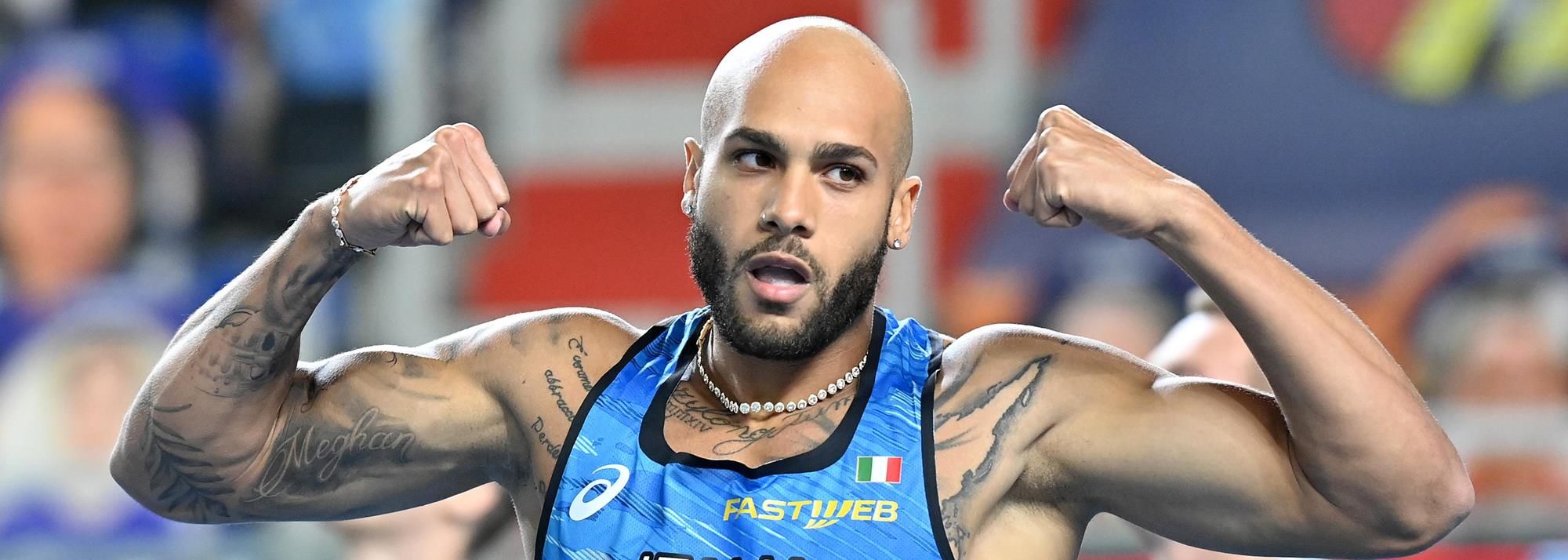


Lamont Marcell JACOBS profile
Three failed attempts at the 2019 European Indoor Championships in Glasgow completely changed Lamont Marcell Jacobs’ life. With this disappointing event he said goodbye to long jump and continued as a sprinter. Less than two years later, he became the first Olympic champion in the men's 100 metres after Usain Bolt, and this year he would reach the top at the World Athletics Championships Budapest 23.
Lamont Marcell Jacobs' story is anything but ordinary. Born to an Italian mother and an American father, the sprinter was confronted with huge challenges at a very early age. Just three months after his birth on 28 September 1994, his father, serving in the US Army, was transferred to South Korea.
Jacobs then moved back home with his mother to Italy to a small town next to Lake Garda. His parents divorced when he was six months old and all contact was cut off. For a long time he was angry with his father for abandoning them. They reconciled shortly before the Tokyo Olympics.
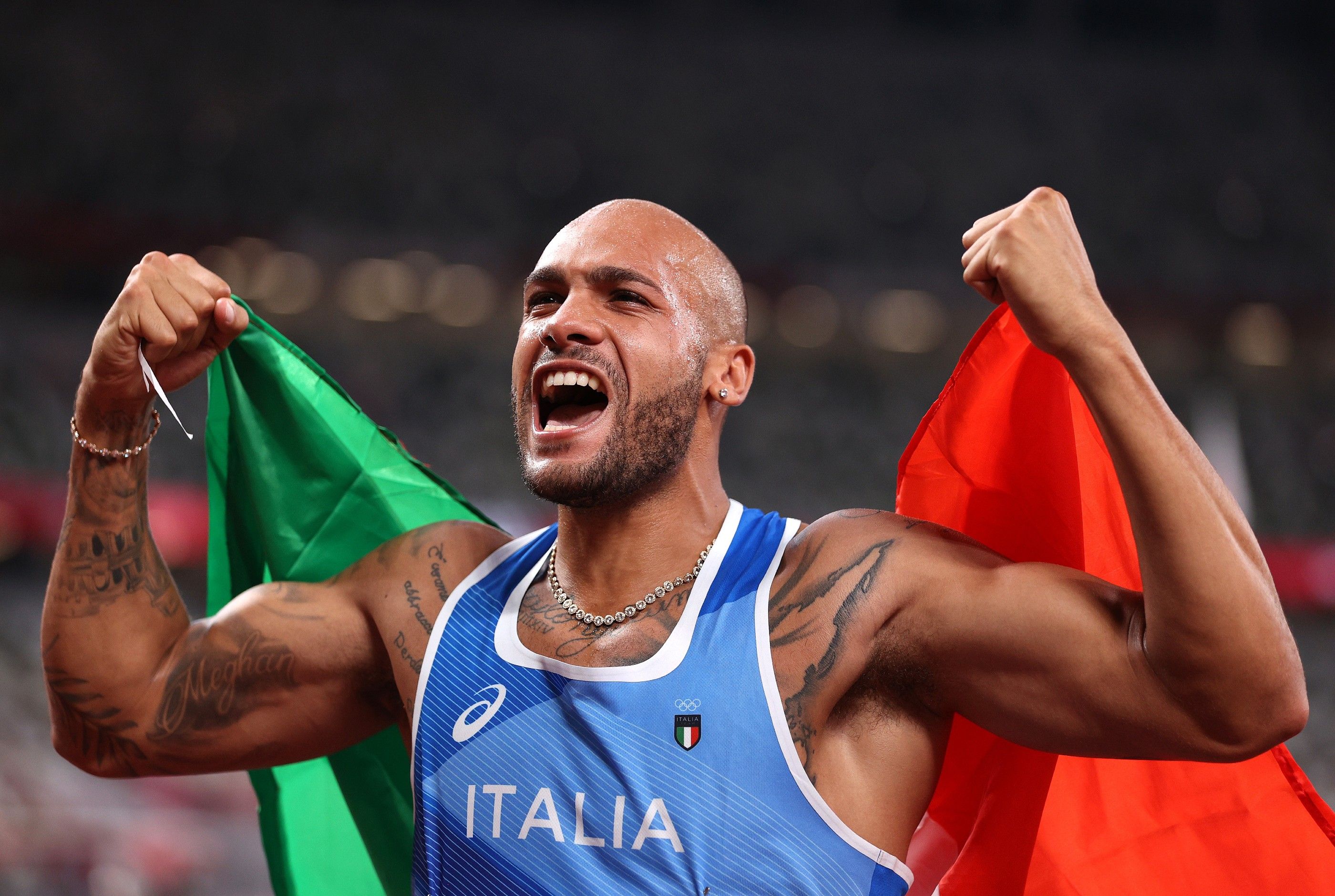
Lamont Marcell Jacobs celebrates his 100m gold at the Tokyo 2020 Olympic Games (© Getty Images)
Thanks to this liberating event he became the first Italian finalist and first winner of the men's 100 metres in the history of the summer Olympic games since 1896. He didn't break the 10-second barrier until Savona in 2021, when he was 26 years old.
He first went down to the track at the age of 10, his first successes came in the long jump. In 2016 he became Italian champion and at the U23 national championships he flew to 8.48 metres. The latter was not an Italian record only because it was achieved in a higher tailwind than allowed.
Due to a hamstring injury, he could not participate at the Rio 2016 Summer Olympics, like Gianmarco Tamberi, who is another great Italian star. At the next Olympic Games in Tokyo, however, they both reached the top. Tamberi shared the high jump gold medal with his good friend Mutaz Essa Barshim, while Jacobs stepped on the top of the podium as a sprinter.
He's still using his ‘crazy long jumper’ nickname in social media and even has a tattoo on his body. A disappointing 2019 European Indoor Championships set him on a new path. In Glasgow, like many other world-class athletes, he experienced what it is like to be eliminated in qualifying without a valid attempt.
Partly because of this failure and partly because of his numerous injuries in the long jump, he decided to focus on sprinting. The breakthrough also required a mental coach. On the advice of the specialist, he made peace with his father before the Tokyo Olympics, which were postponed to 2021 due to the coronavirus epidemic.
Right at his first major competition after the covid period, he managed to leave a mark at the 2021 European Indoor Championships in Torun, winning the 60 metres in 6.47 seconds. In his first outdoor competition in Savona, he set an Italian record, becoming the 150th person to break the 10-second barrier. His 9.95 run didn’t make him an Olympic favourite though.
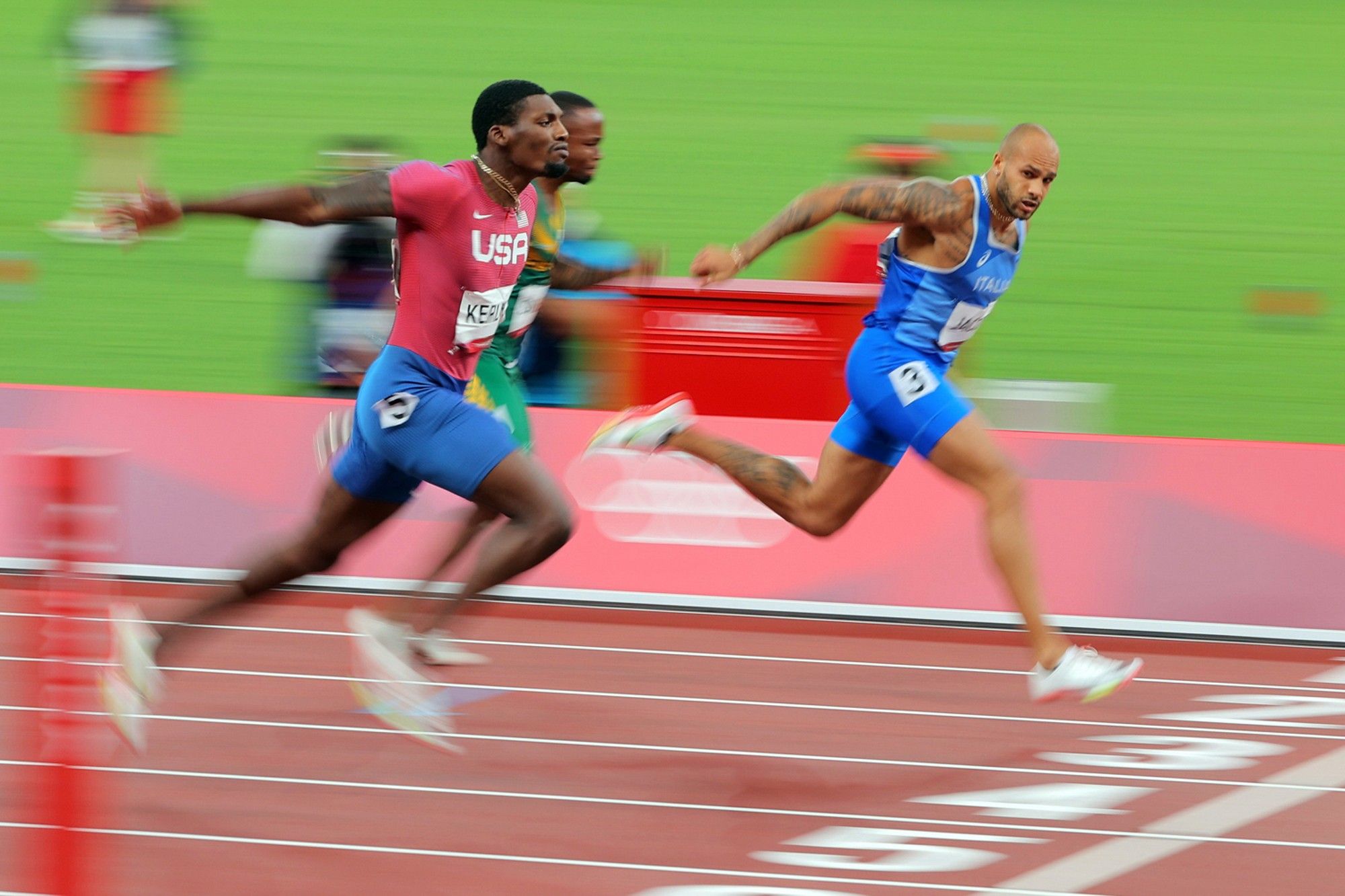
Italy's Lamont Marcell Jacobs wins the gold medal in the men's 100m final at the Tokyo Olympics (© Naoki Enokido / Photograph of the Year)
After Usain Bolt's retirement, one of the biggest questions in Tokyo was who would be the new king of sprints. There were no clear favourites in the 100 metres, but the eventual success of Fred Kerley, Akani Simbine, Trayvon Bromell and Andre De Grasse wouldn’t have been as big a surprise as Jacobs'.
Among the favourites, Bromell was surprisingly eliminated in the semi-finals by a single millisecond. Jacobs, on the other hand, was faster lap after lap, starting with 9.94 and securing his place in the final with 9.84.
Not only did he become the first Italian to reach the 100m final, but only Bolt run faster than him in the history of the Olympics. He needed to run 9.80 seconds, as Kerley (9.84) and De Grasse (9.89) both finished behind him with lifetime bests.
A few days after the 100 metres he also made history with the Italian relay. He ran the back straight after Lorenzo Patta, who was responsible for the start, and then passed the baton to Fausto Desalu. Then came Filippo Tortu, who passed everyone with dizzying speed to win the men's 4x100m for the first time in Italy's history. Their time of 37.50 seconds also became a national record. Jacobs returned from Tokyo as a two-time Olympic champion, but only after carrying the Italian flag at the closing ceremony.
The main event of the 2022 indoor season, the World Championships in Belgrade, was also a fantastic success for him. In the 60m final, he fought a tremendous duel with Christian Coleman, whom he beat by three hundredths, while achieving the fourth best result of all time. His 6.41 performance also broke the European record.
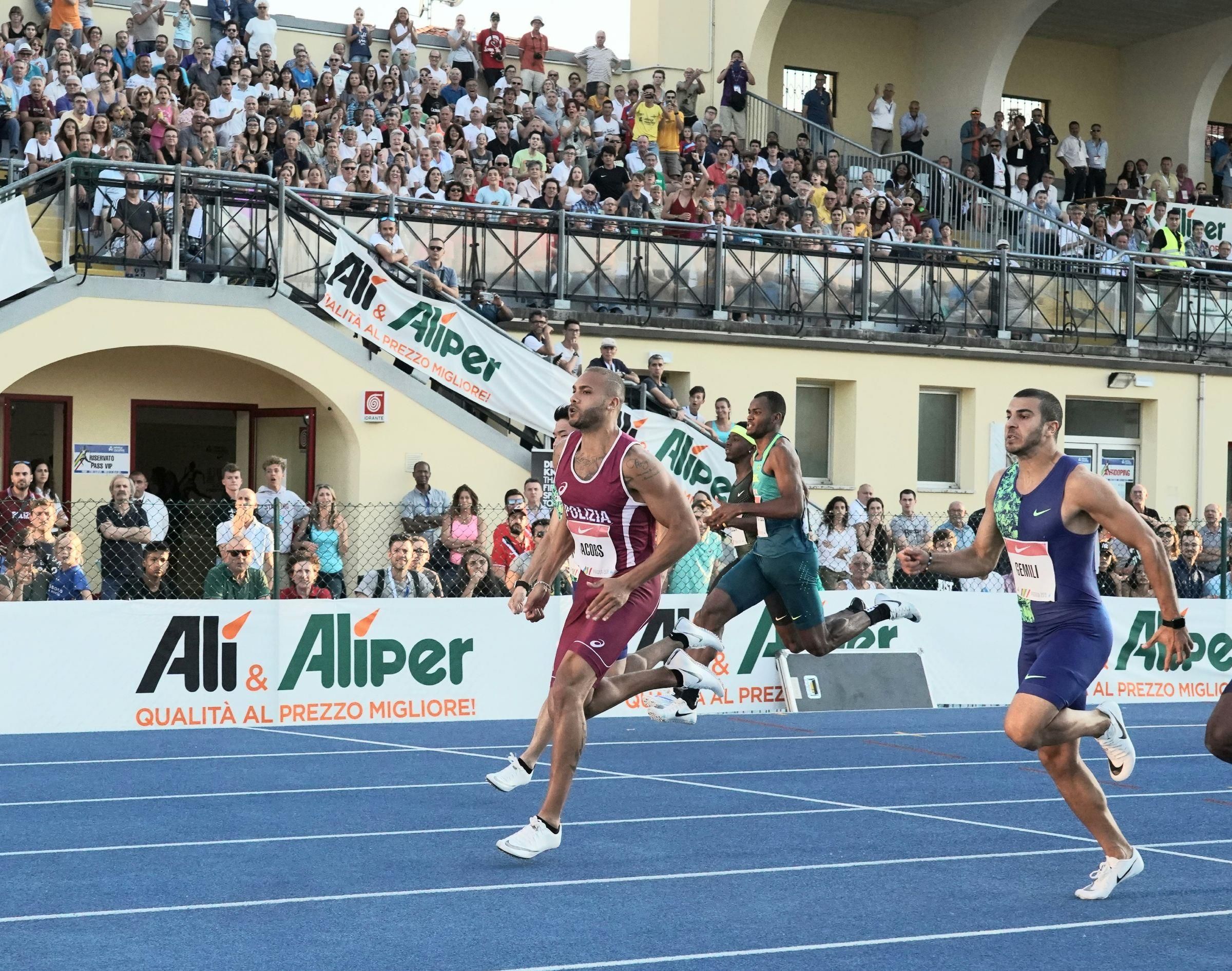
Lamont Marcell Jacobs in Padua (© Roberto Passerini/organisers)
The outdoor season started with food poisoning and continued with a thigh injury. For a long time, it was a question whether he would recover before the World Athletics Championships Oregon 22. He eventually made it overseas and advanced from the preliminaries but withdrew from the semi-finals instead.
This had a beneficial effect: a month later he won the European 100m title in Munich.
He started 2023 in Lodz, Poland, where he ran 6.57 in the 60m. There is no doubt that he will also be the biggest favourite at the European Indoor Championships in early March. While he is going to Istanbul as a defending champion, he will be looking for his first ever outdoor title at Budapest this summer.
However, it will be no easy task for him to claim the last missing major title. In addition to the three Americans who conquered the WCH podium last year - Kerley, Marvin Bracy and Bromell - new challengers also appeared: U20 world record holder Letsile Tebogo and the African record holder Ferdinand Omanyala were also preparing for a breakthrough as big as we saw from him in Tokyo. And perhaps Noah Lyles will also compete in the 100m as well as the 200m in the Hungarian capital.
One thing is for sure: the most anticipated event of the first weekend of the World Athletics Championships Budapest 23 will be the men's 100 metres. If you don't want to miss the qualifying heats and heats on 19 August before the final on next day, it’s worth buying the Flying Start season ticket for the entire opening weekend.

