
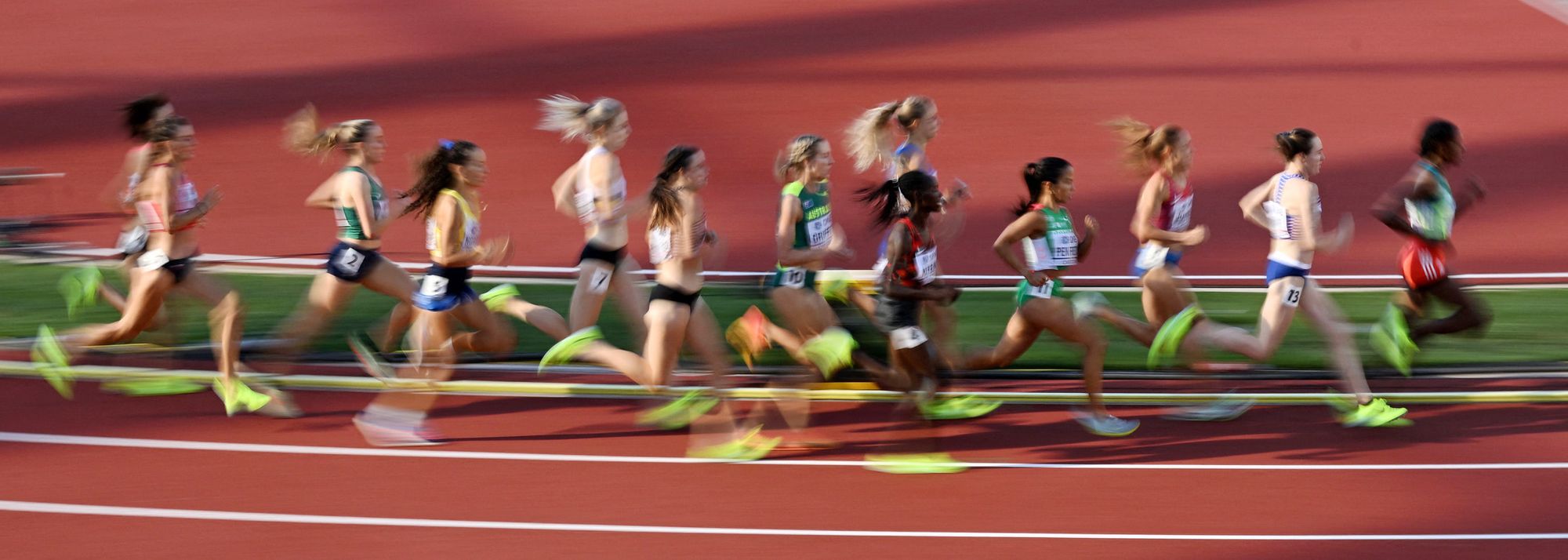
Athletes in the 1500m at the World Championships (© AFP / Getty Images)
Ever wondered about the science behind the distance events? World Athletics goes inside the numbers with Professor Andy Jones, who has worked with athletes including Eliud Kipchoge and Paula Radcliffe, to explain the data behind the three endurance events being contested at the Ultimate Championship.
Shared traits
All three of the distances on the Ultimate Championship programme – the 800m, 1500m and 5000m – are “predominantly aerobic”, explains Jones. “That’s the main thing they have in common, with the 800m getting closer to a 50-50 split between aerobic and anaerobic these days. The 800m and 1500m are a little more similar than, say, the 1500m and the 5000m.”
Body type
Athletes’ physical profiles also tend to change as the distance increases. “As requirements are more aerobic (in the longer events), you tend to want a lighter frame, less muscle mass and a higher VO2 max,” he says. “But in the 800m you’re looking at athletes being more muscled as you’re balancing out the aerobic and anaerobic mix.”
Numbers in training
Training requirements vary considerably between athletes and events. Jones points to Keely Hodgkinson and Georgia Hunter Bell, whose work with the M11 Track Club places less emphasis on high mileage and more on speed, supplemented by cycling and swimming. The longer the distance, the more mileage required. “Take a 5k runner, even in the summer they’ll be doing 70 miles per week, and considerably more in the winter,” he says. “There’ll be track sessions too.”
Pacing in a championship race
Diamond League races often use pacemakers to set the tempo, while athletes can also conserve energy by drafting behind the leader. In championship racing there are no designated pacemakers, so an athlete who wants a fast race may have to take responsibility for the pace.
“If you’re an athlete like Jakob Ingebrigtsen who wants a fast pace, you have to hit the front from early yourself,” adds Jones. “But you make life more difficult as you’re bearing the brunt of the air resistance for the people behind you. For someone like Ingebrigtsen, ideally you get someone else running fast from the gun and that way it plays to your strengths.” That wind resistance element still applies even over the shorter distance of the 800m. “While the race is over sooner it’s run at a higher speed so there’s a greater retarding influence from air resistance. But there’s also another advantage of being out front… you won’t get tripped up!”
Less is more
Jones previously studied the 800m and 5000m races at the Sydney 2000 Olympic Games and found that the winners were not necessarily the athletes who achieved the highest average speed. Some of their rivals ran faster but travelled farther. “The reason they didn’t win is they covered more distance.” The ideal position on the track, he argues, is as close to the inside line as possible. “If you’re in lane two for a lap, you’re running eight metres further, in lane three it’s 16m more.” So, essentially covering less ground is more.
Finishing speed
It is sometimes suggested that finishing speed matters more than ever, but Jones points to the formidable finishes of earlier champions such as Eliud Kipchoge and Kenenisa Bekele. “But it’s always that trade-off of aerobic and anaerobic credentials to have enough critical speed and still be fast enough in the final moments. If the speed is relatively slow for you in terms of your aerobic capability then it’s playing into the hands of those who are going to outsprint you.”
The ideal distance runner
The ideal distance runner combines strong aerobic and anaerobic capabilities. “If you measured everyone in a lab and it was a flat-out race, you could predict the finishing order with reasonable certainty,” he says. “A championship race, however, has a pretty complex interplay which makes it so much more interesting for a spectator, and you can get completely different outcomes.”
For Jones, a good example of an ideal track distance runner is Mo Farah. “He was so strong on both [aerobic and anaerobic] which made him so difficult to beat,” he adds. “He had a high critical speed so he liked fast-paced races but he was similarly happy to sit back.”

