
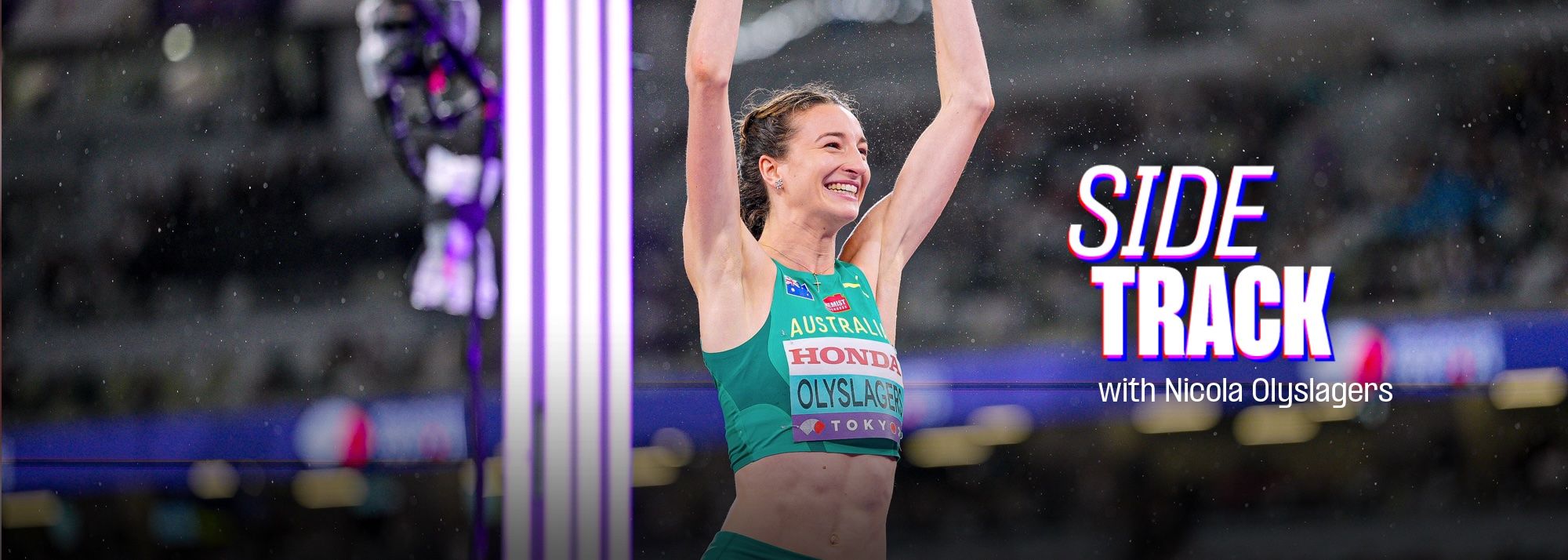
Nicola Olyslagers
Nicola Olyslagers funded her early athletics career by working in an Australian cafe before things fully took off on the international stage at the Tokyo Olympics in 2021. Now a world champion, she looks back on her career path and her other more recent passion alongside her athletics.
Before breaking through in athletics you were studying, right?
My journey may be a little bit different. I wasn’t a junior protégé, I went to university in Sydney which was a two-hour commute each way, I’d catch the train each morning, do my studies and then go back home to train or else train at university. Then I was working on the side in a cafe to fund trips for competitions.
What were you studying?
Biochemistry and it was so hard. I look back and think 'why did I do that?!' I went part-time in the last few years so I extended it from a three-year degree to six years. After the Olympics, we had the Covid quarantine so that enforced two weeks undistracted allowed me to finally get it over the line.
Might you go back to biochemistry after your athletics career?
Science is always updating so almost everything I learned then would be void now with so many more technologies. But my study prepared me to work hard. I didn’t understand half of it but worked and that’s helped me with everyday life.
What about the cafe work?
That was great. It was physically demanding as I was more on the cleaning aspect. We had Colombian baristas so I wasn’t going to disappoint customers with my coffee! But I loved the customer service part and talking to customers. It was something I loved to do and it also taught me value for money. But it was demanding when on your feet for six hours and then having to do a training session afterwards so you’re not going to be at your best. I’ve been pro for the last four or five years now and you can get really caught up in things like 'I’ve walked for 20 minutes to my training session, how am I going to give my best?' So you pull back on those memories and think 'it’s not six hours'. So, I remember what I did and I’m really thankful that I had those experiences.
When did you do that and when did it finish?
I did it for four to five years and the last year was at the end of 2019. It was my way of earning to compete as I wasn’t sponsored or anything like that.
Did you ever give up on the athletics dream?
Honestly, it came to a point in my life where I was willing to give up sport when I was 20. It came from a place where this is not satisfying me, maybe it’s better if work in hospitality or become a scientist.
You also do some work alongside your athletics these days. Can you talk a bit about that?
I have a ministry for athletes called the Ministry of Everlasting Crowns. We’ve had it for a few years. We work with a lot of Christian athletes and it’s about creating communities throughout the world. Athletes really draw on community. At home, you have a church or a community to go to. Finding that community on the circuit when you can be away for three or six months is amazing. It’s different people from different cultures sharing who God is for them. Those experiences really shape people.
You also mentor people, is that right?
Yes, it’s that 18-25 age group where you’re going from youth and junior to senior athlete, going from a structured school environment and going to university or college. I know from my experience that those years can be tough, even with just the training. You go from a big fish to then a tiny fish in this massive sea. There are so many opportunities at that age but you’re also asking, 'what are my values?'.
How important is faith for you in your career?
Well, at 20 years old my faith became real to me. I’d say my identity I had as an athlete previously as a teenager – high jump was priority No.1, but the pressure I put on myself meant I didn’t perform at all. I had a lot of fear so, if the bar fell off, I didn’t know what to do. I had no route or foundation. After finding my faith, I had that freedom as I knew who I was outside this. From then, I felt 'I’m going to be ok, even if don’t do this sport'. It changed everything for me. It’s so real. Then the priority was God in first place over my sport. You realise who you are and it's not attached to what you do. I could then compete and surpass what I did in training whereas as a junior I was better in training than competition.
Do you plan to focus more on the ministry when the athletics career is over?
Yes, I think so. As an athlete, it's important to start things and not wait until you’re retired. It's only a relatively small amount that invest in it and then I can gradually build on it.

