












Athletics powered by AI
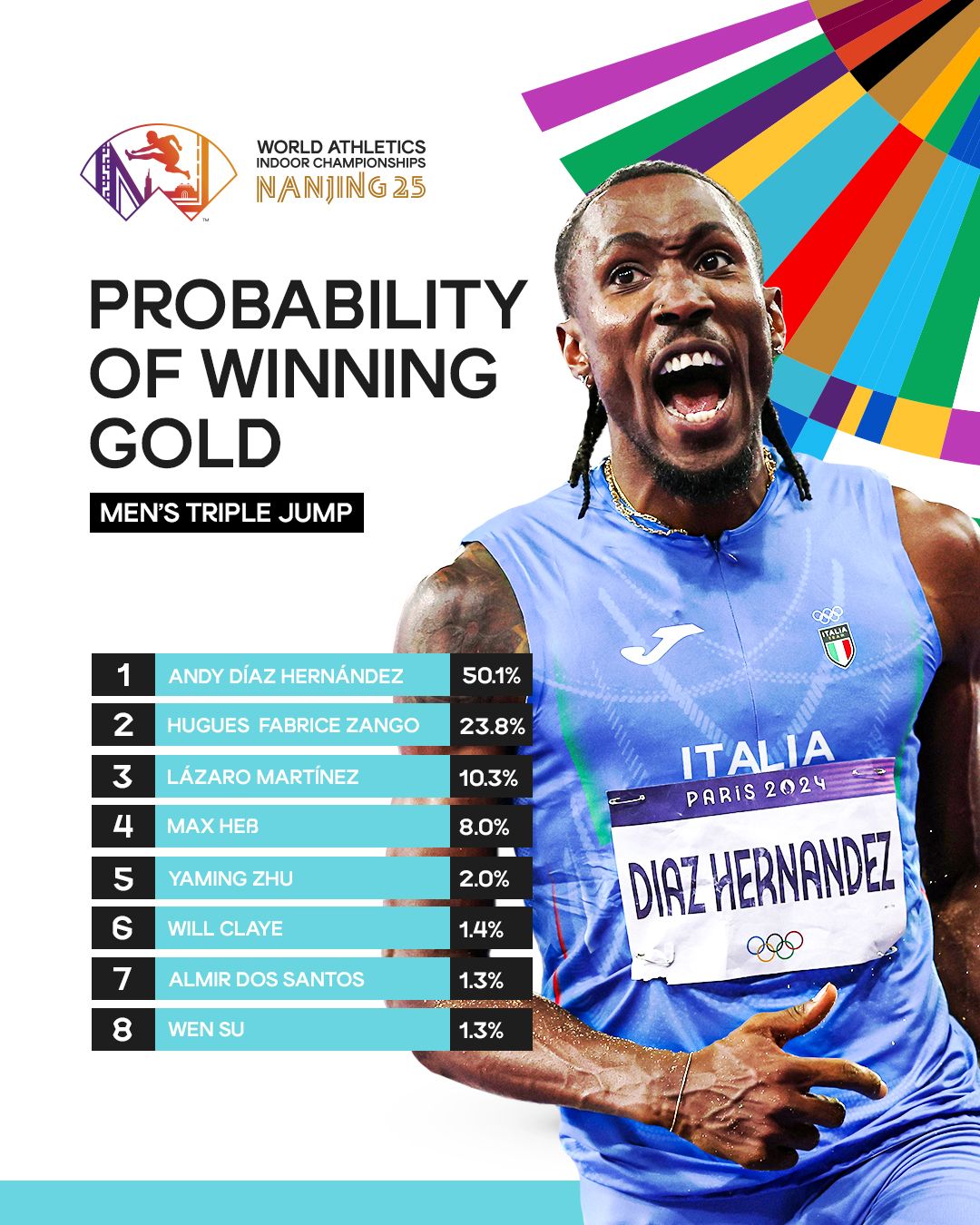
Ahead of the World Athletics Indoor Championships Nanjing 25, World Athletics launches athletics powered by AI, an analytics tool which will give fans fascinating new insights about the competition. Developed in partnership with a team of data scientists, the tool will answer some of the most keenly discussed questions in track and field, such as:
• Who is the favourite for gold in each event?
• What time, height or distance will likely be needed to reach the podium?
• What were the game-changing moments?
• Who caused the biggest shock?
For each individual discipline in Nanjing, the AI tool has a machine-learning model that can simulate the event 10,000 times, drawing on World Athletics’ archive of more than 3 million historical results. These models use a wide range of statistics about each athlete – such as their world ranking, personal best, season’s best and recent form – to predict their performance on any given day.
As well as estimating the average time, distance or height for any athlete, the models also produce a likely range of outcomes for everyone in the competition. This makes it possible to simulate how often we would expect each participant to claim a gold, silver or bronze medal.
A quantum leap
For example, take one of the most memorable stories from the World Athletics Indoor Championships: local hero Ivana Spanovic (was Vuleta) winning gold in the women’s long jump in Belgrade in 2022. Going into the competition, the Serbian athlete was undoubtedly the favourite, with the No.1 ranking in the world, and the highest PB (7.24m) and SB (6.88m) of anyone in the field. AI reckoned that she would finish with a mark of 6.97m on average.
However, across 10,000 simulations of the competition, someone other than Spanovic won gold 53% of the time – with Nigeria’s Ese Brume (6.93m expected result, 37% win probability) and Great Britain’s Lorraine Ugen (6.77m expected result, 6% win probability) being the most likely contenders. In the end, Spanovic raised the roof by winning gold with a mark of 7.06m, with Brume claiming silver on 6.85m and Ugen taking bronze on 6.82m.
While the AI tool often gets the results right on the money, every now and then David does topple Goliath. The 2022 championships also produced one of those moments, when Brazil’s Darlan Romani beat USA’s Ryan Crouser in the men’s shot put. Going into the event, Crouser had not lost a competition since 2019, with his unbeaten streak indoors stretching back to 2015. The simulator expected the then two-time Olympic champion and world record-holder to throw 23.09m – giving him a 91% chance of gold.
Meanwhile, Romani had a decent chance of reaching the podium, with an expected distance of 21.45m and a 33% probability of a medal. But the 30-year-old had not exceeded 22 metres since 2019, meaning he had only a 1% chance of gold. In one of the greatest upsets in athletics history, the Brazilian known as “Mr Incredible” lived up to his name by setting a championship record of 22.53m. Crouser, who later revealed he had been struggling with a nerve injury in his arm, managed 22.44m – a good result in the circumstances, but not quite good enough.
Thanks to AI, it will be possible to add even more context to such historic victories as Spanovic’s and Romani’s. The good news is that the models themselves are highly accurate: if you took the finals of all individual disciplines in the World Athletics Indoor Championships in 2022 and 2024, the AI tool would have correctly identified 87 of the 133 medallists. But the even better news is that this still leaves plenty of room for shock results and famous upsets, with roughly 35% of medals in Nanjing likely to be won by breakthrough stars.