





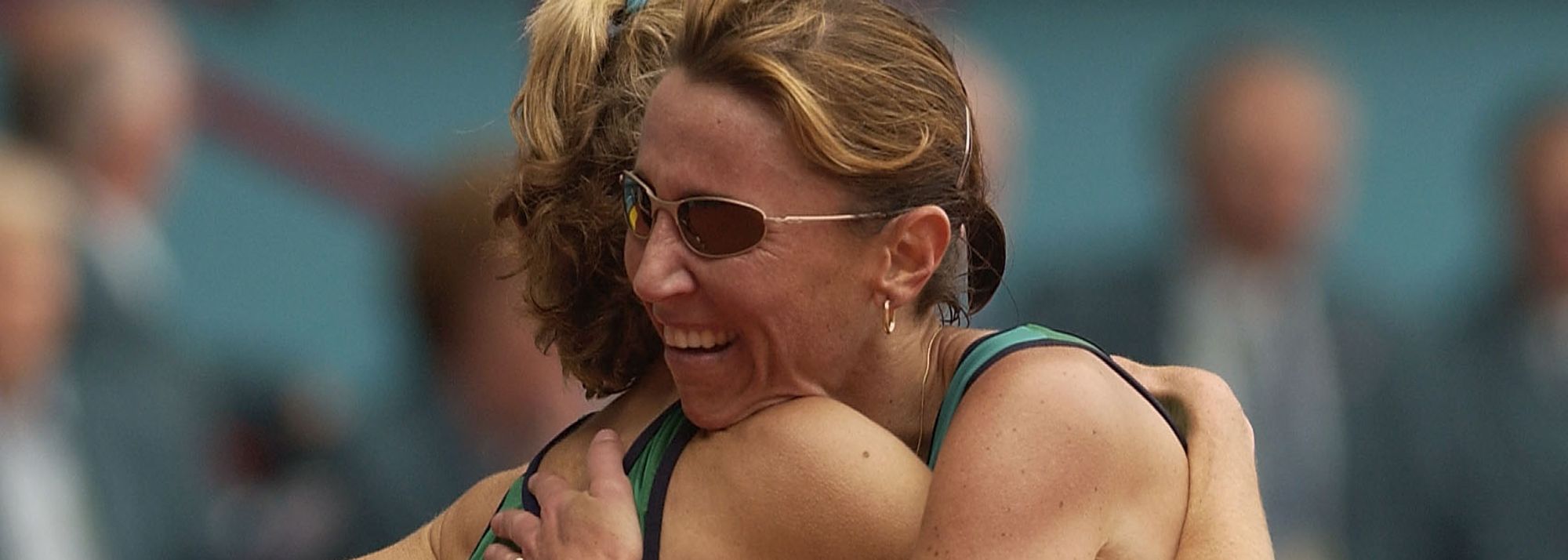


Kerryn McCann (AUS)a and Krishna Stanton (AUS) celebrate in the Women's Marathon in Manchester (© Stu Forster (Getty Images))
A couple of hundred metres into the women’s race at the 1987 World Cross Country in Warsaw, Krishna Stanton found herself in fine company.
To Stanton’s right was one remorseless front-runner in Liz Lynch (now McColgan); to her left another relentless racer in Ingrid Kristiansen. In between Stanton and Kristiansen is US Champion Lesley Lehane; prominent in the large pack on their heels are eventual winner Annette Sergent, Lynn Jennings, Yvonne Murray, Paula Ivan, Rosa Mota and Olga Bondarenko.
In short, a who’s who of women’s world distance running stars. Whatever was Stanton thinking on finding herself in such company.
“I just went for it,” Stanton recalls. “I thought, maybe I can keep up with these girls.”
Five kilometres through the mud, slush, sand and occasional grass of Warsaw’s Sluzewiec Racecourse, Stanton finished eighth, the first Australian woman to gain a top-10 place in world cross country.
Sergent won, from Lynch, Kristiansen and Jennings. Between them, Sergent, Kristiansen and Jennings would win the next five world cross-countries, Kristiansen in Auckland in 1988, Sergent again in Stavanger in 1989, and Jennings three on the trot in Aix-les-Bains in 1990, Antwerp in 1991 and Boston in 1992. Lynch was the World Champion at 10,000 metres in Tokyo in 1991. Paula Ivan was Seoul 1988 Olympic Champion at 1500 metres.
Keeping up with these girls was a very good idea indeed.
Stanton arrived in Poland on the crest of a wave which had taken her to fourth place in the 3000 metres at the World Indoor Championships in Indianapolis. Again, this was a very strong field. The race was won by Tatyana Samolenko from Olga Bondarenko and 1984 Olympic 3000 Champion Maricica Puica.
“The world indoors gave me confidence I could run well against these athletes,” Stanton says.
Stanton was just 20 in Warsaw. She had made her World Cross Country debut aged 19, in Colombier, Switzerland, the previous year when she was Australia’s first finisher in thirty-sixth place. She recalls two pieces of advice from teammate Anne Lord.
“I had no idea what to do. I was very nervous,” Stanton says. “Anne told me to go hard from the gun and get a position and to grab the singlet of the girl in front of me at the finish because others will swamp you from behind and you’ll lose places.”
Pushing and shoving for position was a feature of the finish chutes in those days, as was checking of videotapes by the judges to validate the final placings. The use of chip timing systems has largely obviated the problem. In Warsaw, Stanton knew what to do at the start and the finish and performed outstandingly in the race in between.
At the time of the Warsaw Championships the women’s cross country distance was gradually being increased from 4km to 5km, then to six and eight kilometres. Stanton reckons she always thought “cross country wasn’t for me” as she struggled on longer and steeper hills.
The Warsaw course was on a racecourse. It had plenty of ups and downs and a couple of obstacles to clear each lap. The climbs were steep but relatively short.
“It was fairly flat, and very cold and windy,” says Stanton. “I remember trying not to overthink it. I wasn’t sure about my endurance fitness, but I just stayed up there.
“Cross country is so different from track. It’s not like you’re on show lap after lap. It’s more you and the course. In the home straight I remember thinking I had to catch the girls just in front of me.”
After the 1987 Indoor and Cross Country Championships, Krishna Stanton seemed poised to do just about anything in the sport. The Outdoor World Championships were scheduled for Rome later in 1987 followed by a trio of major championships in Australia’s region – the Seoul 1988 Olympics, Auckland 1990 Commonwealth Games and Tokyo 1991 World Championships.
Instead, Stanton fell victim to a series of injuries and also suffered for a long time from undiagnosed Coeliac disease. Her great resilience kept her going. Stanton made the 1992 Olympic team and 1994 Commonwealth Games team and turned to the marathon for a silver medal as part of the magnificent medal sweep with the late Kerryn McCann (gold) and the late Jackie Fairweather (bronze) at the 2002 Commonwealth Games.
Because so much of her subsequent career was injury, illness and recovery, Stanton looks back on that brief period at the start of 1987 very gratefully.
“The World Indoors and World Cross Country were the highlights of my career."
“It’s always been a case of put me on a starting line and I’ll race as hard as I can. It’s only as I’ve got older that I’ve thought ‘hey, (the women I ran against) were really good runners."
“I had a lot of potential.” she says with a laugh.
By Len Johnson for WXC Bathurst 2023