







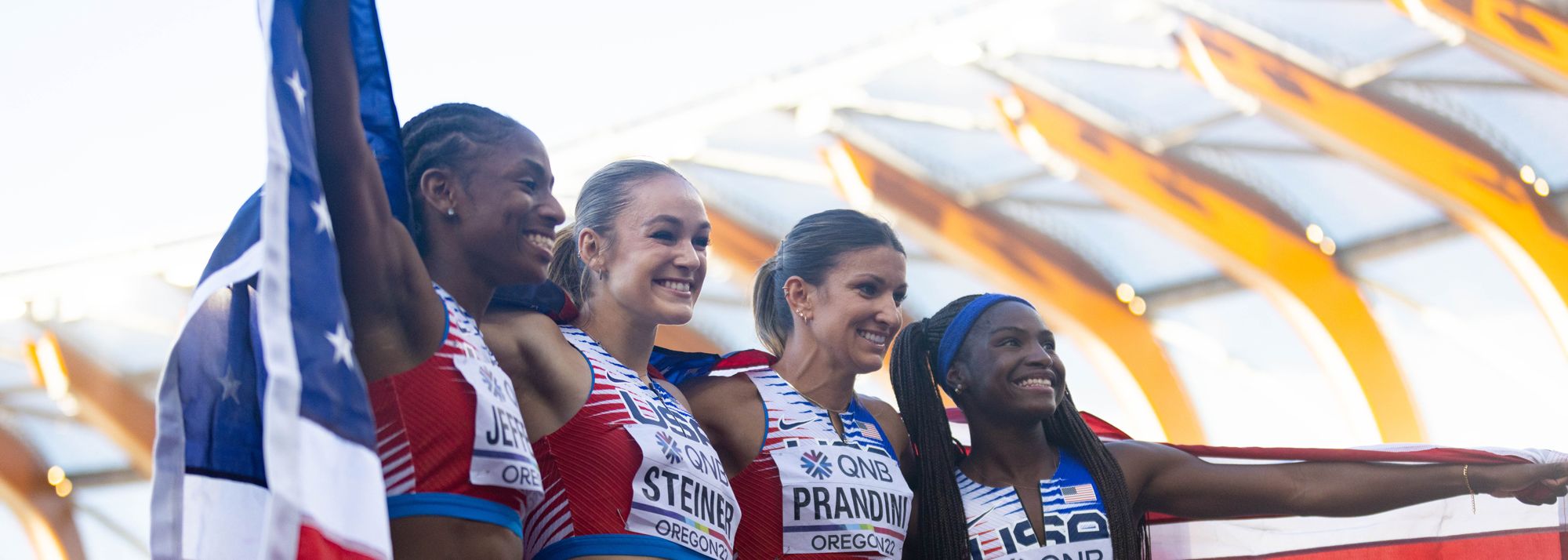


U.S. 4x100m Relay (© How Lao / WCH Oregon22)
The Dream Team couldn’t overcome the American Dream on Saturday night.
The U.S. women’s 4x100m relay team shocked Jamaica in the biggest upset of the first World Athletics Championships to be held on American soil.
The American team of veteran Jenna Prandini and three sprinters — Melissa Jefferson, Abby Steiner, and Twanisha Terry — running in their first World Championships, upset the Jamaican team loaded with veteran superstars with tons of medals and records galore.
But instead of the decorated Jamaicans stepping into another coronation and perhaps breaking the United States’ world record of 40.82 seconds, the upstart U.S. team road the wave of home crowd support at the reimagined Hayward Field at the University of Oregon to knock off sprinting royalty on a marquee stage.
The U.S. got the baton around the track in 41.14 seconds to edge the Jamaican quartet of Kemba Nelson, Elaine Thompson-Herah, Shelly-Ann Fraser-Pryce, and Shericka Jackson, who finished in 41.18 seconds. Germany was third in 42.03, and Nigeria set an African record of 42.22 seconds in fourth.
“It’s special,” said Prandini, who was a star at the University of Oregon and won The Bowerman Award in 2015 as the top women’s college track and field athlete.
“Not only is it U.S. soil, it’s Hayward Field and Hayward Field is home for me. I love coming back for any race and to be able to have World Champs, the biggest race of the whole year, it’s definitely really special. The Hayward magic was real for me.”
WATCH: The U.S. wins the women’s 4x100m relay at WCH Oregon22
Prandini is 29 and has 4x100m relay silver medals from the 2015 World Athletics Championships and the 2020 Tokyo Olympics. Terry, who ran the anchor leg, is 23 and in her first professional season. Steiner is 22 and just completed a standout collegiate career at Kentucky. She ran the second leg and replaced Aleia Hobbs, who ran that leg in Saturday’s heats. Jefferson, the leadoff runner, is 21 and just turned pro after competing collegiately at Coastal Carolina.
“I wasn’t really shocked with the outcome because I knew we were going to do something special as long as we got the baton around the track,” Terry said. “I had already told myself months ago that at World Championships, I was going to shock the world.
“I didn’t know if it was going to be in the 100 or the 4x1. The 100 wasn’t the outcome I wanted, so the 4x1 was the next option, and that’s what we did.”
What they did was knock off the greatest women’s sprinters in history.
Fraser-Pryce won the 100m on Sunday for the fifth time in World Athletics Championships history and is the only woman to win an event five times at the outdoor World Championships. Her winning 100m time Sunday of 10.67 second was a Championships record. She was also the 2008 and 2012 100m Olympic gold medalist.
Thompson-Herah was the 2016 and 2020 Olympic gold medalist in the 100m and the 200m. She is history’s second-fastest performer in the 100m at 10.54 seconds and the third-fastest 200m runner ever at 21.53 seconds.
At the 2020 Olympics, Jamaica swept the 100m medals with Thompson-Herah taking gold, Fraser-Pryce winning silver, and Shericka Jackson taking bronze. Jamaica swept the 100m medals at WCH Oregon22, with Jackson winning silver and Thompson-Herah taking bronze.
Jackson is the only sprinter with World Athletics Championships medals in the 100m, 200m, and 400m. She won bronze in the 400m at the 2015 and 2019 World Athletics Championships. On Thursday, she and Fraser-Pryce went 1-2 in the 200m with Jackson running the second-fastest time ever in 21.45 seconds and setting another Championships record.
Jamaica had won three of the past four 4x100m relays at the World Athletics Championships, too, with only a U.S. win in 2017 interrupting that streak.
Meanwhile, the U.S. was shut out of the sprint medals at WCH Oregon22, failing to win any in the 100m, 200m, or 400m for the first time in World Athletics Championships history.
It was a daunting task before the U.S. 4x100m relay team Saturday night, but the team was undaunted.
“We came out with the gold medal, so obviously we executed well,” Prandini said. “We were really confident with everyone coming in, so I knew if we were able to get the stick around, we had a really good shot at getting that gold medal.”
Hobbs and Jefferson finished sixth and eighth, respectively, in the 100m final, and Terry was knocked out in the semifinals. Steiner finished fifth in the 200m final, and Prandini was ninth in the 200m semifinals when only eight went to the final.
Even a move by the U.S. coaching staff to have Steiner, a veteran of successful 4x100m and 4x400m relays in college at Kentucky, didn’t throw the U.S. off its game despite running so well with Hobbs on the second leg in the heats.
“We had practiced this order of people at relay camp, so I knew that it was a possibility,” Steiner said, “so, I was ready for anything. I kind of had an idea throughout the week that this was going to be the plan, give myself the day off between the 200 and (relay) finals day so the most important thing is just to stay ready.
“The great thing about Team USA is that we have so many interchangeable parts, so if anyone needed to step up, they were going to be able to do it.”
The U.S. may have had an added an advantage besides the crowd support, in being in lane 3 with Spain in lane 4 and Jamaica in lane 5. Jefferson got the U.S. off to a strong start, Steiner stayed with Thompson-Herah on the backstretch, and Prandini burned the curve and was able to give the baton to Terry in the lead despite having to run against Fraser-Pryce.
“I was really happy with the position we got, because for me, I can see the people on the curve and go and work it as hard as I can,” Prandini said. “I knew we were in the lead, and I knew that (Terry) was going to take it home.”
That she did with crowd urging her on at every step with Jackson charging hard trying to overtake Terry and the U.S. team.
“It was electrifying,” Terry said. “I knew it was going to be crazy because before we even took off, and they were just doing announcements, the crowd went crazy. So, once I got the baton, I heard the crowd go even more crazy. I knew I just had to stay relaxed and that brought me through the line.
“I knew they were rooting for us, just run all the way through the line and do your thing.”
And pull of the biggest upset of the World Athletics Championships in the process.
By Ashley Conklin

