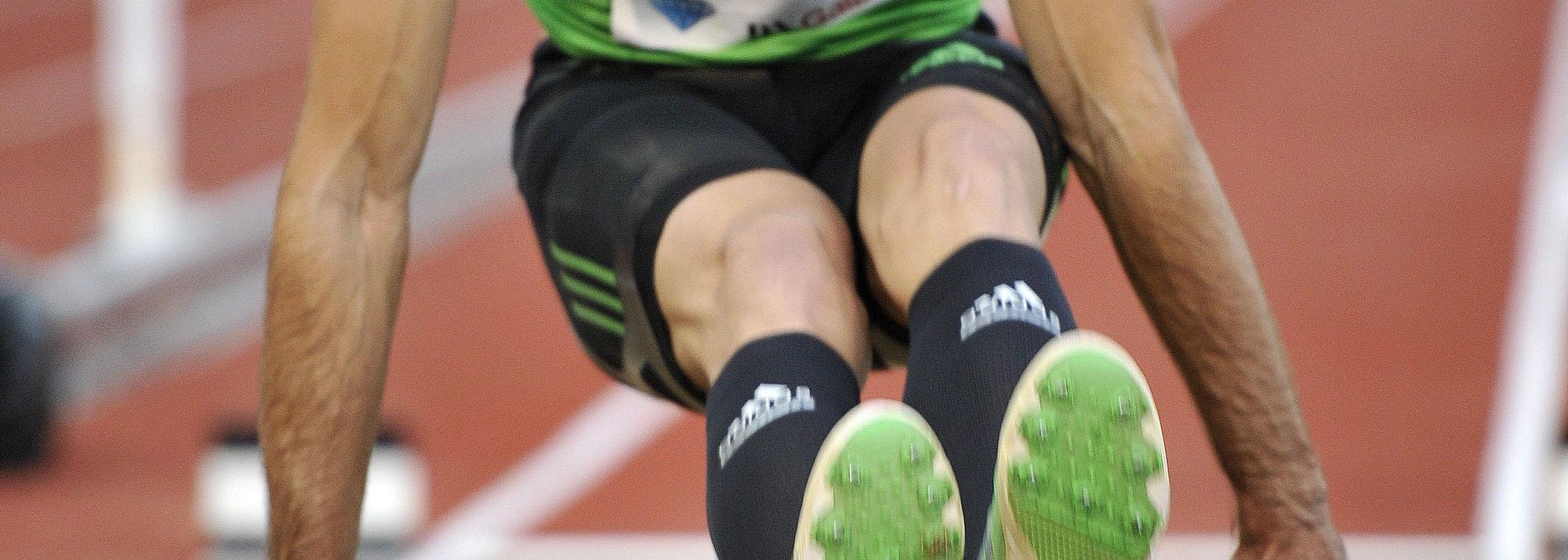


Mitchell Watt of Australia sets a world season lead in the DN Galan (© Hasse Sjogren / DECA Text&Bild)
Two years ago at the IAAF World Championships in Berlin rookie Mitchell Watt surprised many pundits by claiming an unexpected Long Jump bronze medal on his first year on the international circuit.
Yet such has been his meteoric rise that on the eve of the next edition of the championships which begin in Daegu, Korea (Aug 27-Sept 4) anything less than gold would be viewed as a failure for a man who this season owns the four longest jumps in the world this season.
“I’d be disappointed with another bronze medal,” said the laidback Aussie without a trace of arrogance. “I think that is the difference between then and now. Then (at the 2009 World Championships) I was happy to just make the final, but this year I want the gold.”
The fact that he is thinking in such positive terms is a fair reflection of the season he was enjoyed. He has won ten of his 12 Long Jump competitions this year. He twice achieved leaps of 8.44m in Melbourne and Shanghai. Leapt 8.45m to win in London but it was his magnificent world leading effort of 8.54m in Stockholm which offered the clearest evidence yet of his gold medal-winning credentials for Daegu.
Still very much a beginner
Yet the stats tell only half the story for a man who has only been training seriously in the sport for three-and-a-half years.
A talented athlete as a youngster competing in Little Athletics when he used to “win pretty much everything apart from the distance races” he quit the sport aged 14 to pursue other sporting interests.
He played a bit of Aussie Rules Football but thrived in rugby union where he played alongside current Australian international Will Genia at Brisbane Boys College and also made the Queensland State team as an outside centre and full back.
Yet his reconnection with athletics came by total chance in late 2007 when he bumped into two old friends the long jumper Chris Noffke (who jumped 8.33m last season) and the triple jumper Kane Brigg. Watt said they spoke of “competing on the European circuit in front of tens of thousands of people and earning some pretty good money” and he was tempted to give the sport another try.
Noffke introduced Watt to the fabled Australian long jump coach Gary Bourne and within months he had leapt 7.97m – just missing out on the Olympic qualification mark. Even then Watt was not convinced his future lie with the Long Jump. He took a two-month break from the sport and started a full-time job as a law clerk with a leading law firm and recalls having little interest in the Beijing Olympics.
“When Beijing was on I was doing no long jumping and I barely watched any of the programme. I think I only watched the 100m final,” he surprisingly admitted.
Yet Bourne was so impressed by Watt’s natural ability and was so keen to keep him involved in the sport he sent a lengthy email convincing him not to quit.
“I could tell by the email he wouldn’t have gone to all that effort if he didn’t want to coach me,” said Watt. “In the email he had sorted out weight room access and organised a bit of funding for me. It must have taken a few days to sort everything out. It was a big kick up the bum. I thought, okay, I’ll go back and start to do this properly.”
Bourne, the former coach to 2000 Olympic silver medallist Jai Taurima and Australia’s women’s record holder Bronwyn Thompson has a great reputation in the sport and got to work quickly on the talented but raw Watt.
Rapid rise
In 2009 he worked his magic to get the unassuming Watt to improve by almost half a metre and win world bronze in Berlin. The following March he took the same colour medal at the World Indoor Championships in Doha but a torn groin sidelined him for seven months last year and he missed the entire summer season.
He only returned to training in November and the level of progress he has made this year has even surprised the 23-year-old Brisbane-based athlete.
“I must have somehow retained my strength and speed,” said Watt. “I jumped 8.28 in Perth and 8.38m in Sydney (in meets earlier this year) and it was like, okay, if everything goes alright I could be in for a good season.”
Since May he admitted his power to weight ratio is at an all-time high and he has been knocking off personal bests in the weight room, for standing jumps and in the sprints (he ran a swift 100m PB of 10.31 in June) yet he believes he has more improvement to come.
“There are some elements to my training like bounding and some of my weights which are still quite weak unlike Chris (Noffke his training partner),” he says. “He has been training since he was about 13 and it shows I have got some areas to work on.”
“I think over time I’ll become stronger and a bit quicker and if I can improve my technique 8.60m is definitely achievable.”
However, the Aussie is wary of making too many predictions for Berlin. True, of course he craves the gold but he knows not to underestimate the competition he will face in the red-hot furnace of competition in Daegu.
“Even though I think I’ve been the most consistent jumper in the world this year anything can happen on the day,” he reasons. “I improved my personal best by 0.27 in 2009 so I know someone else could do it also.”
Steve Landells for the IAAF


