

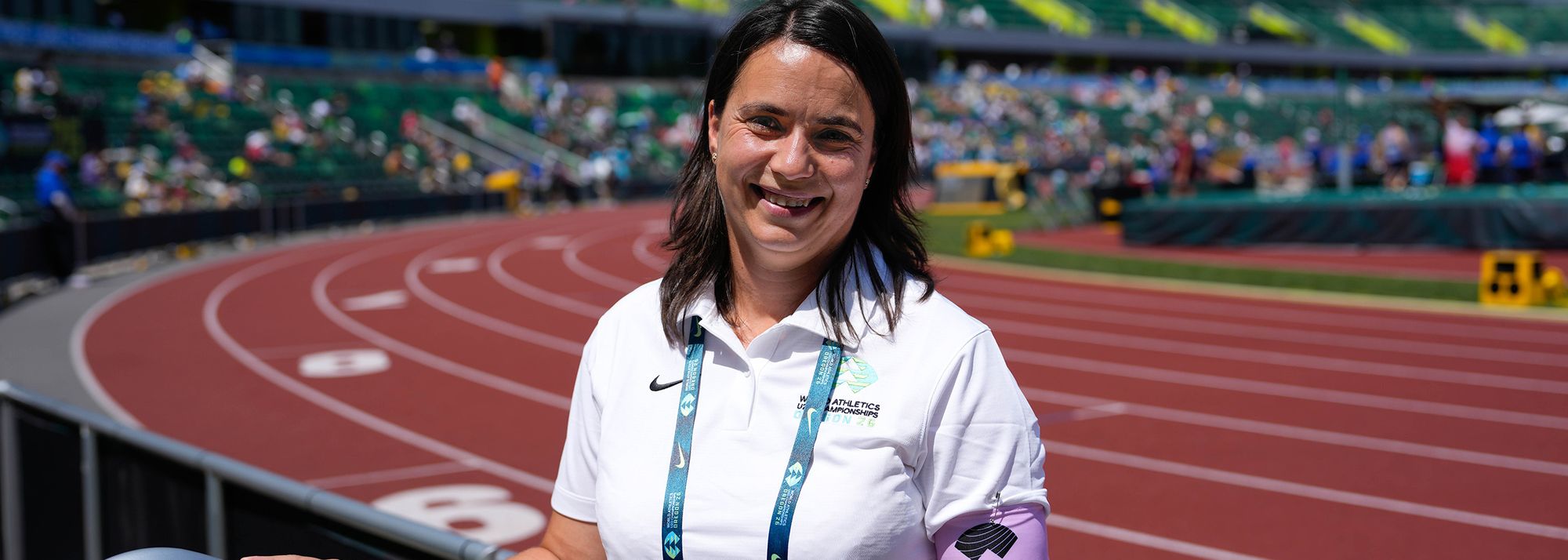


Zuzana Costin at the World Athletics U20 Championships Oregon 26 (© World Athletics Media Academy  Lenny Patram Jr.)
Zuzana Costin is a former athlete turned official, currently the only active female technical official in the world to hold both World Athletics Gold Level Referee and Gold Level Race Walking Judge qualifications.
The two-time Olympian, who competed in the 20km race walk at the Athens 2004 and Beijing 2008 Games, most recently served as a race walking judge and referee during the World Athletics U20 Championships Oregon 26. While there, she reflected on her journey in athletics.
You hold both World Athletics Gold Level Referee and Gold Level Race Walking Judge qualifications – currently the only active female technical official in the world to do so. What does this achievement mean to you?
"There are three of us who hold both qualifications but, yes, I am the only female official. It’s quite amazing to have achieved this. I always try to do the best that I can, therefore it’s nice to see that the work I have put in was recognised, and it paid off."
When you first began your journey as a technical official, did you ever imagine you would reach this level?
"No, I didn’t. I got involved in athletics at a very young age. My dad (Jozef Malik) was the Vice President of the federation (Slovak Athletic Federation) for several years and was active as an administrator, coach and also as an official, so I grew up in the world of athletics. Any time he organised any competitions, I was helping out. So it has always been a part of my life and I never thought about it too much at that stage. Achieving this level in officiating in athletics after finishing my racing career gives me a strong sense of accomplishment and satisfaction."
Throughout your career, have there been mentors who helped shape your journey?
"Undeniably, my dad played a big role at the beginning of my journey and he has kept supporting me since.
"After retiring from being an athlete, I started to officiate in Ireland on a regular basis (I had moved there a few years beforehand). I met with support and encouragement to pursue this to an international level. I was very lucky that I was immersed in an environment where people knew what they were doing, not just on a local level but on an international one, too. So, whenever I came across any problems, I had people I could rely on.
"After passing the Silver level exam, I started getting appointments at European competitions and there were always senior technical officials who were happy to share their knowledge and experience with ‘newbies’.
"That was also the case during one of my first big international appointments as a member of the Jury of Appeal at the European Championships in Berlin where Anna Riccardi was our chief. She took me under her wing, gave me confidence and guided me through this new experience.
"During the Covid-19 pandemic, European Athletics began organising online webinars for technical officials, focusing heavily on the practical aspects of officiating. Those webinars were primary led by Chris Cohen and Niels van der Aar and they helped me to become a more knowledgeable and effective official.
"Later, I was selected for the European Athletics mentoring programme for technical delegates and was appointed as a mentee technical delegate for the European Championships in Rome. I was fortunate to have Chris and Niels as my mentors; their guidance provided invaluable insights and allowed me to expand my knowledge even further."
What practical support is most beneficial for upcoming female officials during the early stages of their careers?
"Having someone you can turn to, talk to and learn from is major. Mentorship is something you can’t replace, especially when you are trying to excel.
"After World Athletics changed its educational programme for officials to the current one, it really opened the door for younger people. Originally, the educational programme and exams to become an international official were only in English, which could be a bit of a barrier for people who don’t have a good standard of English. That is still the case for the Gold level. And this could be something that a mentor could help with – dismantling the language barrier. However, for the lower levels, World Athletics has gradually introduced more languages in which its certification courses and exams can be taken. This shift definitely benefits new candidates who don’t have a sufficient command of English."
Since you started your career, have you seen an increase in more female judges, applicants or volunteers for athletics?
"Absolutely. I don’t remember seeing many female officials in the leading positions when I started, and that has definitely changed now. Also, World Athletics’ encouragement to member federations to enter an equal number of female and male candidates for exams has started to pay off. Panels of international officials are now nearly gender balanced.
"I have also seen a growth in the numbers of younger officials, with more opportunities and positions available for them. It’s more achievable and something that one can work towards now."
What kind of advice would you give someone, especially a younger woman, who is interested in following your footsteps or becoming a judge in athletics?
"Now is the right time. Ask your federation about upcoming courses and exams. If you get opportunities to take part in them or you get any appointments, don’t turn them down because you can always learn something. You might not succeed all the time, but you learn from the experience.
"It is also important to believe in yourself and to have someone, or a group of people, that you can get support from.
"It is nice to see new candidates growing in confidence. When they first get started, it’s all very nerve-racking and there’s so much going on all at once – it creates a lot of feelings of fear. But that’s a normal thing to experience. Sometimes all they need is someone in their corner telling them that this is normal, to believe in themselves, and that someone else has confidence in them."
What kind of legacy do you hope to leave – not only through the competitions you’ve officiated, but through the people you’ve inspired?
"I just hope that all the younger officials coming in see that they can do this. That this, as well as whatever else they want to strive for, is achievable regardless of whether they are coming from a country with a strong tradition of international officiating or not. And that the journey of being an international official can start at any age."
Ash Wehrly for the World Athletics Media Academy
Launched in March, the World Athletics pledge initiative forms part of the organisation’s contribution to the International Women’s Day 2026 global campaign, #GiveToGain, which calls on individuals and organisations to give their time, resources and support to help forge gender equality through abundant giving. By encouraging stakeholders to pledge mentoring hours, World Athletics is turning the #GiveToGain message into practical action across the sport. Learn more on the Women in Athletics website.