
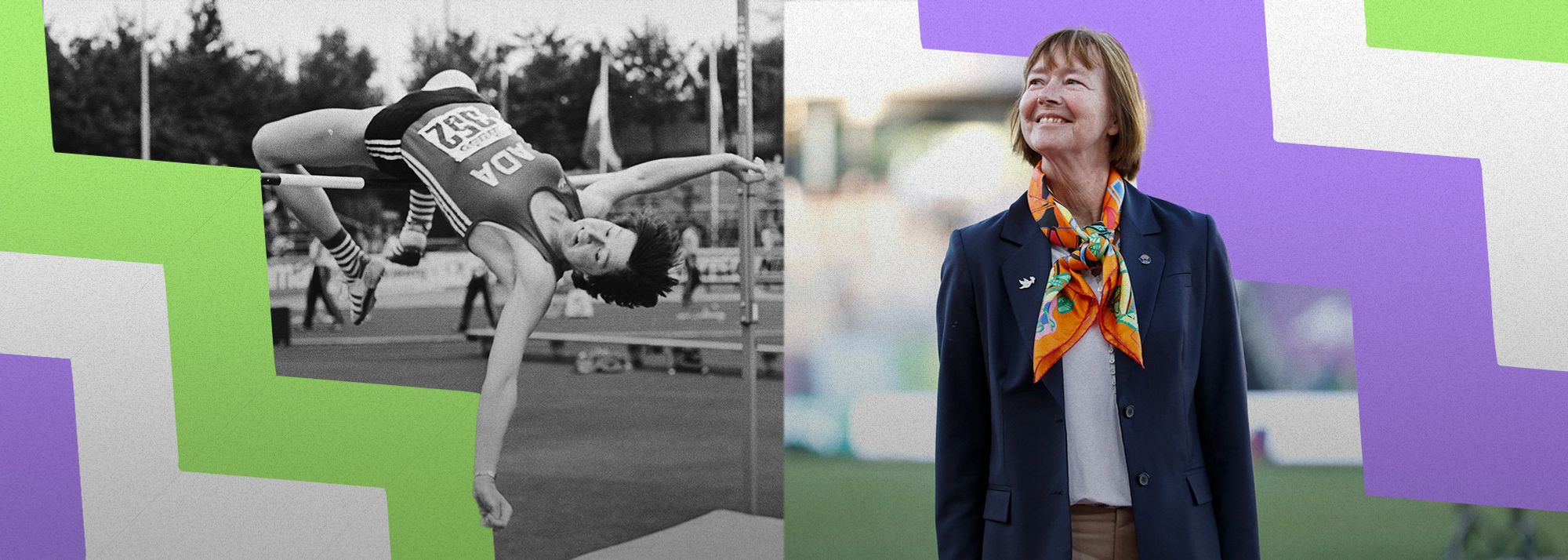


Sylvia Barlag (© Marcel Antonisse / Anefo & Getty Images)
This is a series profiling the pioneering female World Athletics Council members who are helping to guide the organisation on its journey to gender equity.
Natural curiosity has taken Sylvia Barlag a long way – to the Olympic Games as a pentathlete, to a PhD in physics, to the European Athletics Council and ultimately to the World Athletics Council.
As a teenaged basketball player on the fast track to representative honours in the Netherlands, Barlag could never have predicted the direction her life would take, but when she was almost 16 a friend invited her to come to training at an athletics club and she was hooked.
Despite running in basketball flats, she caught the eye of the club coaches who encouraged her to join the club. They gave her a pair of spikes and within eight months she was a national junior high jump champion. She also showed talent for javelin and long jump, and eventually gravitated to the combined events.
“I continued doing basketball and athletics for three years. I was in the national junior team, played in European Championships. And then I decided that it’s time to choose,” she says. “And I chose athletics. I preferred to take personal responsibility and the praise for what you’ve done, and that goes a little bit astray when you're in a team. In athletics, I could excel on my own.”
And excel she did. By 1976, aged 22, she was a top pentathlete in her country, but the Dutch Olympic federation declined to select her for the Montreal Olympic Games. She persisted and finally won the chance to compete in Moscow in 1980, having juggled training with studying for her PhD.
The experience of being overlooked for Montreal also turned her into an athlete advocate and she joined what was an early version of the Dutch athletes’ commission which produced a report on the Dutch Olympic system following the Games.
“That's where it started, because the administration of the NOC, we didn't like it,” she says. “The athletes especially… I had been overlooked, and the second time I couldn't be overlooked because I was really the best western European at the time.”
Having reached the pinnacle of athletics competition, she made her scientific career her priority, finishing her PhD and going to work for CERN in Geneva.
She returned to the Netherlands to take a senior research position at the Royal Netherlands Meteorological Institute in 1989, when she was also invited to join the board of the National Sports Federation (which later merged with the National Olympic Committee). But the merger, in 1994, put paid to her ambitions temporarily, as the new board required 20 hours a week of her time and as the mother of young children with a professional career, she had no extra time to give.
She only returned to sports officialdom when she was nominated to the board of Dutch athletics in 2001. By then she was an experienced corporate manager and in 2007 the Dutch federation nominated her to the European Athletics Council. She was one of three women elected (out of 17 councillors) that year.
Barlag immediately set about designing a programme (with European Athletics employee Bill Glad) to encourage more women to nominate for the European Athletics Council, as well as working in the sustainability area, where she had extensive professional experience.
“I’m not someone who keeps her mouth shut,” she says. “I'm not sitting there just to sit. Some people do, but the point is to be relevant and to contribute, to bring relevant points to the table.”
Her contribution was recognised when she was encouraged to stand for the IAAF (now known as World Athletics) Council in 2011, where six women were to be elected as part of a push towards equality in the ruling global body of the sport.
Barlag recalls a “competitive” election process, marred by the failure of a new electronic voting system, at the IAAF Congress in Daegu.
“I was a new name from Europe, and I had been speaking up and doing things in Europe, I was not the figurehead, but I was very active and that’s how I got elected,” she says.
Her initial experience of the IAAF Council was discouraging as her fellow councillors competed for prestigious positions.
“It was kind of like bidding in an auction, so I got on the sustainability commission at that time,” she recalls. “But it wasn't much about sustainability. It was more about heritage and stamps and medals and things like that, which is interesting but is not sustainability. So, I was pretty flabbergasted, and that commission met maybe once or twice a year just for half a day.
“The president at the time (2011) called me “Ma Petite” (my little one), so it really tells a little bit about how he thought about the new ones on the Council. I was not very young, but I was a new one. To him, I had not shown my value. I think that's it and he was just more relying on the ones that he knew.”
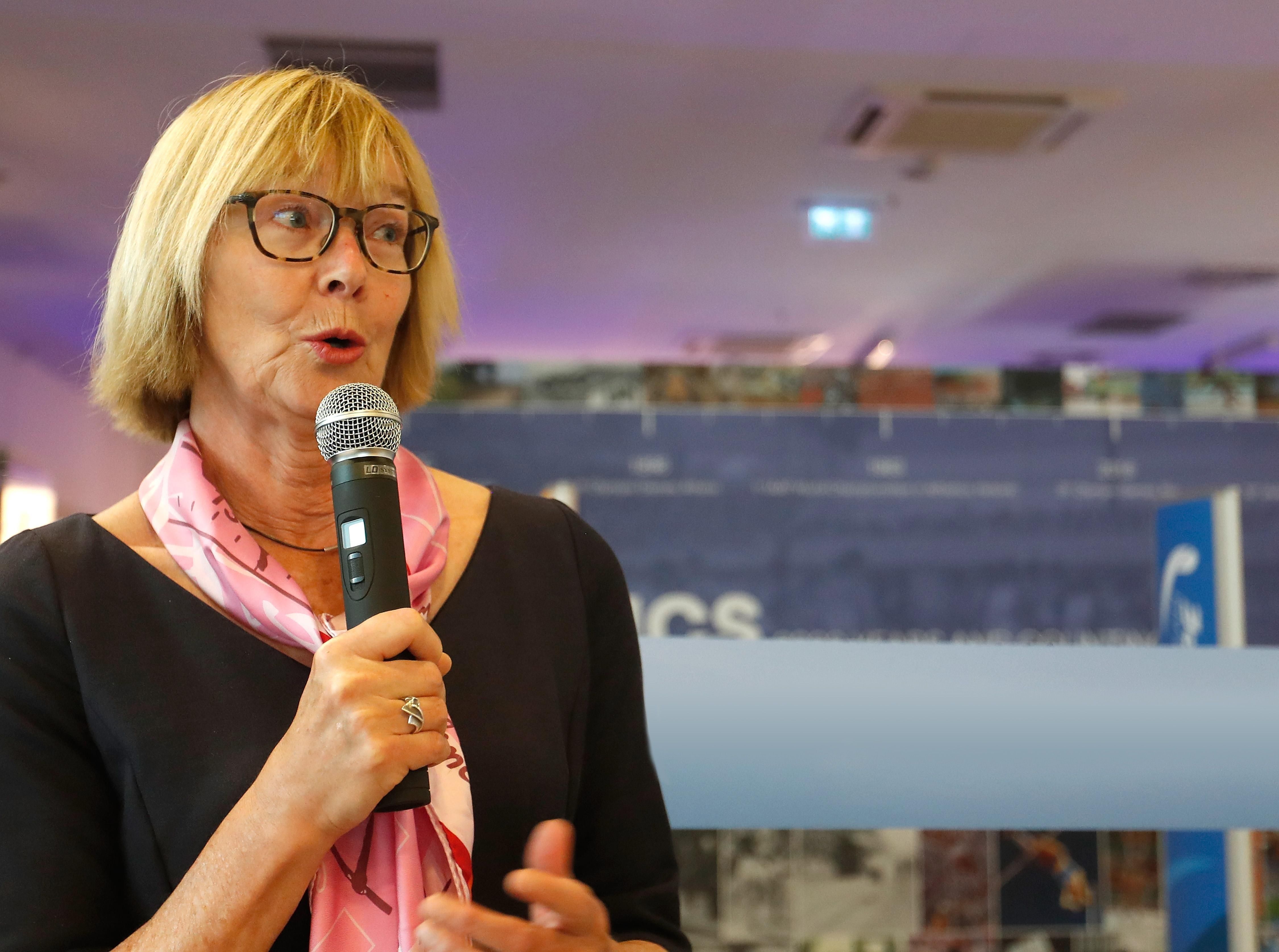
Council Member Sylvia Barlag at the Heritage exhibition in Ostrava (© Getty Images)
Barlag was initially concerned that she would not have the opportunity to contribute to the Council.
“I'm not a politician, I’m not a political figure, I'm not even political in what I do and what I say,” she says. “I’m outspoken and straight. I have my beliefs and I speak them. Some people don’t like that, they think you should deal with business in corridors, which is also a way of doing this. It's not my way. I have adapted but it’s still not my way.”
She was also dismayed by the lack of process in the way that the IAAF Council of that era reached decisions.
“At that time I was working in quality (assurance) and business improvement, I was director of that, so I was always wondering: Where is the process? What is the process? Do we have it? And why aren't we just doing things in a normal process fashion?
“It was a kind of jaw-dropping experience. Decisions were taken this way, without due process. And there were several persons on the Council who felt the same.”
Despite this, she hung in and re-nominated for the 2015 Council election, knowing that the president at the time had reached the end of his term, so a new president would be elected and this might create the opportunity she desired.
Sebastian Coe, who shared similar concerns, was elected as the new president and Barlag was confident that she would be able to contribute more to the new Council in her second term.
However, the organisation was plunged into crisis almost immediately as a corruption scandal engulfed the IAAF, focused on the actions of its former president.
Barlag said that like other Council members she had sensed that something was wrong but could not pinpoint it. She says she felt “stupid and betrayed”, although the structure of the Council at that time largely prevented individuals from challenging the president.
Once the extent of the deceit became apparent, she wanted to help put the organisation back on the right path, joining the taskforce that designed constitutional and structural changes to safeguard the integrity of the federation.
“Seb made up this small group of lawyers and the few council members that, during that year, worked like hell,” she recalls. “My husband counted the days that I spent on athletics over that year (2016). I spent 100 days, having a full-time job (as security directory at technology company Thales Netherlands), but still spending 100 days on this work.
“Seb said: ‘We’re going to overhaul the whole Constitution, and I want the checks and balances to be correct, so that it can never happen again.’”
Barlag worked particularly on the ethical principles that would be put in place to guide office-bearers.
The new Constitution was approved at a Special Congress in December 2016, and Barlag thinks it is working well, but she cautions that it should be a living document always subject to review.
“It's not the Ten Commandments, we didn't set it in stone,” she says. "That's the difference. In the past it would live for 20 years, 30 years, without being touched. Now we're actually regularly reviewing it, and that's what you need to do.”
She joined the newly formed governance working group that bedded in the new Constitution from 2016-2019, and served on the Governance Commission from 2019-2023, which further fine-tuned the Constitution and worked on the Council election process that delivered the historic gender parity result at the 2023 Congress in Budapest, four years ahead of the schedule laid out in the reform process.
Barlag believes that in previous elections the female quota had effectively become a ceiling preventing more women from being elected. However, in 2023, the system allowed more women to be elected, offsetting the male dominance of the area presidencies. For the first time the Council included 13 men and 13 women.
Barlag was delighted to see the historic result in Budapest, and is convinced that all of the women who were elected deserve their places.
“That day was really exciting,” she says. “I felt like all of these women who are there have gone through a struggle already to show their value. It's still a tough road, so all of these women that have gotten in are good women and contributing.”
She regards the current Council as the most athlete-focused of those she has served on “and rightly so”.
More recently Barlag has also had the opportunity to work more on the sport side, becoming a technical delegate at major championships. She did not rise through the ranks as a technical official and that would once have been a barrier to becoming a senior official, but she said she had been a beneficiary of the more flexible structure World Athletics has put in place in the last decade to encourage women.
She has also served as chair of the Sustainability Advisory Group since 2015, using her expertise in climate research and technology to improve World Athletics’ sustainability credentials.
She has two more years to serve on the Council, until she completes her last term, and she is focused on creating a legacy for the women who will come after her.
“My goal is to tutor and to mentor the younger women,” she says. “I’m also doing that in Europe, part of their mentoring programme, mentoring young women to build them up to be strong, to be outspoken, also to understand a little bit of the politics.”
She identifies coaching as the area in which World Athletics needs to do the most work to establish gender equity.
“Looking at Council, I think we might be there, but other parts of the sport are not there yet,” she adds. “And the same goes for some minority groups. It's not enough to just say everybody has gotten the tools and can have the education but we really have to do things to make it up, give them extra tools so the affirmative action phases that have been used with women could also be used for other groups.”
For Barlag, it’s not enough to have equality, she continues to strive for equity, so people from all parts of the world have equal opportunity to succeed.
World Athletics career
• World Athletics Council Member (2011-present)
• Chair World Athletics Sustainability Advisory Group (2015-present)
• Member World Athletics Working Group on Integrity and Governance Reforms (2015-2019)
• Member World Athletics Audit & Finance Committee (2015-2019)
• Member World Athletics Doping Review Board (2016-present)
• Member World Athletics Governance Commission (2019-present)
• Technical Delegate and Jury of Appeal member (various WCH and OG)
Nicole Jeffery for World Athletics

