

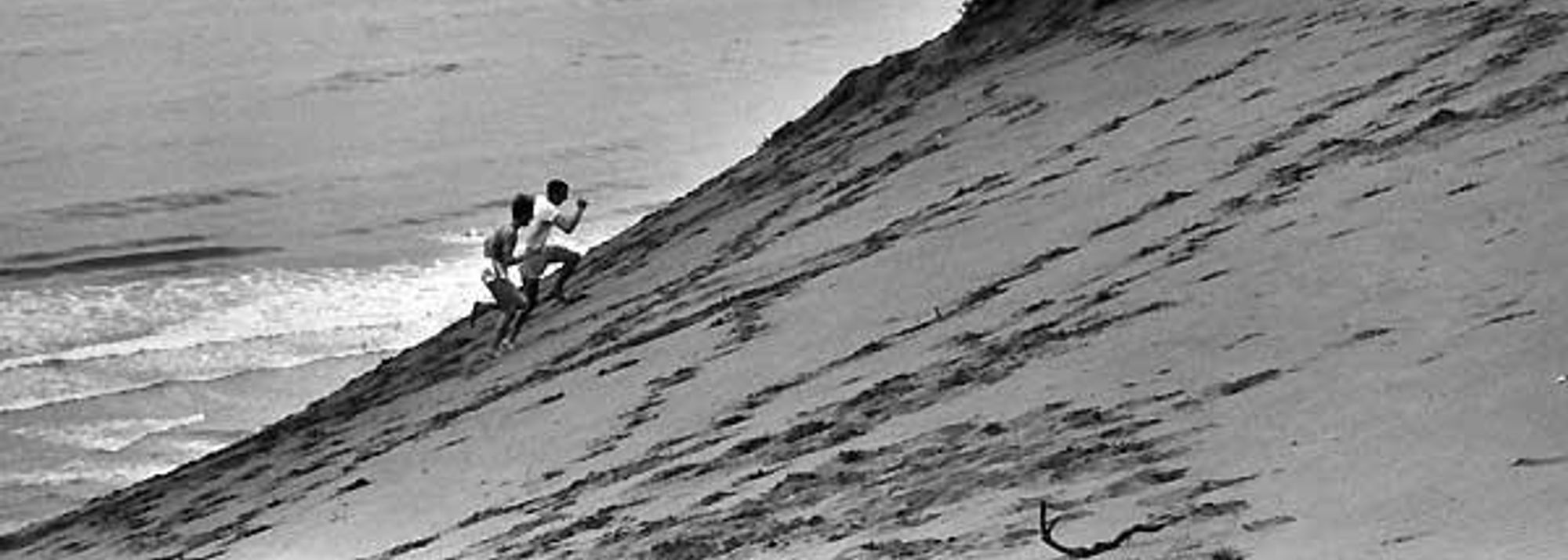


Delany - Uphill beach training on sand dunes (© Fred Lyon)
A special celebration to mark the 50th anniversary of the 1956 Olympic Games opened last weekend in Melbourne, Australia. The five-day reunion from 18-22 November has attracted more than 320 athletes who competed in those Games including Discus Throw legend Al Oerter of the United States who won the first of his four Olympic gold medals in Australia.
Another of the guests of the Victorian Olympic Council is Ireland’s Ron Delany who became Olympic 1500m champion in Melbourne, and he spoke recently to the IAAF website about his memories of the Games:
Olympic champions often come in two forms. The first type is the shy, reticent hero embarrassed and somewhat baffled by the public’s ongoing obsession with past glories. The second type is the gold medallist who relishes dining out on his achievements and is quite happy to chat amiably for hours about the memories, the good times and the golden moment. Ron Michael Delany is definitely the second type and with a book ‘Staying the Distance’ to promote he is all too happy to chat.
Delany made Irish folklore by becoming Olympic 1500m champion on December 1, 1956 in Melbourne’s cavernous Melbourne Cricket Ground (MCG), the Olympic stadium which refurbished played host to packed audiences of 80,000 spectators at the 2006 Commonwealth Games.
To put the Irishman’s Olympic achievement into context he was competing in not only the blue riband and most keenly contested event in the Olympic programme but he was also running during a golden age for middle-distance running. Only two years earlier England’s Roger Bannister had achieved what many thought was impossible - the first sub-four-minute mile. And as a measure of how far the event had progressed by June 1956, Delany had become the seventh man to dip below the magical barrier at a meeting at Compton, California. By the Melbourne Olympics he was primed to take his opportunity.
Raised in Sandymount in Dublin and educated at the middle-class Catholic University School Delany was a talented tennis player but turned to athletics in his mid-teens and quickly discovered a gift for running.
After setting an Irish record to reach the 800m final at the 1954 European Championships in Berne he left his homeland to study at Villanova University in the United States where he hooked up with the highly respected track coach Jumbo Elliott who persuaded Delany to move up to the Mile.
In late 1955 he stepped up in distance although he recalls his preparations for Melbourne were far from perfect.
He missed most of July 1956 after being badly spiked in a race in Paris and although he returned with a respectable 4:06 effort in the Emsley Carr Mile in England in his next race he slumped to a pedestrian 4:20 at a race at Lansdowne Road, Dublin.
Reflecting on his summer 50 years earlier the articulate Delany said: “The 4:20 was my signal to stop racing and go back into training. The Irish press said I was burnt out and should not go to the Olympics. But I was so positive I just thought there was no way I wasn’t going to the Olympics. I was one of the fastest milers in the world.”
Delany’s self-belief was not misplaced and he was selected in a 12-strong Irish team to fly to Melbourne. The small but select squad were to return home with a record Olympic haul of five medals for the island country and remarkably achieved the feat without the assistance of a team manager, team coach or doctor.
But nothing could have prepared Delany and the Irish team for the reception they received at Melbourne Airport.
“It has seemed as if the whole Irish diaspora in Australia had met to greet us on the runway,” he explained. “When you think of airport security today it was extraordinary. We were met by an Irish piper the scene was simply overwhelming and something I’ll never forget.”
There is little doubt Delany was among the favourites for 1500m gold and followers of the US collegiate scene were aware of the threat he posed with his devastating kick finish. But while the Dubliner was quietly confident the Irish press were dismissive.
“I think the Irish press rated my chances at 100-1 but I knew in my own mind I would win,” he said confidently. “Although the reality was I needed a lot of things to go right on the day and I needed to be tactically astute.”
Delany, who had comfortably breezed through his heat, remained calm in the final and the then 21-year-old chose to jog at the back of the field for much of the race. At the bell he was tenth – six metres off the lead – and running alongside Australia’s John Landy, the pre-race favourite and the second man to smash the four-minute mile barrier.
“I progressively moved up down the back straight,” he said as if reading the race from a script. “I passed Landy with 180m to go and I think I had Brian Hewson, Klaus Richtzenhain and another athlete ahead. I hit the front with 90 metres to go and I was just flying. I could tell from my posture and strength, I don’t think I have ever felt as good. As I crossed the line I threw my arms up in joy and the first thing I remember thinking is I just can’t believe it. My second instinct was to kneel down and give a prayer of thanksgiving.”
But such were the austere times of the Fifties there was little opportunity for celebration. Melbourne was a dry city after 6.30pm and Ireland’s hero enjoyed a modest evening.
“The night after the race was a bit of a disappointment – I saw Fred Tiedt (his Irish colleague) win his silver medal in the boxing. The media also made big demands, but although I had beaten their man (Landy) the Australian press were very fair.”
Just two days after winning the Olympic gold medal he flew back to the US to continue his studies at university.
Achilles problems hampered his preparations for the defence of his title in Rome four years later and he was forced to withdraw from the 1500m after failing to make the final of the 800m. He hung up his spikes in 1962 aged 26 and never ran again.
For the past 50 years Ireland has enjoyed a smattering of world-class middle and long-distance runners but no-one has managed to match Delany’s feat of winning Olympic track and field gold.
Delany, however, offers his own theory on the gold famine:
“Ireland is only a small nation and you can only really hope for a gold medal every 20 or 30 years,” he explained. “I reckon we are probably due one. Forget Beijing, wouldn’t it be nice to win one in London 2012.”
Since Melbourne, Delany has not been a forgotten hero in Ireland. He has enjoyed a relatively high profile and was chairman of the National Irish Sports Council from 1978 to 1990 and the sprightly 71-year-old still runs his own marketing and sports consultancy business in Dublin.
Delany added: “I’m very lucky. I’ve had a fulfilled life. My life is my family but I have somehow always managed to maintain the myth of the Olympic champion.”
Steve Landells for the IAAF
Staying the Distance (0-86278-975-3) is published in hardback by the O'Brien Press. It is available direct from the publisher at http://www.obrien.ie

