World Athletics Partner
World Athletics Partner
World Athletics Partner
World Athletics Media Partner
World Athletics Supplier
World Athletics Supplier



TRAINING PLANS
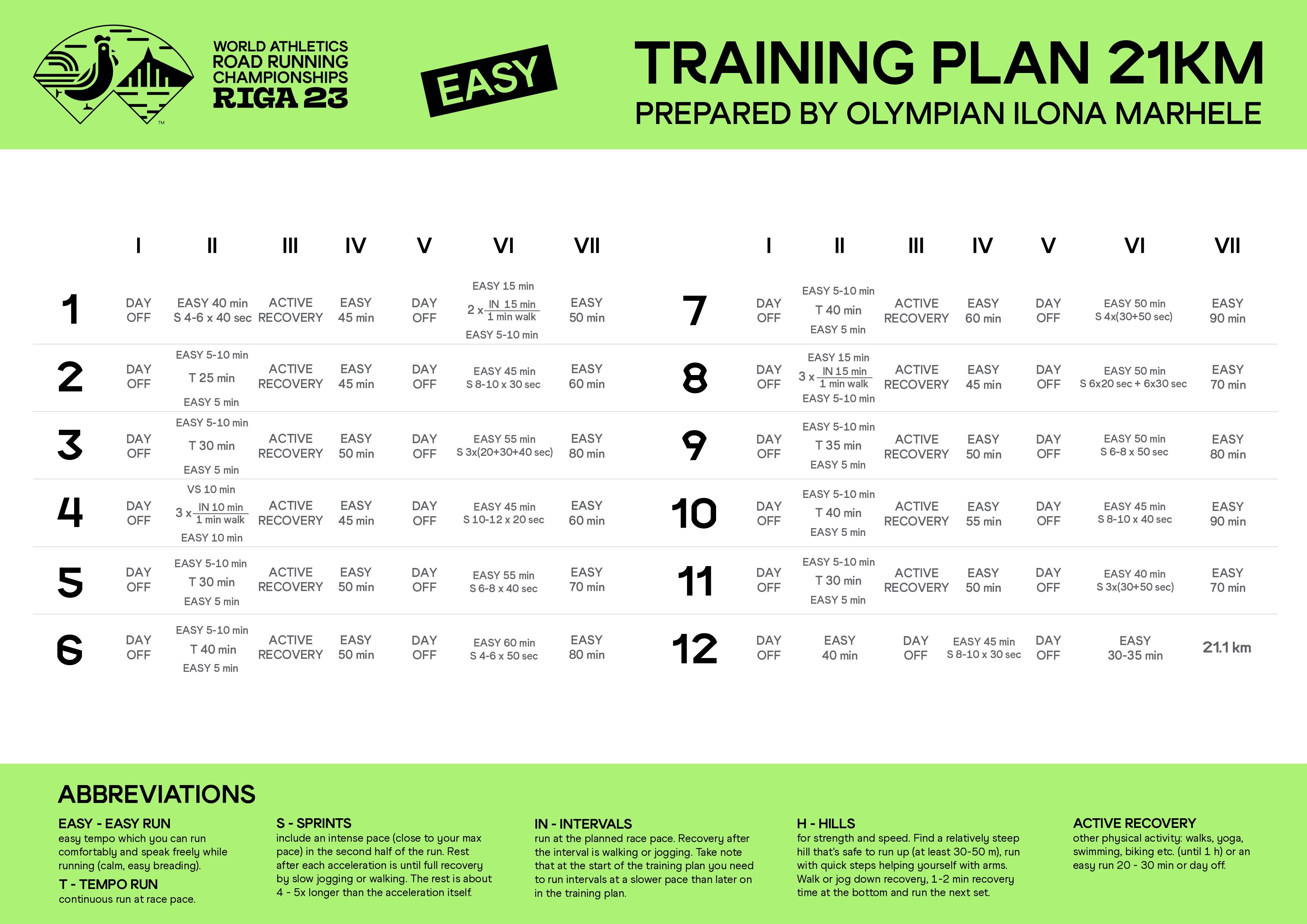
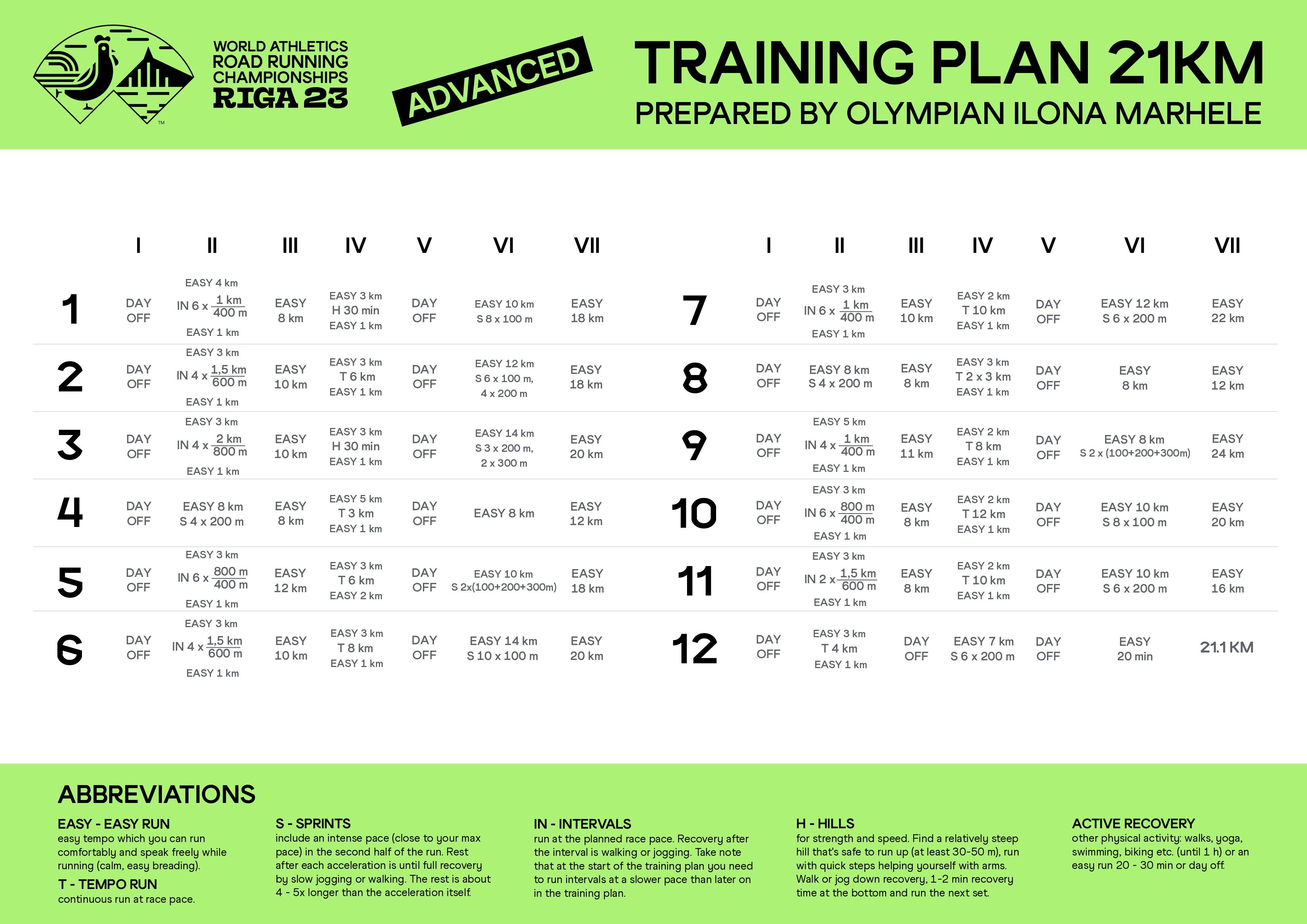
Ilona Marhele, Olympian, coach and one of the leading Latvian long distance runners has prepared 12 week training plans so that everyone can prepare themselves for October 1. Training plans have been prepared for 2 intensity levels - easy and advanced - depending on the runner's physical abilities.
EASY
For runners who have started training fairly recently and wish to take on a longer distance and train systematically. The main priority is to finish comfortably, not a fast result.The plans are made to include more training on the weekends and diversification of activities, for example, strength training, yoga or swimming.
ADVANCED
For experienced runners who are focused on improving their result and wish to train systematically to improve their time. In this plan there is more speed work - tempo runs and sprints to improve your average speed and get used to competition pace.
ABBREVIATIONS INCLUDED IN TRAINING PLANS:
- EASY (easy run) - easy tempo which you can run comfortably and speak freely while running (calm, easy breading).
- S (sprints) - include an intense pace (close to your max pace) in the second half of the run. Rest after each acceleration is until full recovery by slow jogging or walking. The rest is about 4 - 5x longer than the acceleration itself.
- I (intervals) - run at the planned race pace. Recovery after the interval is walking or jogging. Take note that at the start of the training plan you need to run intervals at a slower pace than later on in the training plan.
- T (tempo run) - continuous run at race pace, speeding up gradually.
- H (hills) - for strength and speed. Find a relatively steep hill that's safe to run up (at least 30-50 m), run with quick steps helping yourself with arms. Walk or jog down recovery, 1-2 min recovery time at the bottom and run the next set.
- A (other activity) - other physical activity: walks, yoga, swimming, biking etc. (until 1 h) or an easy run 20 - 30 min or day off.
INSTRUCTIONS FOR RUNNERS FOLLOWING THE ADVANCED TRAINING PLAN:
For experienced runners the intervals (I) need to be run at a slightly faster pace than your intended race pace. Half marathoners need to run intervals at your 10 km pace. Heart rate monitor frequency zones to determine the approximate intensity of the run (you need a heart rate monitor):
- Easy run = 60-70% of your maximum heart rate (max HR)
- Intervals = approximately 85-90% of your max HR
- Tempo run = 75-90% of your max HR
- Sprints = 90-95% of your max SF
FIVE TIPS FOR SUCCESSFUL WORKOUTS USING THESE TRAINING PLANS:
- There is a saying that what works for all works for none. Every runner is different, with their own running experience, understanding and approach, so it should be noted that the tasks of training plans should not be taken dogmatically.
- Pay primary attention to when and what to run. For example, when a tempo workout is planned and when it's time for a long run. Only look at the required number of km after that. The purpose of the training plans is to give insight into the necessary training approach and serve as a reference point for training progress. Its purpose is not to show that an X number of km will give a certain result.
- Keep track of your well-being - fatigue, energy level (how productively you can spend the day), sleep, appetite. If constant fatigue occurs, the load should be reduced. It is recommended to make training notes to promote the habit of evaluating the progress of training and how you feel in the process.
- Training sessions should easily fit into the daily rhythm. The more often you have to look for time to "squeeze them in" in your schedule, the faster you will lose motivation to continue with the plan.
- Consult with specialists, coaches, experienced runners about your training, so that the preparation for the start goes smoothly and with the lowest possible risk of injury.
TIPS FOR TRAINING IN HOT WEATHER:
In addition to the training plans, we have also prepared useful tips for running in hot weather, which will come in handy when preparing for the World Championships over the summer months.
- Try to avoid running your training sessions in the middle of the day when the air temperature is the highest. We recommend running sessions in the morning or in the evening on the hottest days.
- Take in enough liquid throughout the day, drink it in small sips every 20-30 minutes. Remember that coffee and tea have a dehydrating effect on your body.
- Be sure to bring water with you on your workouts, especially when you plan a longer or more intense workout.
- Pay attention to electrolyte intake in hot weather. Electrolytes are what we lose when we sweat and need to be replenished so that the body can recover fully after running exercise and eliminate the risk of cramping and dehydration.
- Wear light-colored clothing that is light, quick-drying, and breathable. Avoid black, dark clothing, especially on the upper body. Avoid clothing made of cotton which becomes heavy when you sweat and does not "breathe" in hot weather.
- In sunny weather, definitely wear a hat which should also be light, breathable and easy to dry.
- Try to run as much of your training session as possible in a shady place, for example, in a park or in the forest.
- Take a cool shower after your workout.