








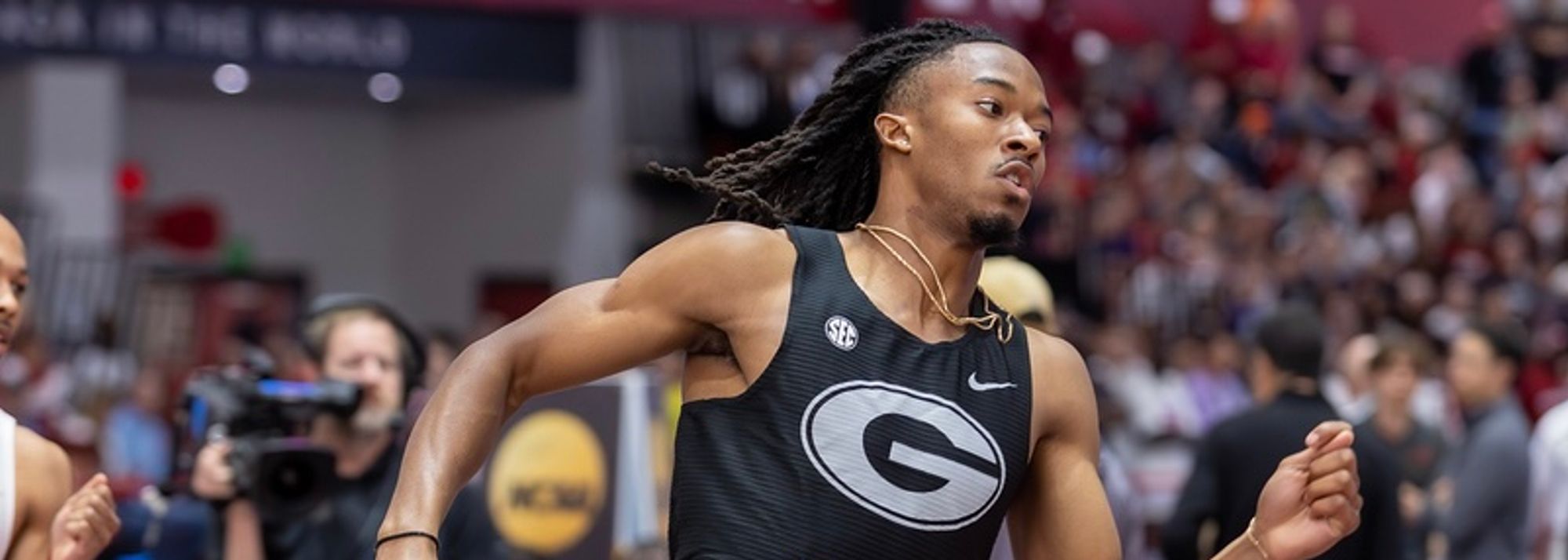


Jonathan Simms
By Owen Murray
Does Jonathan Simms regret it? Was it the right call? Would he do it again?
He knew it was his last high school race — that’s part of the reason he made his decision. Simms, a Nike Elite athlete with a commitment to the University of Georgia already declared, lined up for the Texas state 400m final. His injured leg wasn’t relevant, not then, even if it would be a lap later.
“At Texas regionals, I felt it a little bit,” he remembers, a year later. He’s talking about his hamstring. He took a couple of weeks off after qualifying at regionals.
Simms was back on the line at state. He didn’t even get set for the gun before the train derailed. He was coming out of the blocks when he felt it pop. The damage ended up a grade one strain, he thinks, but he decided to run anyway.
“I’m like, ‘Whatever,’” he said. “I just got out there and finished the lap.” He did, in 47.21.
Was it the right call? “Probably not, but I don't regret it.”
Would you do it again? “I would do it again.”
That’s what the world needs to know about Jonathan Simms. In Athens, Georgia, he’s racking up times (and national awards) as the newest phenom in the Bulldogs’ shed of 400m flashes. Simms put himself on the map with a 44.62-second world U20 record* in his NCAA debut, but behind the scenes, he’s been building his case for a long time. It just took no regrets, a disregard for pressure and some help from a mad scientist, plus a trick from his dad to get it started.
Because your parents always know best.
Simms’ story started at a track in Texas — or, maybe more accurately, a few weeks before that. Jonathan didn't know yet that his father, Daryl, had run track at the University of Iowa. He just loved the Olympics. Simms was 7 years old when he told his dad that he wanted to go there one day.
“Like, to watch,” Jonathan clarifies now. Oh, you can go, Daryl told him. “And so I was like, ‘All right, bet.’ I thought we're going to the Olympics.”
Then came the track, one day in the heat of the summer of 2014. Daryl told him that sure, he was going to the Olympics.
He was going to run there. It was going to start on that track.
Track didn’t take over his life immediately. Jonathan spent almost a decade playing soccer — he was the stopper at the heart of the defensive line — at the same time as track. When he started to fall out of love with soccer, though, running stepped up. He didn’t feel much pressure.
It was Amateur Athletic Union (AAU) sports that taught him that pressure isn’t necessary. By the time he got through middle and high school, he’d been running for years. When he went to practice — even to meets — the faces were familiar. The ones that weren’t didn’t have the same dedication that he did. Pressure wasn’t an issue then. It isn’t really now, either.
“I got used to running for so much that even when things were getting more serious, as I was getting older and things were starting to look at college, and what times I need for college and on bigger stages like that, I was just used to running in general so I didn’t feel so much pressure to get recruited for this or that,” Simms said.
The first time it twinged, though, was at his sophomore year state meet. Lined up with the juniors and seniors, he just remembers a thought: Oh, wow.
That summer, he ran at the Brooks PR Invitational and Nike Outdoor Nationals. It’s a specific type of pressure that he remembers from that summer— the type that comes from feeling inexperienced.
At that Brooks meet, he ran sub-46 (45.90) for the first time. Daryl bought him a rose gold chain. He still wears it, alongside the yellow gold chain from his mother, Kay McClelland. NON came with a 46.09 win.
Two years later, he lined up again at state. This time, he was the experienced one, and he’d committed to Georgia in December 2024. It didn’t matter that his hamstring wasn’t having it: he was finishing his last lap at Allen.
The injury, though, did mandate weeks of rehab before he made it to Eugene for the USATF U20 Outdoor Championships. He remembers flashes from the 400m final there, too. He remembers feeling nervous, then getting out fast — but everyone was getting out fast. He remembers feeling strong. It was over quickly, in 45.44. He took home gold, with a new feeling.
“It was the first time I ran when I felt strong like that,” he said.
Pressure evolves. At Georgia, he’s training with one of the nation’s best 400m groups. Paris Olympian (and former Bulldog) Christopher Morales Williams is a frequent competitor, but Georgia athletes London Costen and Mohamed Adoini have 47-second times to their names already this season.
“Especially here at college, I know everybody here is fast,” Simms said. “Nobody here is slow, so it's a real competition every time I run.
“But I enjoy it.”
It’s the furthest he’s ever been from home — he always lived within 45 minutes of the same place in Texas. In Georgia, “It’s different, but I like it,” he said. Daryl and Kay still call before he runs. He tries to call at least once a week.
Simms has evolved too, under the man he calls alternatingly “Sunshine and Rainbows” and “The Mad Scientist.” Karim Abdel Wahab is an associate head coach at Georgia — he handles its sprinters and hurdlers. Simms is already all-in.
“(Abdel Wahab) cares,” Simms said. “He invests a lot of time into it, and you can trust him — you can trust what he says. He makes it easy to trust him.”
The first nickname comes from his positivity. The second comes from his ability to break down 400m races “to a science” (Simms’ words). Proficiency happens in three steps, Abdel Wahab says.
1. Put in the conditioning. Put in the technical work. This happens in the fall.
Abdel Wahab says that it’s Simms’ comprehension that keys his ability to improve at rapid pace. It’s something he can’t coach, he says — maybe it’s the ability that Simms picked up as a mechanical engineering major, but it might be something else, Abdel Wahab says, that allows him to garner and implement so much information. Abdel Wahab puts it down to the “obsession of mastering his craft.” Simms describes the process as “fine tuning.”
2. Put the race together (that’s what Simms did at Clemson)
Before the Clemson Invitational on Jan. 10, Simms and Abdel Wahab met multiple times to talk about the plan for his debut. On the table was race strategy, down to different split models and how he could execute them, but also how each 100m split should feel. Simms soaked it all in. In South Carolina, his NCAA debut ended with a world U20 record time: 44.62, and nobody close. But there’s one more step.
3. Put the race together under elite competition and pressure
Two weeks later, Simms raced Morales Williams at the Razorback Invitational. He came second, in 45.04 (at the same meet, he split 44.32 in Georgia’s 4x400m race). Abdel Wahab told Simms he’s “so happy” they raced each other — it’s a race that they can get in the lab with and pick apart. He gets to fix flaws way before (he hopes) toeing the line at the NCAA Championships. More obsession. More fine tuning. Less pressure.
When Simms talks about why he picked his sport, he’s not always sure —“I don't know,” he said. “I just love track.” Some of it is the opportunity it provides him to push himself. He doesn’t like letting others down — that’s why he doesn’t love team sports. In track, with a bad race, he says that he’s not letting anyone down but himself. He runs to spread his faith, too — “That’s my whole purpose in running track,” Simms said. It’s what he wants to use his new platform for. That stage is only growing, and success is measured in little things, like the day he’ll buy himself a white gold chain to complete his set.
In Georgia, the pressure switch is flicked off.
“He’s a young man,” Abdel Wahab said. “We’re not putting any pressure on him.”
They don’t have numbers for him, the coach says. They’re watching him race, against Morales Williams and the best in the NCAA, and taking notes. His career isn’t one to be measured in numbers yet. Simms is getting comfortable. Maybe the pressure will evolve there, too. After all, it happened in high school. Why not in college?
There’s something Abdel Wahab does want to measure in, though. It’s something that Simms has been getting ready for for a while. It started on a track in Texas, with his dad and some wordplay. It’ll end in Los Angeles, or maybe in Brisbane.
“We’re thinking about Olympic Games,” the Mad Scientist says.
*pending ratification by World Athletics