








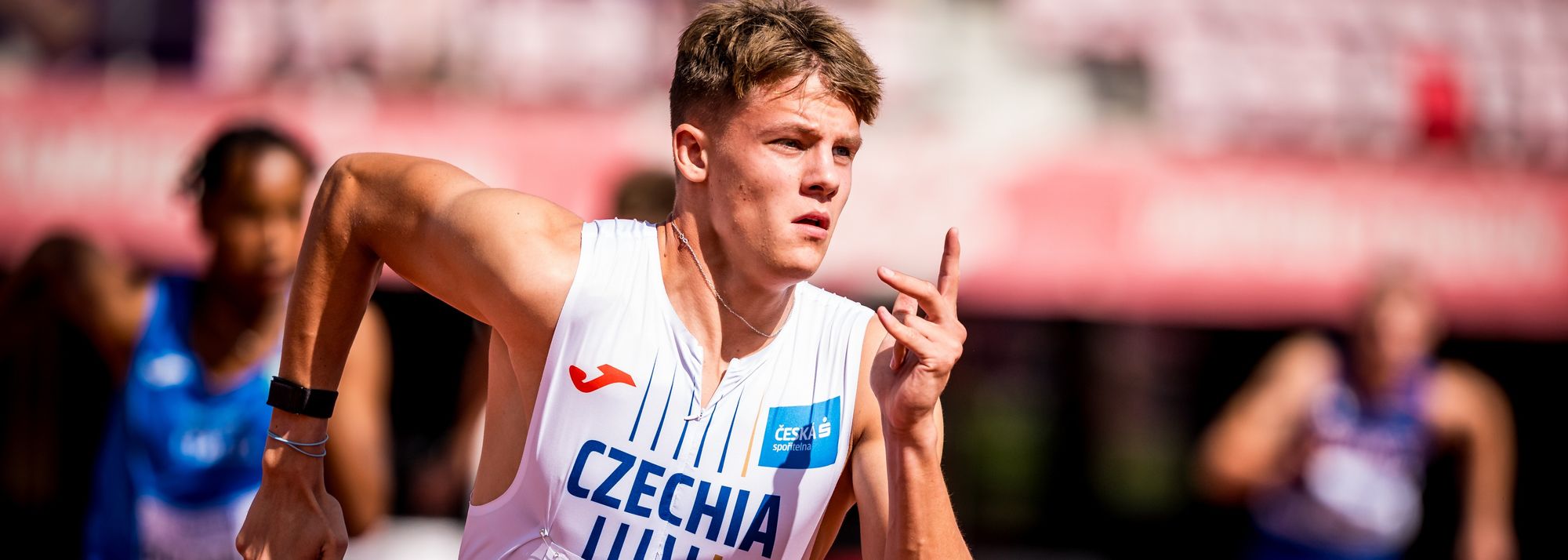


Michal Rada (© Czech Athletic Federation)
By Owen Murray
Michal Rada is many things.
Before one of the biggest races of his life, he was playing a videogame with his friend.
In a room in Tampere, Finland, in between the semifinal and final 400m hurdles race of the 2025 European Athletics U20 Championships, Rada and Marek Váňa worked together. In less than a day, they’ll cross the finish line in the stadium. Rada will be the championship record holder. Váňa, his friend formed from three years of competition, will watch him do it (and secure third place, too).
Their project in between the races was a careful, painstaking process that requires honest attention and faces close to screens. It’s relaxing, if you ask them. The two teenage boys directed their avatars. They spent hours of their time in between races focused on the laptops. Then, finally, they reached the last stage of the project.
They’re two of their nation’s best U20 hurdlers. Rada was stressed about the weight of expectation on tomorrow’s race. That didn’t matter then. What mattered to them was their game of Minecraft.
Michal Rada is many things.
A teenager. A twin. Yes, now a Minecraft aficionado. He spends much of his time talking about connection. His twin sister, Nina Radová, is a hurdler, too. With his eyes — their eyes — on the World Athletics U20 Championships in Eugene, Oregon this year, Rada is thinking more about those bonds. He doesn’t remember his races, but the memories come flooding back as soon as he crosses the finish line.
What he’s seen over the past two years are second–place finishes that turned into first-place medals. He’s grinned with his twin sister and his friend on the finish line in Tampere. Next is a return to the world stage. Rada took silver as a relative outsider two years ago in Lima. This year, he’s hoping to head to Eugene as Europe’s best. The part that matters the most to him, though, is the connection.
It starts with Radová (even though she knows, in her own words, “nothing about Minecraft.”)
The two older siblings — they have a 14-year-old sister and a six-year old brother, both in athletics — agree that their least favorite question about being a twin is how far apart they were born. It’s because the people who ask him know that Radová was first (Rada: “I’m not annoyed about it…but she’s older, and everyone knows it.”).
The rest of it is, in Rada’s words, “actually amazing.”
For now, he and Radová are around each other constantly. When Rada broke his arm on his skateboard, he hid it for two days, only giving in when it hurt too much (per Radová). They’re both high schoolers — she’s the one who remembers when assignments are due. In July 2024, they won gold medals minutes apart at the European Athletics U18 Championships. When they compete at the same meets, it’s not easy on his heart.
“It is stressful, to be honest,” Rada said. “Because you not only have to think about your race, but because we're twins, we’ve been living with each other our whole lives, you're also thinking about her, about how she feels, what she's thinking.
“But when she's doing well, your joy is also two times bigger.”
Radová said something similar.
“I don’t really like racing before him,” she said. “I like it more after, so I know how he ended up. She remembers watching his race in Tampere, getting ready for her own, and seeing his effort. “It’s stressful,” she said. “But you have double happiness after.”
It’s nothing new. Their parents signed them up for athletics as kids because they wanted a sport that the twins could do together. Since then, Rada said, “We’re basically in love with this sport.”
“Since childhood, Michal wanted to win in any activity,” his coach, Jiří Couf, said in writing through a translator. “The whole family still competes in everything…and that ability, concentration and focus on victory and the desire to succeed since childhood certainly helps Michal in the present.”
The race that Rada calls one of the “greatest races of my entire career,” though, came when he finished second.
In Lima two years ago, a month after he and Radová won gold in Banská Bystrica, Slovakia at the European Athletics U20 Championships, Rada entered the U20 400m hurdles field as a relative outsider. By his own estimation, he was more focused on qualifying for the final than any thought of winning it.
He’d taken the European U18 crown with a 49.42-second win. Despite that, the teenager wasn’t expected to shine at the World Athletics U20 Championships in Lima a month later — he was just focused on getting in the final.
When he qualified for the final with a 49.36 world U20-leading time in the semifinal race of the World Athletics U20 Championships, his focus changed.
“Who knows?” he thought. “Maybe I won't have this opportunity ever again.”
After he rumbled across the finish line in the final, he landed on his hands and knees, waiting for the time. When it came, he looked up. Second place, by 0.04 seconds, in a Czech U20 record 49.30.
Michal Rada is many things. After that race, he was the world U20 vice champion.
He was happy, too.
“It was bittersweet for me the first one or two weeks,” Rada said. “Because I knew that it was super close to the gold medal. But in general, I'm so happy for it.”
He grinned nonetheless as the Czech flag expanded underneath his arms.
A year later, Rada made it to the European U20 stage for the first time. By that point, he and Váňa were good friends. They’d risen to the top of the 400m hurdles pool, and Rada arrived in Tampere as a favorite with eyes on the record books.
That’s why he was so stressed, he thinks. He knew he was the favorite, and that directed his thoughts to what would happen if he didn’t win.
That’s where the game comes in.
In the mixed zone after the semifinal, Rada smiled during an interview as Váňa explained that they’d prepared for their race by playing the game in their room all day.
“We were like, ‘Yo, we both have our laptops here, so let's download Minecraft and we can play together,” Rada said now. “And since then, we're playing nonstop every day.’”
They downloaded the game before the semifinal race — ”We were playing the whole afternoon, for five or six hours straight,” Rada said. They ran the semifinal, qualified — Rada ran so well that, “Perhaps it’s a pity that there wasn’t a final that day,” Couf said — and hopped back on the game for another four hours before they finally slept.
They woke up the next day with the race not scheduled until the night…and played all day. By the time they left Finland, they’d beaten it.
It was more about relaxing, Rada thinks, than the game itself. They were stressed and looking for a way to take their minds away from the races (“We were so bored,” he said). He thinks of it as a way to talk with friends. That’s what he and Váňa were doing in their room before the race.
In his room at home, Rada hangs his medals in a long line on the wall. In order to remember the races, though, he has to jog his memory.
“Every time I compete on a big stage, I basically cannot remember anything,” he said. From the gun to the tape, it’s a void. Instead, in order to learn, he rewatches old videos of his races, almost every day.
“I repeat them, almost every day, trying to be the best version of me,” Rada said.
What he noticed before Tampere was his trailing leg — vital in the hurdles events — was mistimed. He figures that it’s what lost him the race in Lima. That year was spent on drills, time counting steps between hurdles and slowing down. It’s not just running the race over and over. It’s technique — careful, painstaking process with honest attention. His face watches the screen as the videos of his old races play.
His memories start again after he crossed the finish line in Tampere. What he remembers: a win — one he was expected to take — but a championship-record time to pair with it.
“I was nervous at the final, after all, it was already the third run in a row,” Couf said. “I knew that Michal wanted to break the championship record and the European record. I believed that Michal would give an excellent performance. He did well in the final, and most importantly, the eighth obstacle came out very well and I already knew that he could get closer to the record. In the end, only the championship record came out, but as I know Michal, he will strive for the European record this year.”
With Eugene on the horizon, Rada is ready. It’s no fault of memory — he’s never crossed a finish line in the U.S. He’ll have connections anyway; he’s expecting Radová to qualify “no problem.” Should they both race in Eugene, the focus will be on a new title: world U20 champion. He was 0.04 seconds off the European U20 record when he won in Tampere last year. He’s been watching the videos back.
Michal Rada is many things. He wants to go to university after high school, because he thinks that he can’t focus his life on just track and field. He wants to try American fast food — especially Wingstop. He’s happy (“Really, really, really, really happy”) that his family has been by his side the whole time. His coach sees it, too.
“Family and friends are very important in Michal’s life,” Couf said. “It’s not about his sports development, but also about his mental development.”
Before the final in Lima, Rada thought he might not have the opportunity again. Before the final in Tampere, he pushed past nerves.
Before Eugene, he’s prepared for another chance.