














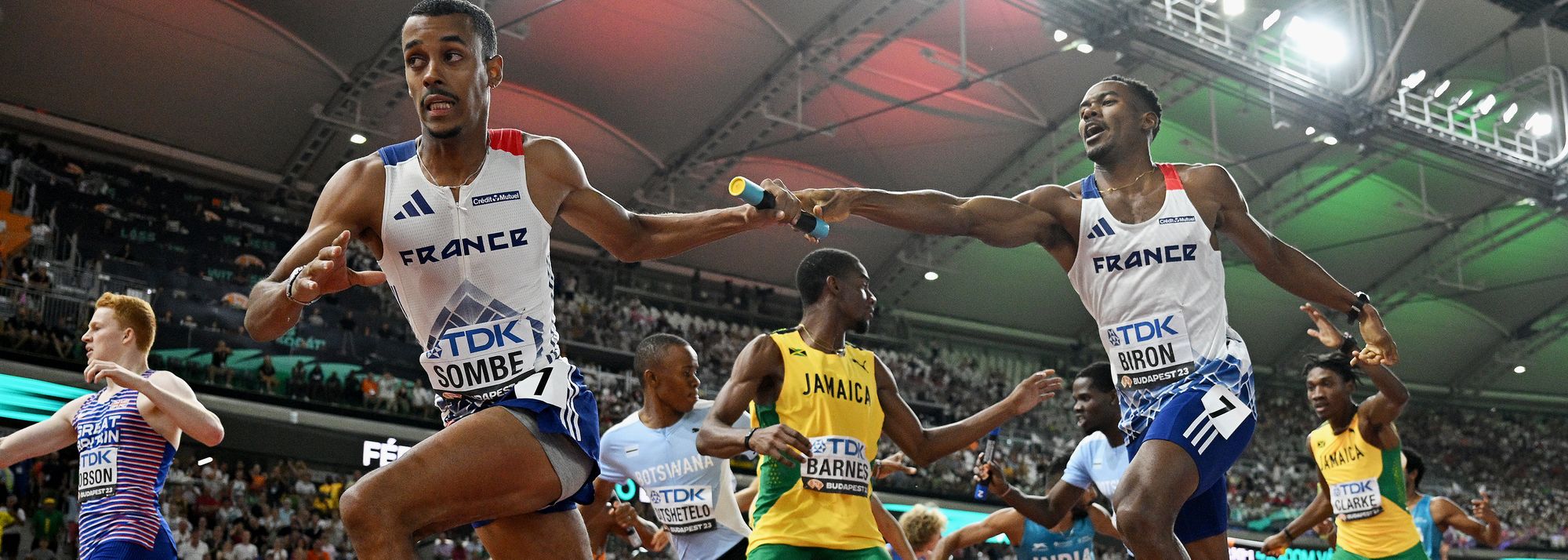


David Sombe of France at the World Athletics Championships Budapest 2023 (© Getty Images)
World Athletics Championships
The World Athletics Championships ranks alongside the Olympic Games as the highest level of global senior outdoor competition for track, field, marathon and race walk athletes. The Olympics and the FIFA World Cup are the only sporting events which boast a bigger global reach and impact.
What is the World Athletics Championships?
The World Athletics Championships is organised by World Athletics, the global governing body of the sport.
- It features 12 track events and eight field events for men and women, plus a mixed 4x400m relay.
- Combined events decathlon for men and heptathlon for women.
- Marathons and 20km and 35km race walks on the road for men and women.
- The inaugural championships, in Helsinki in 1983, featured 1333 athletes from 153 countries. The last event, in Budapest in 2023, showcased 2100 athletes from 195 countries, plus an Athlete Refugee Team.
- In 1983 in Helsinki, 25 countries won medals, 13 gold. In 2023 in Budapest, 46 countries won medals, 23 gold.
How often are the World Athletics Championships held?
The first World Athletics Championships was held in Helsinki in 1983. The next edition, the 20th, takes place in the Japan National Stadium in Tokyo from 13 to 21 September 2025.
- The first three World Athletics Championships were held at four-year intervals.
- Since the 1991 event in Tokyo, the championships have taken place biennially.
- The 2021 championships in Eugene were moved to 2022 to avoid clashing with the rescheduled Tokyo Olympics, which could not be held in 2020 because of the Covid pandemic.
- The World Athletics Championships is held in odd years to avoid clashing with the Olympic Games, which take place on a quadrennial basis in even years.
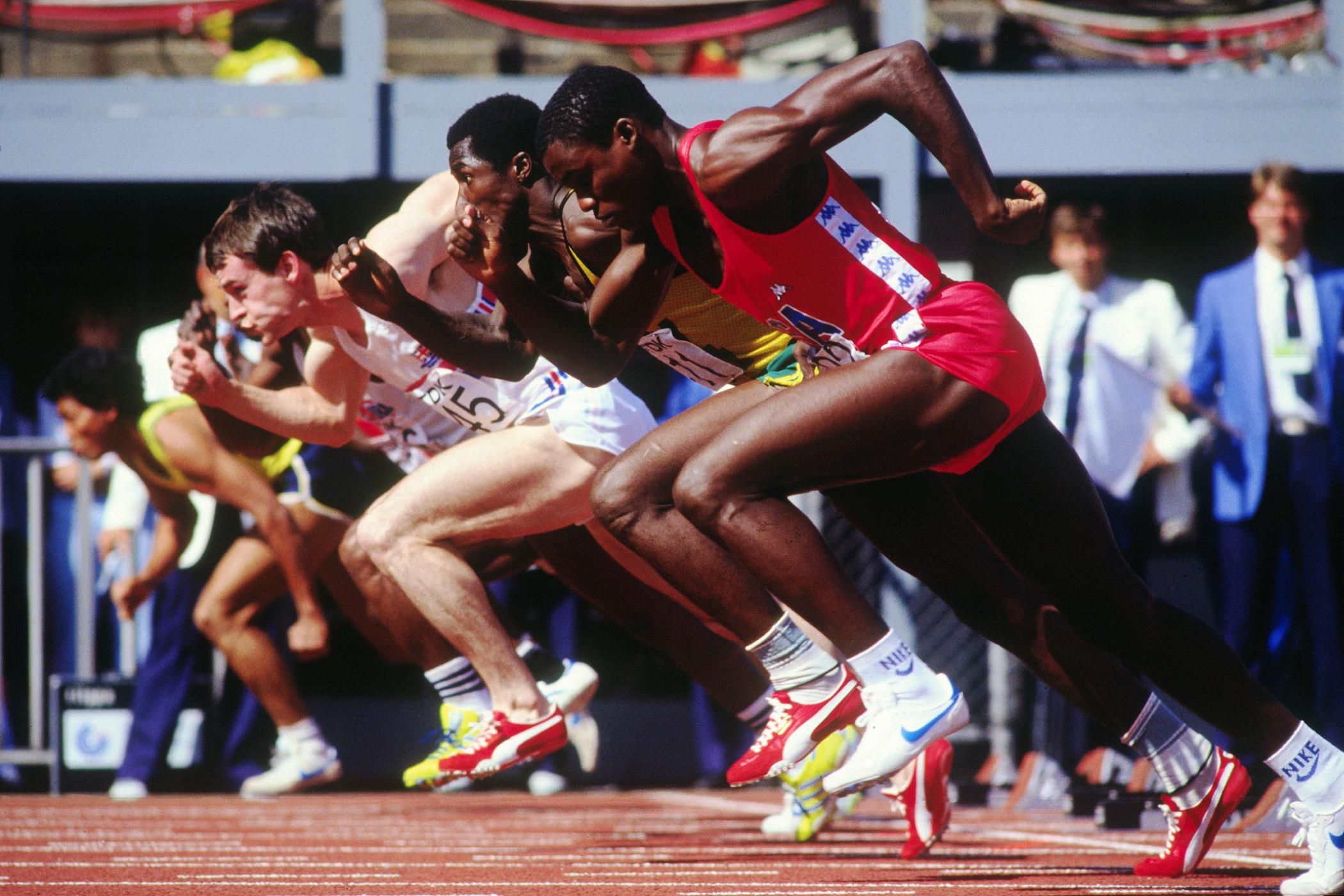
Carl Lewis in the 100m at the 1983 IAAF World Championships in Helsinki (© Getty Images)
Key differences between the World Athletics Championships and the World Athletics Indoor Championships
The World Athletics Indoor Championships are held every two years. (They were staged concurrently in 2003 and 2004 to facilitate the need to take place in alternate years to the outdoor World Athletics Championships in future, and in 2024, 2025 and 2026 because the 2020 edition in Nanjing was moved to 2025 because of the Covid pandemic.)
- First held as the World Indoor Games in Paris in 1985.
- Became the World Indoor Championships in Indianapolis in 1987.
- Track events take place on a banked 200m track, rather than a flat 400m oval – apart from the 60m and 60m hurdles, which have a straight sprint in the centre of the arena, alongside the field events.
- The longest track event at the World Indoor Championships is 3000m, compared to 10,000m outdoors. The shortest is 60m, rather than 100m.
- Race walk events were dropped after 1993 and the 200m after 2004.
- There are no steeplechase races, 400m hurdles, javelin, discus or hammer events.
- Men’s combined eventers take part in a heptathlon rather than a decathlon; women compete in a pentathlon instead of a heptathlon.
- Takes place over three days, compared to nine outdoors.
- Generally, outdoor titles are considered more prestigious. Not all athletes aim to compete in the indoor season, saving themselves for outdoors. Usain Bolt, for example, never raced indoors.
How the World Athletics Championships compares to the Olympics and other meets
The World Athletics Championships is the jewel in the crown of the World Athletics Series of events.
- The biennial staging provides athletes with double the chance of becoming a global outdoor champion than an Olympic gold medallist within a four-year Olympic cycle. Athletics is the leading Olympic sport.
- The World Athletics Series also includes the biennial World Athletics Indoor Championships and World Athletics U20 Championships.
- There are also two-yearly specialist discipline competitions: the World Athletics Cross Country Championships, World Athletics Race Walking Team Championships, World Athletics Relays and the World Athletics Road Running Championships.
- The Diamond League comprises 15 of the world’s leading one-day invitational meets in Africa, Asia, Europe and the USA, climaxing with a two-day final in September.
- The World Athletics Ultimate Championship will become a biennial event after launching in Budapest from 11-13 September in 2026, with Olympic, world and Diamond League champions and the world’s top ranked athletes battling in straight semi-finals and finals to become the Ultimate Champion in their event. It will feature a new mixed 4x100m relay.
World Athletics Championships: full line-up of select stars?
In addition to the prestige of becoming a global champion, the World Athletics Championships has offered the planet’s preeminent runners, jumpers, throwers and race walkers the perfect platform to produce historic performances.
- 36 world records have been set, 18 by men, 15 by women and three in the mixed 4x400m relay.
- A peak of five world records were set in Stuttgart in 1993: by Britons Colin Jackson (12.91, men’s 110m hurdles) and Sally Gunnell (52.74, women’s 400m hurdles), Russia’s Anna Biryukova (14.90m, women’s triple jump) and by the USA in the men’s 4x100m relay (37.40) and men’s 4x400m relay (2:54.29).
- The hugely successful 1991 championships in Tokyo produced three world records, all by US men: Mike Powell’s still-surviving 8.95m long jump, Carl Lewis’ 9.86 in the 100m and 37.87 by the 4x100m relay team, anchored by Lewis (who also took long jump silver).
- Usain Bolt has broken the most world records at the World Championships (four), including 9.53 for 100m and 19.19 for 200m in Berlin in 2009, both of which still stand.

Mike Powell jumps 8.95m to set a world record at the 1991 IAAF World Championships in Tokyo (© Getty Images)
World Athletics Championships prize money
There is a total prize money pot of US$8,498,000.
- Gold medal winners receive US$70,000.
- Silver medallists earn US$35,000.
- Bronze medal winners collect US$22,000
- There is a world record bonus of US$100,000.
World Athletics Championships venues
Helsinki’s 1952 Olympic Stadium holds a special place in track and field history as the venue for the inaugural World Athletics Championships in 1983 – and as the first to stage the event for a second time, in 2005.
Carl Lewis was the star of the first championships, capturing golds in the 100m, long jump and 4x100m relay. His compatriot Mary Decker completed a 1500m-3000m double, while other all-time greats were among the gold medals: Grete Waitz (marathon), Ed Moses (400m hurdles), Daley Thompson (decathlon) and Sergey Bubka (pole vault).
Tokyo will become the second city to host the World Athletics Championships for a second time when the Japan National Stadium stages the 2025 event from13-21 September.
Why the World Athletics Championships matters to fans
The last edition, in Budapest in 2023, showed why the World Athletics Championships matters so much to fans of track and field. Fans from 120 countries packed out the National Athletics Centre on the banks of the River Danube – 404,088 spectators over the course of nine days generating an electrifying atmosphere helping to produce some spellbinding performances in what was the most attended event in Hungarian sporting history.
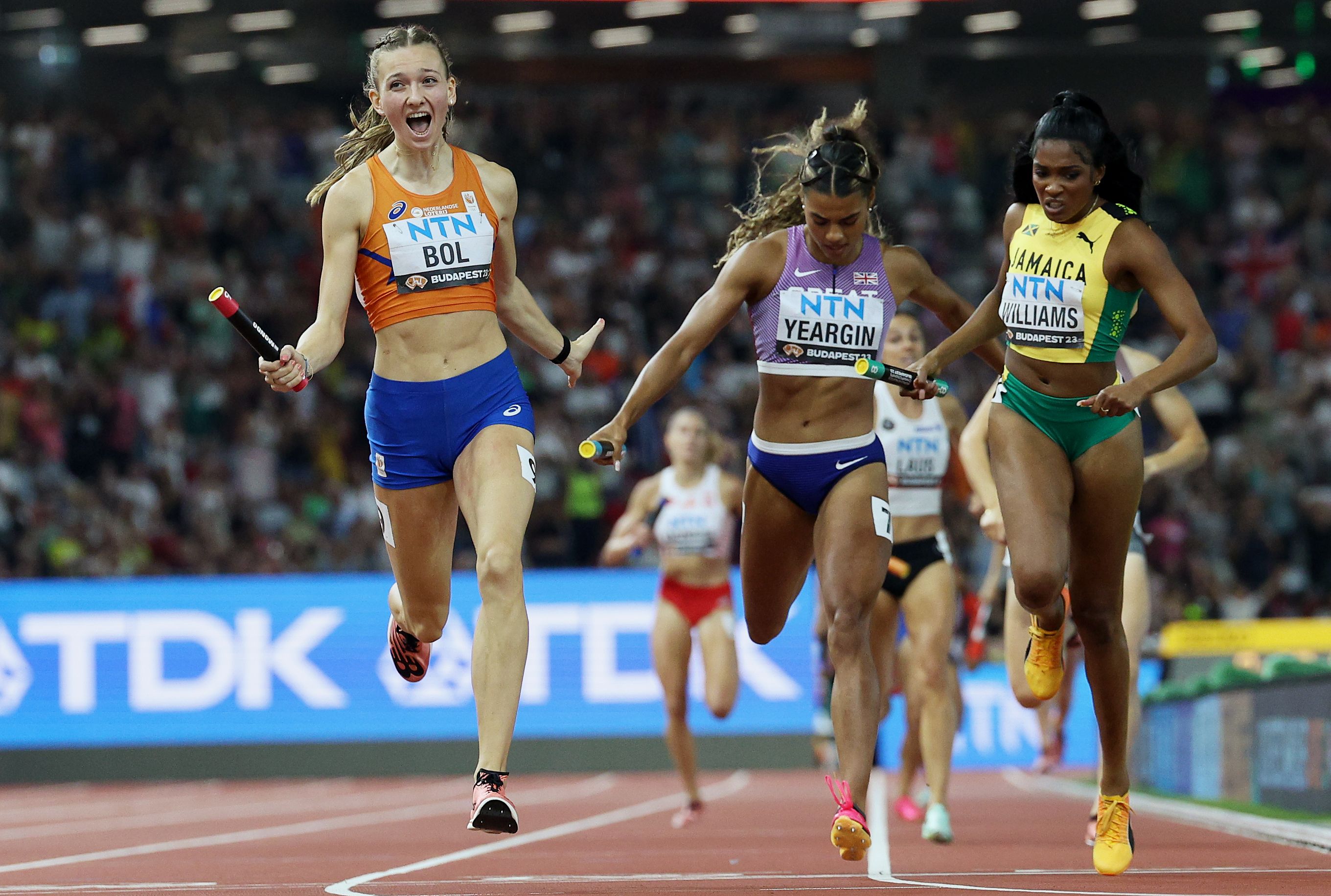
Femke Bol anchors Netherlands to the world 4x400m title in Budapest (© Getty Images)
The thrills and spills were sensationally bookended by Femke Bol’s fall within sight of the line in the final of the mixed 4x400m relay and her stunningly victorious anchor leg in the women’s 4x400m relay final. Other memorable moments included the great showman of the sport, Gianmarco Tambieri, feeding off the roars of a huge Italian contingent to complete his set of major high jump golds, Kenya’s Faith Kipyegon completing a historic 1500m-5000m double and US sprinters Noah Lyles and Sha’Carri Richardson securing five golds between them.
The level of fan engagement could be gauged by the World Athletics website’s championship section receiving more than 400,000 requests per minute and more than 14 million per hour, with social media platforms passing 11 million followers.

